

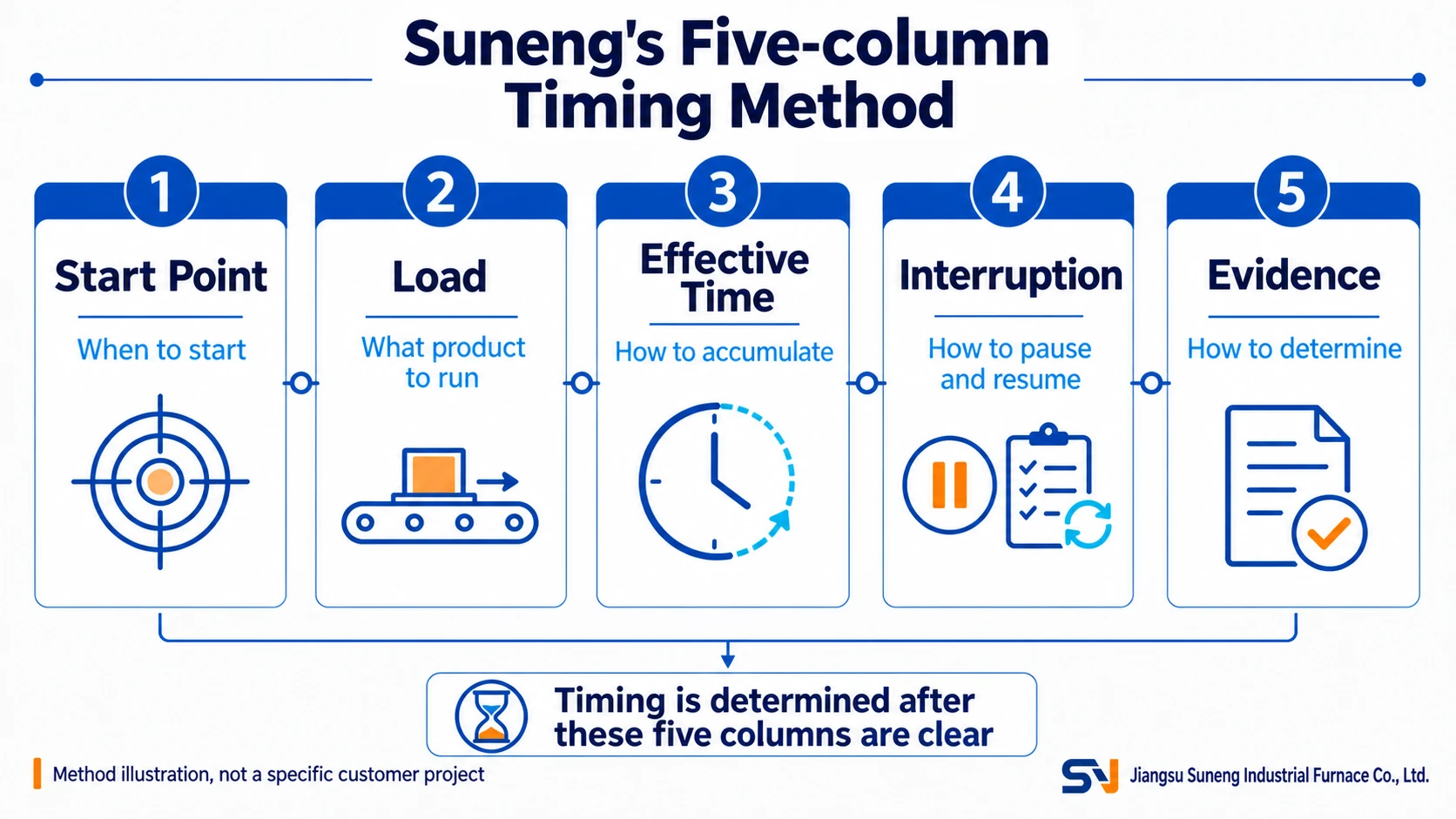
There is no fixed continuous-running duration for every heat treatment line's Site Acceptance Test (SAT). Before specifying days, agree the starting point, representative products, effective operating time, interruption handling and acceptance evidence. Suneng's five-column method makes the duration support a verifiable conclusion.
Here, SAT means Site Acceptance Test
It is the agreed testing after installation at the customer's site. Scope may include utilities, adjacent interfaces, integrated operation, loaded trials, process records and product inspection, as defined in the contract, technical agreement and SAT plan.
Take care with the abbreviation: the official ISO 20431:2023 summary also uses SAT in Annex D when discussing measurement-chain testing methods. This is different from the Site Acceptance Test discussed here. Write the full name, object and method in project documents.
Why “15 days of continuous operation” is insufficient
A Suneng line proposal from 2020 lists successful complete-line commissioning, no faults within 15 days of normal production, and acceptable equipment and part tests as joint acceptance conditions. The same proposal separately identifies cold/hot, no-load/loaded tests, trials, process suitability and technical-agreement targets.
The 15-day clause belongs to that project, not every heat treatment line. Without defined start, products, daily operating time, interruption treatment and evidence, the same wording can be interpreted differently. The five columns below are clarification recommendations in this article; they are not a record that the original project performed a continuous rated-output test on that basis.
Column 1: start
Positioning equipment does not start SAT. First confirm completed installation checks and machine commissioning; usable water, power, gas and ventilation; integrated interfaces; and available test products, process documents, inspection means and participants. Prefer a mutually confirmed readiness checklist as the starting record.
Column 2: load
Empty running checks actions and some interlocks but cannot replace loaded operation. Agree representative products/product mix, fixtures/loading, process version, target cycle, shifts and changes to cover. A mixed-product line should not test only its easiest part.
Column 3: effective time
“Three continuous days” could mean calendar days or production days, one shift daily or the site's continuous schedule. State calendar span, planned shifts, effective running hours, product/batch coverage and planned changes together.
Column 4: interruptions
Material waits, changes, planned maintenance, customer upstream/downstream stops, utility loss, equipment alarms, interlock stops and program changes need different treatment. Agree categories, clock-pause conditions, affected-process retests and when the continuous-run clock restarts.
Column 5: evidence
Check whether the log records production, standby or stoppage, and match it to products, versions and valid periods. Compare measured results with the agreed criteria. Nonconforming items need correction and retest; missing records need retrieval or investigation, not an automatic conclusion that operation never occurred. A log or a completed time total alone does not establish acceptance. Define at least these record groups within the project scope:
- Equipment/integration: runtime, states, interlocks, alarms, stops and recovery.
- Process/batches: products, tooling, version, temperature, speed and critical process records.
- Output/quality: input, conforming output, inspection and nonconforming disposition under an agreed basis.
- Issues/documents: symptoms, owner, repair version, retest and final closure.
Project documents must say whether product quality is a final SAT criterion. Stable equipment operation does not automatically mean conforming products; conforming products do not prove that every interlock and recovery function was tested.
Align the timing agreement
| Provide | Suneng checks | Effect if missing |
|---|---|---|
| Contract, agreement and site-acceptance terms | Object, scope, start and document priority | Different interpretations of the start date. |
| Representative products, tooling, versions and changes | Critical loaded conditions | Elapsed time may omit the hardest products/changes. |
| Shifts, schedule, cycle and material supply | Calendar span, effective hours and coverage | Standby may be mistaken for production. |
| Utilities, ventilation, adjacent stages and inspection | Interruption classification and clock recovery | Equipment and external interruptions become confused. |
| Output, quality, runtime, alarms and closure criteria | Raw evidence, retests and signing scope | Evidence of running may be mistaken for evidence of testing. |
The table supports clarification and does not replace the contract. Apply project-location safety/environmental requirements, product standards and agreed customer procedures.
How to determine the duration
Purchasing, production, process, quality, equipment and safety staff should agree the five columns, then derive calendar and effective time from product mix, shifts, changes, acceptance items and abnormal-recovery coverage.
Complexity may require additional representative products, changes, restarts, recovery tests and record checks rather than simply more days. Reassess timing when scope changes instead of copying a previous project's number.
Four misleading clauses
- “Seven days of SAT means acceptance”: days alone lack start, load, interruption and pass conditions.
- “No equipment fault means SAT passed”: capacity, process, quality, records and recovery may also be required.
- “Standby due to insufficient site material counts as continuous running”: agree this before testing, not unilaterally at settlement.
- “After restart, all previous tests remain valid”: first assess the change and impact, then select retests.
Scope and first discussion
The method suits new/retrofitted lines with several machines, process sections, site utilities, automatic integration or batch records. A single machine can simplify the scope but retain the five definitions. ISO 13577-1:2016 provides general safety context, not a universal SAT duration. Confirm current editions, scope, location requirements and agreed documents for a formal project.
Prepare acceptance terms, representative products/process versions, shifts/cycle, utilities/adjacent-stage conditions, and output/quality/runtime/closure criteria. Suneng can identify timing and evidence gaps. Duration, product mix, interruptions, pass conditions and responsibilities follow the confirmed project documents.
Information basis
- Archived Suneng mesh-belt and roller-supported mesh-belt line proposals covering installation, commissioning, production periods, hot/cold and empty/loaded trials, and documents; only anonymised methods are presented.
- ISO 20431:2023, Heat treatment — Control of quality.
- ISO 13577-1:2016, general furnace safety.