

Individual-machine acceptance checks one machine's manufacture, configuration, actions and protection against the agreement. Factory Acceptance Testing (FAT) checks one or more machines and the interfaces, integrated actions, records and documents that can be tested before dispatch under an agreed plan. Individual-machine acceptance may form part of FAT; it does not replace complete-line integration, site acceptance or product-process validation.
Suneng mesh-belt line documents list equipment composition and separately allocate site wiring and process commissioning. For a factory acceptance plan, identify which equipment can be combined for testing at the factory and which interfaces require site connections. If only individual-machine trial records exist, place untested combinations in the subsequent plan and responsibility table. Do not simply rename the records complete-line acceptance reports.
One defines the object; the other defines the stage
FAT means Factory Acceptance Test: buyer and supplier check agreed items at the manufacturer's facility before shipment. Individual-machine acceptance asks whether a furnace, washer, cooling unit, conveyor or cabinet meets the approved configuration and performs its independent functions/protection.
A line FAT may include machine checks, limited integrated demonstrations, signals, records and documents. Its depth depends on the contract, technical agreement, factory setup and acceptance plan. Separate acceptance objects from stages, then decide which machine tests belong in FAT and which complete-line items require later site verification.
| Comparison | Individual-machine acceptance | FAT |
|---|---|---|
| Object | One machine or independent functional unit | Agreed machine(s) and factory-testable system scope |
| Purpose | Manufacture, configuration, independent actions/protection | Pre-dispatch confirmation, issues and stage conclusion |
| State | Independent energisation, no-load movement or agreed conditions | Machine, partial interfaces, limited integration, records and documents |
| Evidence | Checklist, movements, images, curves or alarms | FAT list, raw records, deviations, retests and signed documents |
| Not established alone | Line cycle, cross-machine interlocks, site interfaces or product results | Site installation/utilities, continuous production or product quality |
Why passing machines may leave line tests outstanding
Loading, conveying, heating, cooling, washing, tempering, discharge, controls and data depend on mechanical positions, timing, safety/control signals and process handovers. Independent start/stop cannot establish upstream feed permission, downstream-fault stopping, workpiece tracking, record continuity after recovery, or site utilities/foundations.
Suneng checks machines, interfaces, integration, load and site conditions separately so a “pass” does not claim something never tested.
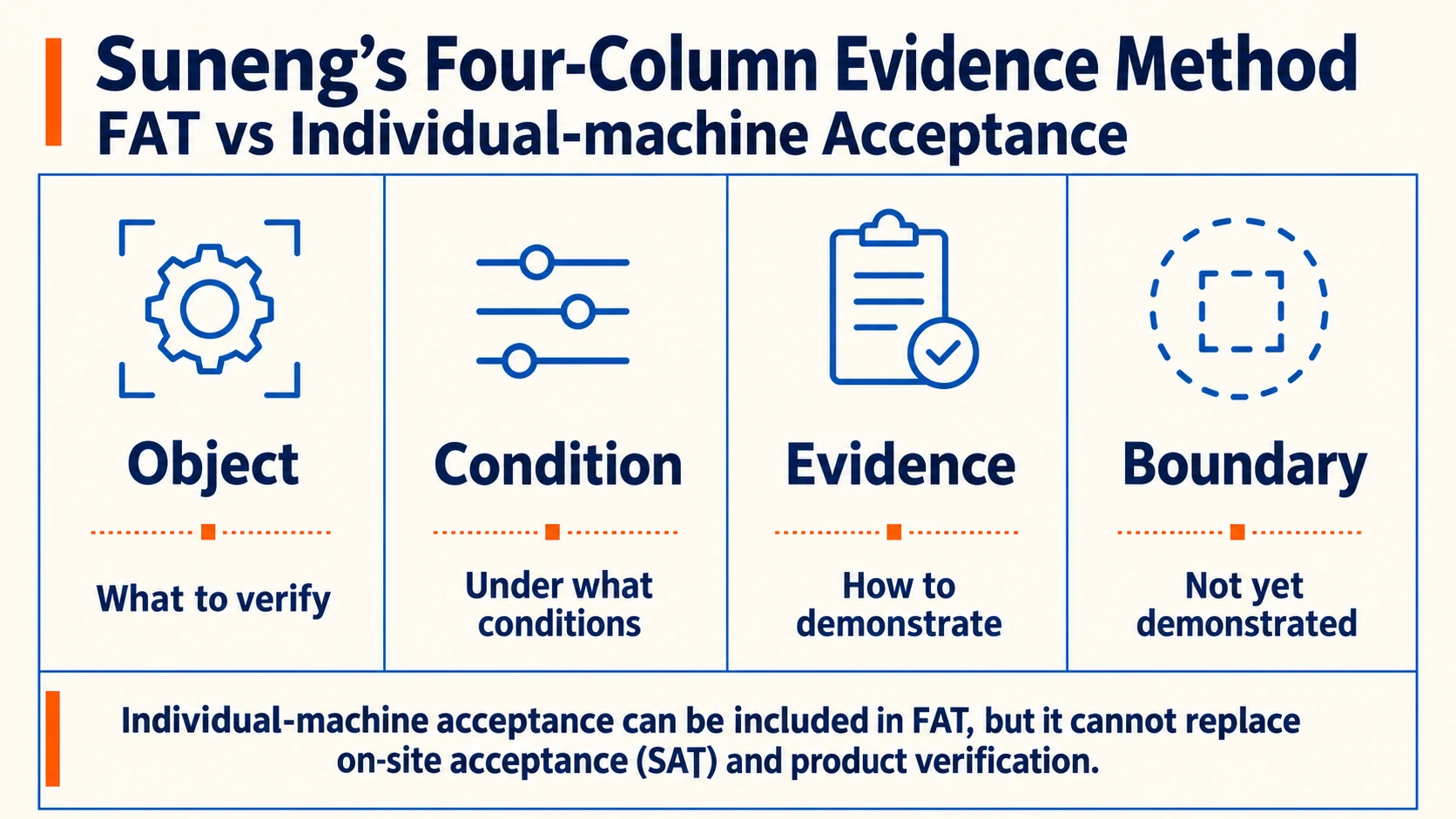
The four columns: object, state, evidence and boundary
The method follows staged acceptance, interface responsibility and issue-closure structures in line proposals. It organises acceptance scope and does not replace the technical agreement.
1. Object: exactly what is being tested?
Name the equipment, function or interface, not just “the line”: furnace body/configuration, conveying, cabinet inputs/outputs or heating/cooling/handling permission. Include quantity and version. Manufacturing-stage design/program changes must reconcile the list, drawings, parameters and actual equipment.
2. State: under what conditions?
Unpowered inspection, independent energisation, empty running, simulated signals, partial integration and loaded running establish different things. State utility source, real/simulated signals, assembled upstream/downstream equipment and actual/equivalent load.
Mark unavailable site conditions as not covered. Simulation can test some logic; it cannot establish site piping, foundations, utilities or real production rhythm.
3. Evidence: what supports the conclusion?
First match records to the equipment, version and test state, then compare actual results with agreed acceptance criteria. Nonconforming results require correction and retest; missing documents require investigation or retrieval, not an automatic conclusion that the work was never done. Complete records alone do not establish acceptance. A normal-running video is insufficient. As appropriate to risk/agreement, retain checks against drawings, action steps, alarm/interlock records, temperature/process curves, exports, issue photos, retests and signatures.
For faults/protection, verify stopping, alarms, interlocks and recovery under the controlled plan. ISO 13577-1:2016 covers commissioning, start-up, operation, shutdown, maintenance and foreseeable faults; project checks must follow applicable risk assessment, technical documents and acceptance plan.
4. Boundary: what remains unproven?
Record whether adjacent interfaces, full integration, site connections, continuous running or product validation remain outstanding. A FAT pass should list tests deferred until installation.
Each remaining issue needs symptoms, owner, milestone, retest method and closure evidence. Decide explicitly under project documents whether it affects shipment; “handle later” is insufficient.
Align information before FAT
| Provide | Suneng checks | Effect if missing |
|---|---|---|
| Confirmed contract, technical agreement and acceptance terms | Object, scope, criteria and document priority | Parties may disagree on test depth. |
| Equipment, process and interface lists | Machine, interface and integration owners | No lead for cross-machine issues. |
| Factory power, gas, water, load and space | Real, simulated and site-deferred tests | Temporary conditions may be mistaken for site proof. |
| Steps, records and acceptance criteria | Raw data, traceability and retest methods | Conclusions lack supporting evidence. |
| Open items, changes and deviations | Versions and effects on tests/shipment | Obsolete conclusions or unclosed issues may persist. |
This table supports planning and clarification. Confirmed objects, states, criteria and responsibilities belong in mutually accepted technical documents.
Organising FAT
Before: freeze equipment, versions, test states, criteria, participants and templates. Mark unavailable site conditions in advance.
During: follow agreed steps and retain separate evidence for normal actions, abnormal protection, records and interfaces. Record deviations factually before deciding whether dependent tests may proceed.
After: separate passed items, retests, site tests and retained items that do not prevent shipment. Assign each owner, milestone, retest and closure evidence. The report establishes the agreed factory-stage state, not unperformed site/product tests.
Four common confusions
- Individual-machine acceptance is not appearance inspection alone: configuration, actions, protection and records may be included.
- A signed FAT does not automatically establish complete-line production capacity.
- No-load heat-up is not product-process validation: controller behaviour, workpiece temperature and product quality need separate evidence.
- Define abbreviations in full with object and method; the same abbreviation can mean different tests in different technical contexts.
Where the method applies
Use it for new/retrofitted lines with multiple machines, processes, controls or site installation. A standalone machine can use a simpler scope while retaining the four columns. ISO 20431:2023 can inform heat-treatment quality audits, facility checks and specification discussions. Applicable standards, methods and pass criteria depend on product standards, process documents, agreement, contract and regulations.
Four inputs for the first discussion
Provide main equipment/process, current agreement/acceptance terms, proposed factory tests and major remaining site connections. Mark unknowns. Suneng can separate machine, interface, integration, record and site-verification scope and identify FAT gaps. Test states, methods, duration and delivery responsibility need project confirmation.
Information basis
- Archived Suneng line proposals covering factory pre-acceptance, machine/integrated commissioning, interfaces, documents and issue closure; only anonymised methods are presented.
- ISO 20431:2023, Heat treatment — Control of quality.
- ISO 13577-1:2016, general industrial-furnace safety.