

Before quoting a heat treatment line, align workpieces, treatment, output, operating organisation, equipment connections, records, site utilities and supply/acceptance scope. Check the eleven input groups below; one furnace’s size, temperature and output cannot define a complete-line enquiry.
One Suneng mesh-belt line proposal lists total equipment power separately from rated quench-furnace heating power. A power entry in an enquiry must identify its equipment and scope. If only one number is provided, request an equipment list and the included loads before checking plant supply conditions. Do not compare one furnace's figure directly with another proposal's whole-line figure.
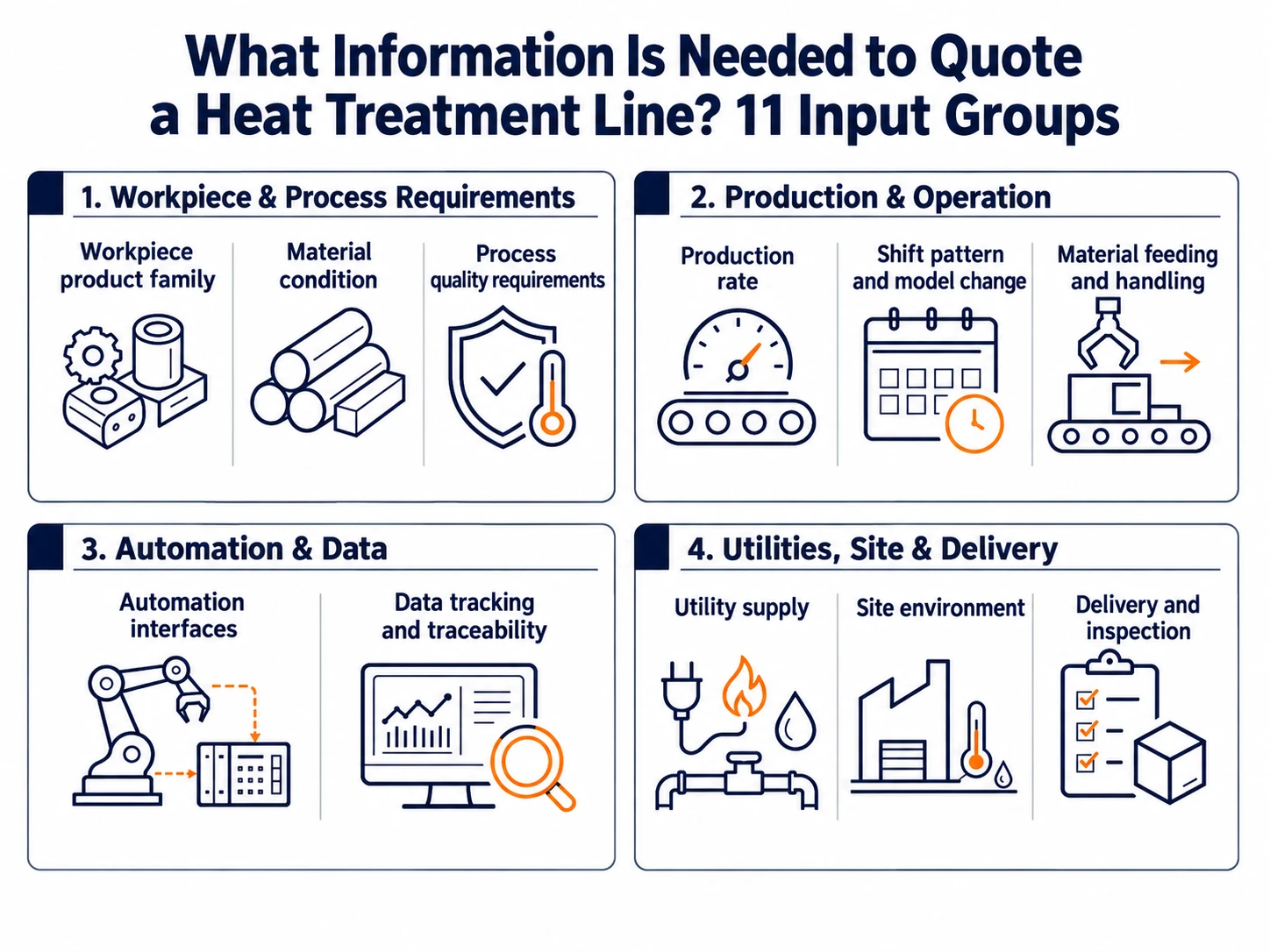
Why individual-furnace parameters are insufficient
A furnace enquiry may begin with chamber, temperature, load, process and energy. A line adds upstream feeding, cooling/washing/tempering interfaces, bottlenecks, controls/data, utilities/foundations and integrated/product verification.
Without common inputs, suppliers may be pricing different lines. A lower total may omit equipment, interfaces or tests; a higher total may include extra responsibilities. Align inputs to distinguish scope differences from configuration differences.
Eleven input groups
1. Workpieces and product families
State the products covered, dimensions, individual weights, loading orientation, baskets/fixtures and reasonable minimum, usual and maximum specifications. One representative product name is insufficient.
2. Material and incoming condition
Provide grades, incoming structure or preceding process, surface condition and allowed mixed-loading rules. Mark missing information explicitly rather than leave suppliers to guess.
3. Process route and quality
List actual heating, quenching/cooling, washing, tempering, inspection and other stages in order. Give the source of temperature schedules, cooling media, atmosphere, surface and quality criteria.
4. Output and cycle
Supply annual output, production days, shifts, effective time per shift and peak demand. Continuous lines also need hourly quantity or the interval between successive parts leaving a stage.
5. Shifts and changeovers
Describe shifts, continuous operation, product-change frequency, line clearance and planned maintenance. Frequent changes require transition-material, buffer and first-piece confirmation arrangements.
6. Loading, unloading and transfer
Define manual, mechanical or automatic feeding, positioning, stage-to-stage transport, temporary storage and nonconforming-product diversion. Provide existing equipment heights, directions, speeds and safety interfaces.
7. Automation and equipment connections
List automatic actions and equipment supplied by others. Define mechanical, electrical, safety and control interfaces and who supplies hardware/signals, jointly commissions and leads fault diagnosis.
8. Records and traceability
State recorded data, retention, search/export, batch-to-process association and existing management-system connections. Define permissions, backups and interface-test responsibility.
9. Energy and utilities
Provide electricity, gas, compressed air, cooling water, protective atmosphere, exhaust and ventilation, including locations, available capacity and restrictions. Unconfirmed capacity is not established availability.
10. Site and environment
Supply usable length/width/height, column grid, openings, foundations, floor capacity, lifting/transport routes, material flow, maintenance space and adjacent equipment. Retrofits also need retained equipment/interfaces, removal scope and shutdown window.
11. Supply and acceptance
Assign equipment, foundations, piping, lifting, transport, installation, commissioning, training, spares and documents to supplier, buyer or third party. Separate factory checks, site individual commissioning, line integration and product validation with conditions, criteria and records.
Can an enquiry begin with incomplete information?
Yes. Start with representative products/materials, dimensions/weights, route, output/shifts and site utilities/space. Mark the rest unconfirmed and create a shared issue list.
Before key conditions are confirmed, suppliers can propose a direction, provisional scope and missing inputs with explicit assumptions. Those assumptions are not guarantees or replacements for an agreed design, configuration, supply boundary and contract.
How to compare the returned quotations
First align input versions, then complete-line scope, then key configuration and acceptance responsibility. Separate each offer into included, excluded, buyer-supplied and unconfirmed items.
For “turnkey,” “fully automatic” or “meets the process,” ask for the corresponding equipment list, interface responsibilities, tests and documents.
Suneng provides furnace design, manufacturing, integration, commissioning, retrofit and support. Its engineering team can organise the process, equipment, connections, information gaps and quotation boundaries. Confirm parameters, schedule, price and acceptance in the project documents. Call +86-130-5298-6814 or use the website.
Public reference documents cited by the original article: GB/T 37752.1-2019, GB/T 5959.1-2019 and GB/T 28475.1-2012, listed on China's national standards information service. They support review of furnace safety, controls and project requirements; actual adoption depends on type, energy, process, location and contract.