

A Suneng mesh-belt line document assigns plant-supply-to-cabinet wiring to the buyer and cabinet-to-equipment wiring to the seller. Equipment-side wiring being complete does not establish that the plant supply reaches the cabinet. After an electrical-installation commitment, clarify the start and end points, materials and installation responsibilities of both sections and put uncovered work in the responsibility table. This division belongs to that document; other projects follow their own agreements.
Start with common inputs, then evidence and responsibilities
A heat treatment line may combine loading, heating, quenching/cooling, washing, tempering, conveying, inspection and records. Not every project contains every stage, but each actual stage needs an input, output and owner. Complete-line responsibility means identifying who supplies each item, how items connect, who resolves interface problems and how the line is accepted.
Suneng recommends three steps: give every supplier the same product, process and output inputs; request calculations, lists, drawings or test plans for key conclusions; and record each supply, interface, commissioning and acceptance responsibility in agreed documents. Different inputs make prices incomparable, and verbal promises are weak delivery evidence.
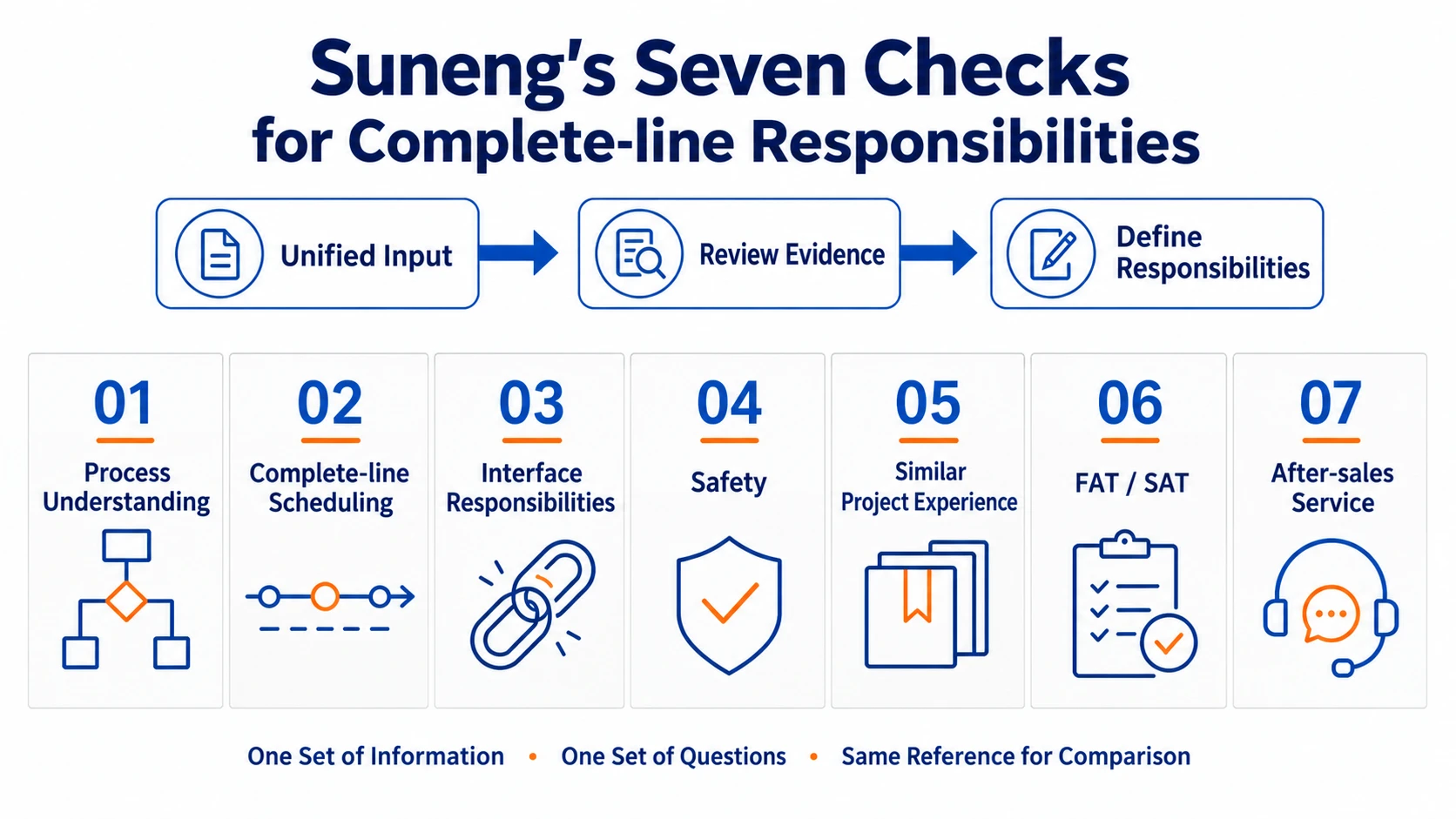
Seven checks at a glance
| Check | Request from the supplier | Buyer assessment |
|---|---|---|
| Process understanding | Confirmed inputs, temporary assumptions and missing data/tests. | Do proposals share the same basis? |
| Line cycle | Stage times, buffers, changeovers and abnormal stops. | Where is the limiting stage? |
| Interfaces/responsibility | Equipment, utilities, safety signals and data matrix. | Who supplies, commissions and resolves each connection? |
| Safety | Hazards, interlocks, energy isolation and fault response. | Are production, commissioning, maintenance and faults covered? |
| Relevant experience | Authorised/anonymised processes, document lists, inspections and sample records. | Can experience be verified beyond names and counts? |
| Acceptance | Factory, site and product tests, conditions and signatories. | Are stages and sources of limits separate? |
| Support | Spares, drawings, manuals, backups, training and remote/site service. | Are promises actual deliverables? |
1. Does the supplier understand the product and process?
Start with material, workpiece form, loading, route and quality, not a preselected furnace type. Request a one-page explanation separating confirmed conditions, temporary design assumptions and information or tests still needed. Assumptions allow discussion to continue but are not guarantees; replace them with confirmed inputs or results.
2. Can it calculate the complete production cycle?
The cycle describes time per batch or interval between parts. Main-furnace speed does not establish stable line output. Loading, cooling, washing, tempering, conveying, inspection and discharge can each limit the line.
Explain product changes, buffers, likely bottlenecks and abnormal slow-down/stops. Efficiency, reliability and stability depend on interacting systems, not optimisation of one machine alone.
3. Are interfaces and owners explicit?
Interfaces include mechanical connections, electricity, gas, cooling water, compressed air, safety/control signals, data and foundations. Assign what the buyer, line supplier, other equipment suppliers and third parties provide, when they provide it and who jointly commissions it.
For production or enterprise-management connections, define exchanged data, connection tests and who investigates failure.
4. Does safety cover commissioning, maintenance and faults?
A normal-running video cannot establish complete safety design. Review commissioning, start, operation, shutdown, maintenance and foreseeable faults.
Ask about isolation and locking of hazardous energy before entry; door/conveyor interlocks; power, gas or cooling loss; reset permissions; and maintenance space. These questions reveal missing responsibilities; they do not replace project risk assessment or regulatory review.
5. Can comparable experience be verified?
Within customer authorisation and confidentiality limits, request a similar process description, design-document list, manufacturing checks, joint-commissioning approach, sample test records, training and spares. If customer names or parameters cannot be disclosed, explain who verified the evidence and its scope. Unauthorised customer materials should not be used as marketing proof.
6. Are factory, site and product tests separated?
Factory acceptance establishes the agreed pre-dispatch state. Site acceptance assesses the installed equipment with actual utilities. Neither alone proves all final heat treatment results.
Define equipment actions, temperature/process records, line integration and product quality with their test states, methods, sources of limits and signing responsibilities, using product standards, process documents and the contract.
7. Can service promises be implemented?
Specify wear and initial spare parts, drawings/manuals, program/parameter backups, operation/maintenance training, conditions for remote assistance and site attendance, routine maintenance and software/document management. “Lifetime service” does not explain the response to an actual fault.
Ask all candidates the same questions and classify answers as evidence supplied, terms that can be agreed, or clarification pending.
Three distinctions to retain
- Building one furnace does not alone establish the ability to integrate upstream/downstream equipment, controls, safety, data and site commissioning.
- A similar project does not remove the need to reassess changed products, processes, output and site conditions.
- Factory acceptance does not prove the line has achieved its output target; site, continuous-run and product checks remain separate.
Applicability and first enquiry
This method suits new or retrofit lines with multiple machines, stages or system interfaces. Simplify it for a standalone furnace. It is a supplier-checking method, not a ranking or replacement for process, safety, compliance and contract review.
Start with five inputs: product/material, dimensions/weight, treatment, target output/shifts and available electricity/gas or other utilities. Mark unknowns as unconfirmed. Loading, changeovers, automation/data, logistics, safety/acceptance, spares and support can be developed next.
Founded in 2006, Suneng provides furnace design, manufacturing, integration, commissioning, retrofit and support. Its engineers can organise the initial information into confirmed, missing and test-required groups, then outline line stages, major interfaces and supply responsibilities. The detailed proposal still requires agreement. Call +86-130-5298-6814 or use the linked contact page.
Reference documents
- ISO 20431:2023, Heat treatment — Quality control: heat-treatment quality review, facility inspection and technical requirements.
- ISO 13577-1:2016: general safety requirements for industrial furnaces and associated equipment across commissioning, operation, shutdown, maintenance and faults. Recheck the current applicable version before a project adopts it.
- ISO/TR 14121-2:2012: practical machinery risk-assessment and risk-reduction methods.
- ISA-95 overview: boundaries and data responsibilities between production, manufacturing management and enterprise systems.
- U.S. Department of Energy process-heating sourcebook: system-level evaluation of heating performance and operation.
The related line-planning, quotation-input and contact pages and original reference links are provided below.