

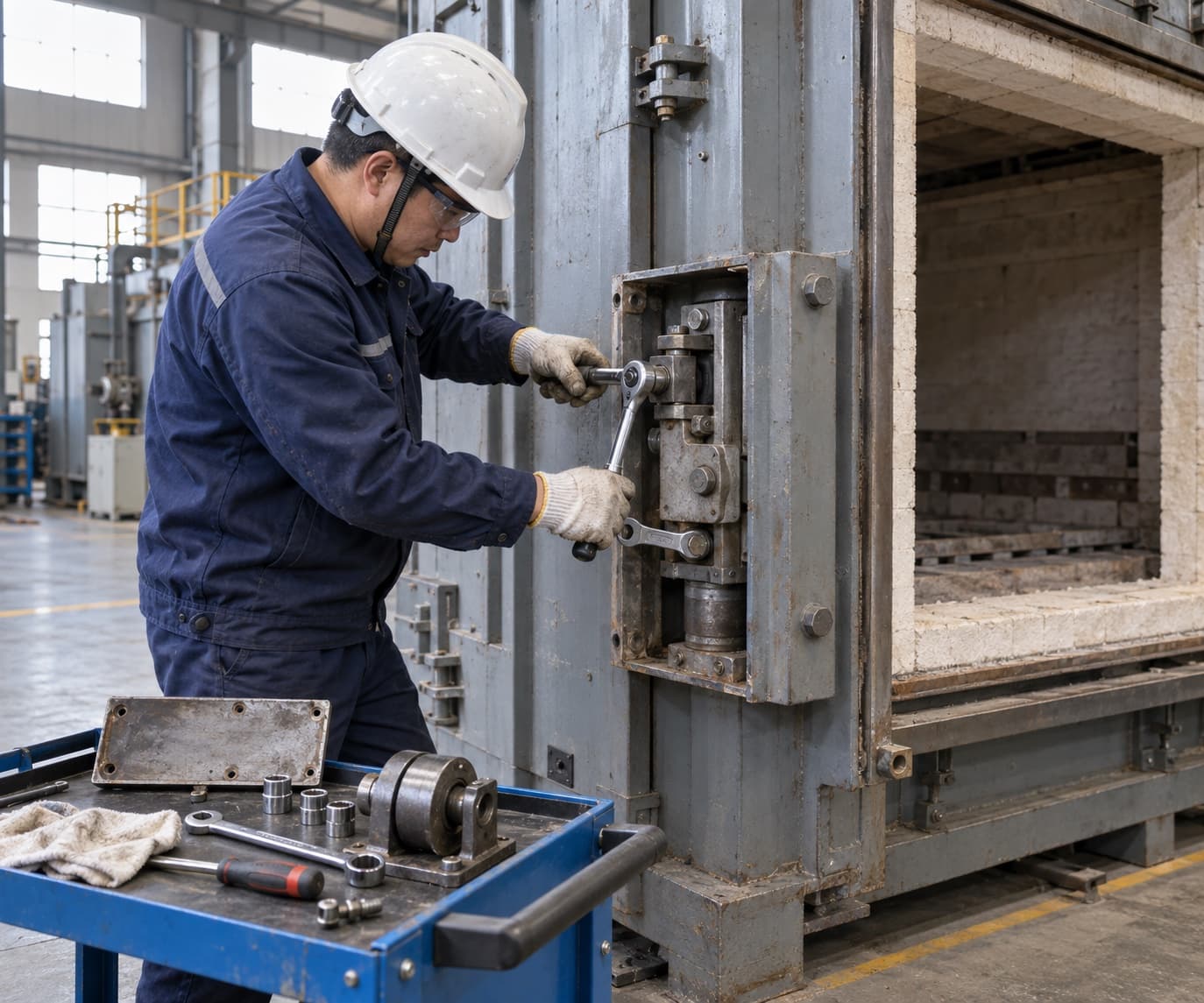
When do repair, retrofit or replacement make sense?
Compare the equipment with the conditions below. Assess interacting problems together.
Consider an overhaul
- Sound shell with no obvious deformation
- Ageing lining with a usable supporting structure
- Heating system can be repaired or replaced
- Controls can be upgraded
- Wear is confined to part of a mechanical drive
- The process requirement is largely unchanged
- Retrofit cost is materially below new-furnace cost
- An acceptable shutdown window is available
Consider a targeted retrofit
- Cracked lining or declining insulation
- Poor door seals and visible heat loss at the opening
- Obsolete controls or incomplete records
- Low combustion efficiency in a gas furnace
- Ageing electrical heating elements
- Reduced air circulation
- Local wear on the hearth car, belt, rollers or pushers
- Interlocks or alarms need improvement
Evaluate replacement
- Severe structural distortion or an unsafe condition
- Chamber dimensions no longer suit the workpiece
- The furnace no longer suits the new process
- Retrofit cost approaches or exceeds replacement cost
- Essential drawings and spares are missing
- Long-term maintenance costs are excessive
- Energy, productivity and quality issues stem from the overall design
- The buyer also needs greater automation or line capacity
Find the first check for your problem
The same symptom can have several causes. Use these checks to plan the assessment.
| Current condition | First option to assess |
|---|---|
| Sound structure, ageing lining | Assess lining renewal and insulation. |
| Obsolete controls, serviceable structure and heating | Assess a controls upgrade. |
| Door leakage, poor seals or local heat loss | Check the door, car seals and local structure. |
| High gas consumption and incomplete combustion | Assess the combustion system and air-to-fuel control. |
| Worn heating elements, sound structure | Assess replacement elements and electrical servicing. |
| Severe deformation with a safety risk | Assess a full overhaul or replacement before minor modifications. |
| Retrofit cost close to replacement | A new furnace may be the better option. |
| Major process change and incompatible furnace type | Reconsider the complete furnace design. |
| Missing drawings, operating records and key part information | Arrange a site survey and condition assessment first. |
Put performance measures, construction scope and shutdown arrangements in the formal proposal after inspection.
Three projects, three different decisions
Use these project figures to identify decision variables. Design requirements are separate from measured acceptance and from the condition of your furnace.
Car-bottom spheroidizing annealing furnace for bearing-steel wire
The 2017 proposal specified a 10 × 3 × 2.2 m working chamber, 850°C maximum design temperature, 30 t maximum charge and a working-zone uniformity requirement within ±5°C.
Where furnace type, load rating or uniformity no longer fits, compare a new design independently. These are design figures and requirements; measured acceptance was not reported here.
Large gas-fired car-bottom annealing furnace retrofit
Chamber approximately 13 × 7.4 × 4.3 m, 700°C rated temperature, 14 gas burners and combustion-air preheat of approximately 250–300°C in the design.
Check structure, burners, lining, sealing, exhaust and site scope when evaluating a large old furnace.
Continuous line for PC200–PC400 track rollers
Heating furnace rated at 950°C. Working zone approximately 6400 × 300 × 300 mm, with a design throughput of approximately 500 kg/h.
When the requirement becomes continuous heating, automatic quenching, tempering, cooling and coordinated cycles for several sizes, compare a new line independently.
Three groups of information to prepare
Gather what is available so an engineer can identify what needs a site check.
Equipment and workpieces
- Furnace type
- Chamber dimensions
- Maximum temperature
- Usual operating temperature
- Workpiece material
- Workpiece dimensions
- Individual weight
- Batch load
Site and operation
- Equipment photos
- Current problem
- Energy-use records
- Lining condition
- Control-system photos
- Heating-system photos
History and plans
- Years in operation
- Shutdown window
- Availability of original drawings
- Past maintenance records
From initial assessment to an agreed scope
When choosing a contractor, check diagnosis, quantities, shutdown planning, acceptance and comparable project evidence.
Submit basic equipment information
Assess critical systems
Compare repair, retrofit and replacement
Define the initial recommendation and scope
Agree the formal technical boundaries
How do you choose a furnace overhaul contractor?
An existing furnace needs compatible structure, heating, controls, charging and process requirements. Confirm shutdown duration, energy outcomes and acceptance measures against its condition and the proposed scope.
Frequently asked questions
Is an old heat-treatment furnace worth overhauling?
Check structural safety, lining, controls, heating and the current process. A sound structure and unchanged process can justify repair or a targeted retrofit. Severe distortion or hazards warrant evaluating replacement.
How does overhaul differ from an energy-efficiency retrofit?
An overhaul restores components such as lining, doors, heating, drives and controls. An efficiency retrofit addresses consumption, insulation, combustion, controls and operation. A project can combine both.
When should we reconsider routine repairs?
If the structure is deformed or unsafe, the chamber no longer fits the workpiece, process requirements have changed substantially or retrofit cost approaches replacement, assess a full overhaul or a new furnace.
Can we assess a retrofit without drawings?
Photos, chamber measurements, workpiece information, faults and site conditions can support an initial assessment. Complex cases may need measurement, dismantling for inspection or further engineering.
How much downtime does a furnace overhaul need?
It depends on scope, condition, spare parts, site readiness and commissioning. Local lining repairs, a controls upgrade and a full overhaul have different schedules. Agree the site programme together.
What if retrofit costs approach the price of new equipment?
Compare remaining service life, energy, process fit, downtime and maintenance. If the old furnace no longer suits the new process, evaluate replacement separately.
Can a retrofit achieve new-furnace performance?
Assess each target against the original structure, lining, heating, controls and operating conditions. The proposal and acceptance terms must define each improvement and how it is measured.
What should we prepare for an assessment?
Gather furnace type, chamber dimensions, maximum temperature, workpieces, batch load, fault description, equipment and controls photos, energy data, drawings and shutdown window. Start with the available records and an engineer can advise on a survey.
Source and update information
The Chinese article, published 13 June 2026, cites Suneng project records SN-CASE-P1-013, SN-CASE-P1-014 and SN-CASE-P0-001. They illustrate systems and decision factors. The current project still needs inspection, risk assessment and a formal proposal.