

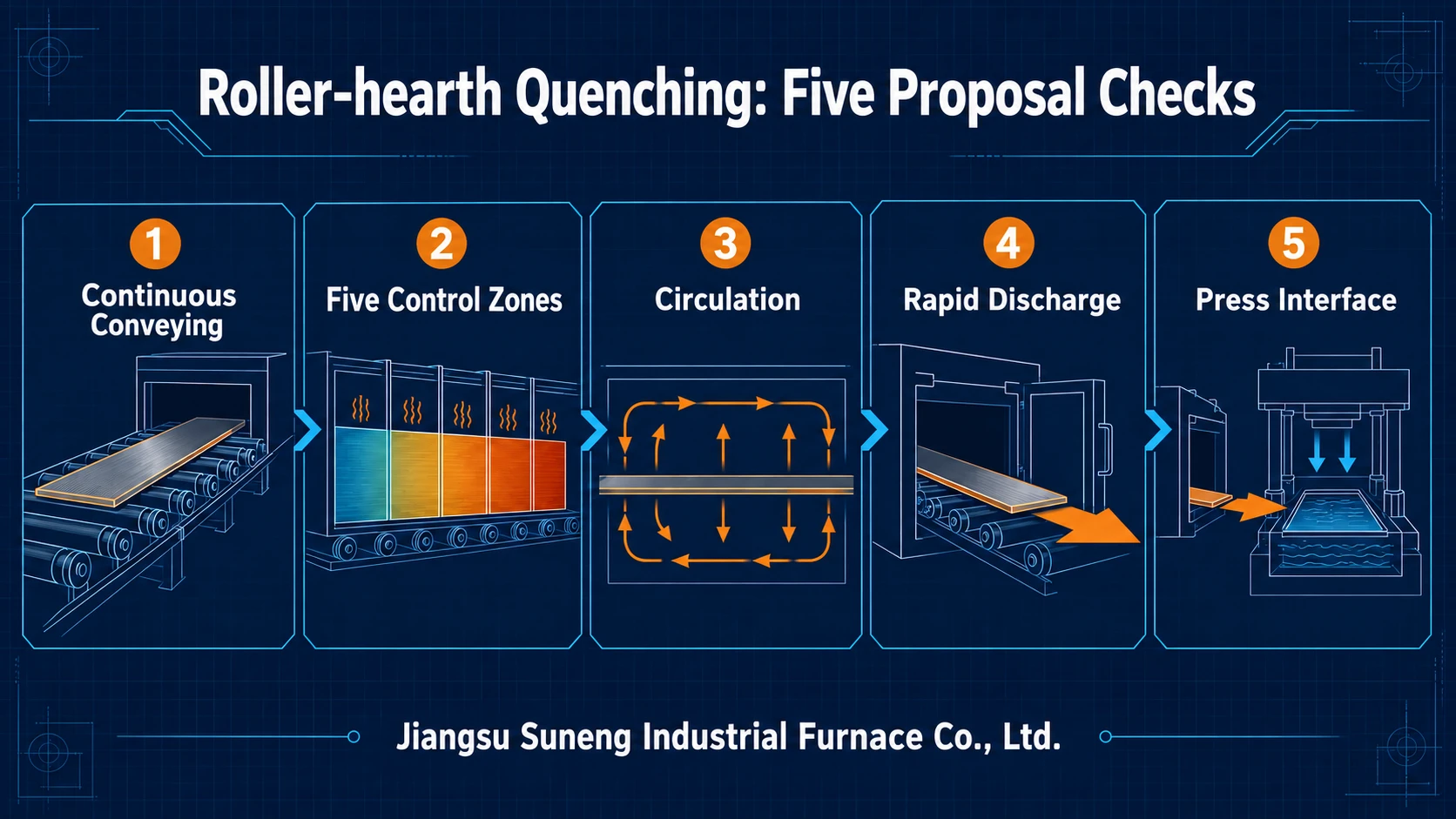
Review a bulldozer-blade roller-hearth quenching proposal in five parts: conveying, heating zones, circulation and measurement, discharge interfaces, and supply/acceptance. The historical Suneng proposal records these configurations and interfaces. Match them to this project’s workpieces, treatment and quenching press; maximum temperature or power alone is insufficient for selection.
This article explains a Suneng roller-hearth quenching-furnace technical proposal prepared in 2020. The proposal does not establish delivery or acceptance. Customer information remains anonymous. The dimensions, power, zones and temperature figures below describe the project's design inputs and agreed targets; this article does not reproduce the individual final test measurements. They are not standard values for every roller-hearth furnace.
Match the recorded workpiece and process path
The proposal covers bulldozer blades and similar elongated plate parts, with input dimensions of 260–3,000 mm long, 100–550 mm wide and 12–120 mm thick. After heating and holding, parts transfer quickly to the customer's press-quenching machine.
The design must establish stable entry, travel through heating and equalising zones for different lengths and thicknesses, rapid discharge and the movement and responsibility interfaces between furnace, discharge equipment and press. Specifying a “950°C quenching furnace” alone does not answer these questions. The proposal combines continuous rollers, five control zones, circulation in the middle/rear equalising section and an independently driven rapid-discharge section.
1. Conveying and workpiece support
The proposal combines continuous roller conveying with rapid discharge. Compare conveying paths, support, cycle and the press interface separately. The configuration description alone does not rank roller-hearth, trolley or other furnace types.
Assess hot-workpiece support and stability; entry, dwell and exit timing across the size range; door opening relative to thickness; access for individual roller replacement; and speed transition between slow furnace travel and rapid discharge. The independent outlet drive is specific to this project and does not establish universal roller counts, drive sections or speeds.
2. Match temperature-zone configuration to the process
The proposed working chamber is 12,000 × 570 × 160 mm, with maximum working temperature 950°C, rated heating power 400 kW and five independent temperature-control zones. Five zones establishes zoned control, but does not by itself establish each zone’s process duty or the number needed for another project.
Ask for the project’s zone description linked to workpiece length and thickness, product changes, conveying speed and residence time, heater arrangement, thermal load, door disturbances, heating rate, holding and records. The historical five-zone, 400 kW configuration is not a general selection conclusion; a new project needs its own process inputs and design.
3. Define circulation, sealing and measurement objects
Zones 3, 4 and 5 each have one high-temperature circulation fan. Circulation improves heat exchange around the parts, but uniformity also depends on element distribution and zone output; roof, wall and roller-penetration seals; inlet/outlet door conditions; loading, spacing and shielding; and thermocouple positions, test state and calculation method.
The historical proposal lists uniformity as “≤±7.5°C” and control accuracy as “≤±1°C”. These are proposal targets, not measured proof of achieved performance; a control target cannot replace a qualified-work-zone temperature survey.
For the current assessment method, GB/T 9452-2023 uses readings corrected for the sensor, compensation cable and instrument. Subtract the test-zone temperature setpoint from each actual temperature, then compare the maximum and minimum deviations with the process limits. The highest-minus-lowest temperature spread cannot replace these setpoint-referenced checks.
For a continuous roller-hearth furnace, first identify the survey zones with a fixed process heating temperature and a uniformity requirement. A zone falls outside this standard’s qualified-work-zone test if it lacks a fixed process heating temperature or has no uniformity requirement. Five control zones do not automatically form one constant-temperature work zone. Match records to each survey zone’s setpoint, loading, conveying and door state, and meet the data-collection and test-validity requirements; one reading or an average cannot establish conformity. If a point fails the original process target, adjust and resurvey. This explains the current method, not additional measured evidence for the 2020 project. Neither the historical targets nor the three-fan arrangement transfer automatically to another chamber, load or temperature condition.
4. Discharge actions and the press interface
The proposal links infrared arrival detection, rear-door opening, activation of the independent rapid-discharge drive and transfer to the customer-supplied quenching press. Uncontrolled transfer can change the workpiece's thermal state before pressing.
Agree the permitted transfer window; outlet and press height, centreline and speed; arrival, door, drive and press-ready interlocks; safe responses to failed discharge, an unpositioned door or an unavailable press; and responsibilities for quench water, circulation piping and integrated commissioning. The source proposal does not establish a fixed transfer time for all projects.
5. Supply scope and interface responsibility
Suneng designs and supplies the roller-hearth furnace. In this project, the customer provides loading and discharge racks and the quenching press, quench water/circulation and specified utility connections. This is a technical integration boundary, not only a commercial attachment.
A furnace may operate individually while the line cannot complete its sequence if the press state, rack centreline, water capacity, compressed air and power connections are unresolved. Assign equipment, actions, signals, utilities, installation, commissioning, trial loads and acceptance, with inputs and documents. Other projects require their own responsibility agreement.
Project parameters and their limits
| Item | Proposal | Interpretation |
|---|---|---|
| Workpiece | Bulldozer blades and similar elongated plate parts. | Furnace selection follows both the workpiece and press-quench route. |
| Working chamber | 12,000 × 570 × 160 mm. | Specific to the project arrangement. |
| Maximum working temperature | 950°C. | Not the operating temperature for every recipe. |
| Rated heating power | 400 kW. | Requires thermal-load, cycle and loss calculations. |
| Control zones | 5. | Confirm each zone’s duty against the project process. |
| Internal roller speed | 0–20 m/min. | Adjustment range, not a fixed process speed. |
| Circulation | Fans in the three middle/rear zones. | Assess with heating, sealing, loading and sensing. |
| Temperature targets | Source notation: uniformity ≤±7.5°C; control accuracy ≤±1°C. | Historical targets. Assess corrected survey readings against the test setpoint; check the control item separately. |
Acceptance covers the furnace and process chain
The source proposal calls for an agreed acceptance outline and 3–5 heat treatment trial batches after site commissioning, including blade hardness, hardness uniformity, microstructure and flatness checks. It separates equipment functions—mechanisms, doors, rollers, heating, sensing, records, alarms and interlocks—from workpiece verification under the agreed material, load, heating, transfer and press-quench conditions.
Initial material, loading, transfer, pressing pressure, cooling medium, sampling and inspection also affect hardness, structure and flatness. The acceptance outline must assign guarantees and evaluation responsibilities rather than attribute every product result automatically to the furnace supplier.
When this design approach is relevant
Consider it for elongated plate parts needing continuous or indexed movement, heating/holding, rapid discharge and press quenching, where different sizes can share a support reference and the furnace must coordinate with downstream equipment. The buyer needs workpiece, curve, cycle, transfer and press-interface data.
Complex shapes, difficult supports, highly variable loading or long complete-batch holding may favour trolley, box or other furnaces. A quenching requirement alone does not establish roller-hearth suitability.
Enquiry inputs
Prepare material, size range, individual weight, flatness target, loading orientation, curve, cycle, upstream/downstream flow, permitted transfer time, press interface, utilities and acceptance. Suneng can assess the furnace, controls and supply responsibilities from these inputs. Confirm dimensions, power, zones, speeds, temperature targets, interfaces and tests in the technical agreement.