

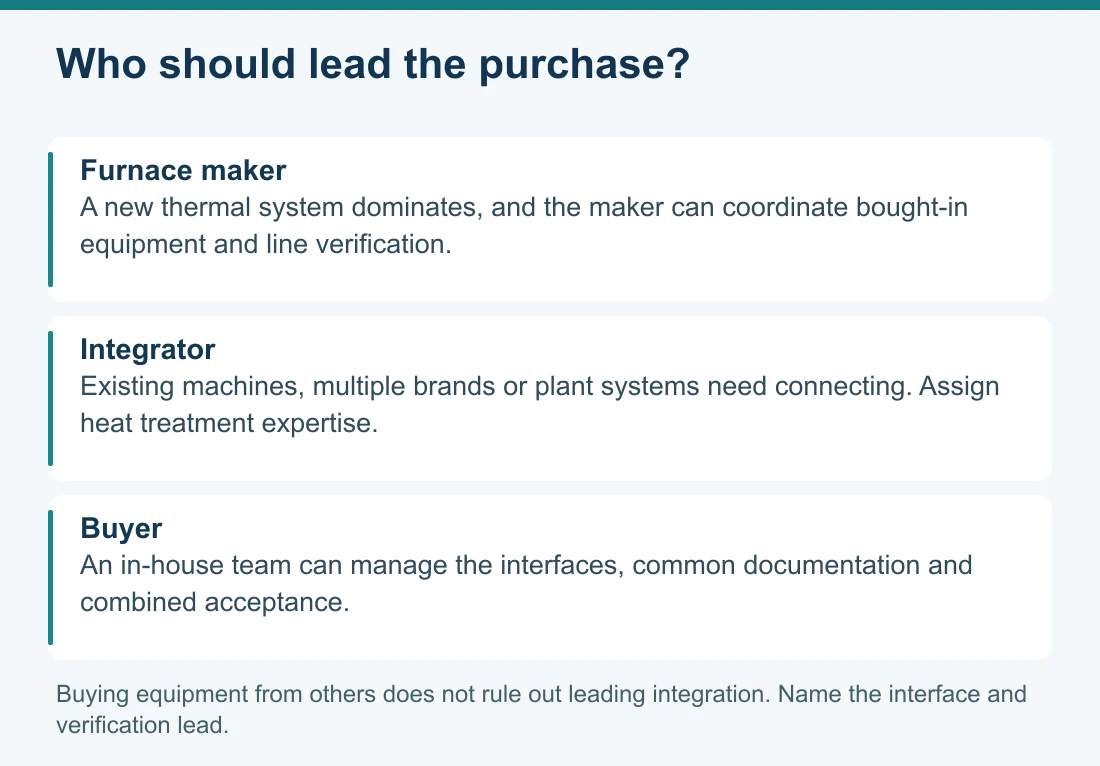
If you want to put on a fastener quenching and tempering line, if the main task is to build a new set of mesh belt quenching and tempering equipment with a clear process, and the furnace factory can coordinate transportation, quenching, cleaning and control, it can be led by the furnace factory; if you want to connect to multiple existing equipment, transform workshop logistics or unify multiple control systems, you can consider a whole line integrator with professional ability of heat treatment. The key is whether the candidate can catch the process connection and result verification of the whole line.
The whole line integrator here is the unit responsible for connecting different equipment into a production system. Being able to make a mesh belt furnace indicates the direction of a device, which cannot prove that it can deliver the quenching and tempering lines you need; combining several quotations together does not mean completing the whole line design.
Are the fasteners suitable for mesh belt conveying?
Fasteners cannot be selected only by the two names of "bolt and nut". Material, specification range, shape, loading method and quality requirements should be included in the plan. Quenching and tempering usually refers to quenching and high-temperature tempering, but the specific process should be determined according to the material and product requirements, and quenching and tempering cannot be mixed with carburizing, carbonitriding and other routes into a general scheme.
If the product can be belt loading and continuously transported according to the confirmed method, and can still meet the loading and process conditions after changing the specifications, the mesh belt line will have the basis for further comparison. If long parts are easy to hook, small parts may leak, or complex shapes make it difficult to stack and load transfer, the feeding, dropping and loading methods should be verified first. Just expanding the furnace or replacing a wider mesh belt may not solve these problems.
Let the candidate first explain how to follow the complete line of common specifications, maximum specifications and difficult specifications, which is more useful than just looking at the appearance of a main furnace.
Furnace maker as lead: check the stages after quenching
For quenching and tempering lines that use liquid quenching and need to be cleaned and dried, they can be checked step by step along the "up-heating-quenching-cleaning and drying-tempering-unlewing". The specific settings of cleaning and drying are determined according to the medium and subsequent requirements, and the fixed list cannot be copied.
After the discharge capacity of the main furnace is improved, if the continuous heat load, discharge conveying or cleaning capacity of the quenching system are not matched together, the whole line may still fail to achieve the target output. The volume of quench tank and the conveying speed of the washing machine cannot replace the description of the processing capacity under the corresponding working conditions alone.
Therefore, if the furnace factory is ready to take the lead, it should be able to explain what workpiece and loading conditions each section is designed according to, how to receive the next section, which equipment is outsouted, and where the output is finally counted. For the qualified product output required by the purchaser, the product inspection conditions should also be written into the verification arrangement, and the main furnace should not only be promised how much weight the main furnace will pass per hour.
Integrator as lead: identify responsibility for heat treatment
When the new line needs to be connected to the original cleaning machine, packaging line, workshop conveying and data system, it will be an important task to design the connection conditions and manage the information and version of all parties. Such projects can be considered to be organized by the integrator, but it should be clear who judges the ability of the heat treatment process and equipment.
For example, the existing cleaning function does not mean that it can handle the workpiece, residue and continuous incoming materials brought by the new line. The integrator shall arrange the corresponding equipment party and process personnel to check the applicable conditions, indicating which equipment should be retained and which need to be modified. If only layout drawings and automated demonstrations are provided, but there is no explanation of heating, quenching and tempering conditions, the purchasing party still cannot judge whether the product requirements can be realized.
When the supplier changes or the product range changes, there should also be a clear person to recheck the whole line. The original plan explains that the changed working conditions cannot be automatically covered.
Compare three ways of organising the purchase
| Purchasing method | Conditions that can be considered | What should be verified before signing the contract? | What will it affect if it is not clear? |
|---|---|---|---|
| Mesh belt furnace manufacturer takes the lead | New heat treatment equipment is the main construction, and the furnace factory can coordinate the support before and after. | Each segment's capability and process connection, outser-purchased equipment management, and whole-line verification scope | The main furnace has been delivered, and the peripheral still needs to be temporarily coordinated by the buyer. |
| The whole line integrator takes the lead | Multi-brand equipment, existing equipment and workshop systems need unified access. | Heat treatment professionals, applicability of old equipment, design and change management of each connection point | Automation can be demonstrated, but the actual workpiece or production target cannot be verified. |
| Buyers purchase separately | Own team can continuously manage process, connection design, progress and acceptance. | Internal general manager, unified information version, joint verification arrangement of all parties | The sub-item equipment has arrived, but there is no person in charge of the connection and joint adjustment work. |
The external purchase of quench tank or washing machine itself does not constitute a reason for elimination. What is more worth asking is: according to who confirms the working conditions of the outser, who reviews the supporting equipment, and who organizes to deal with cross-equipment problems. Buyers can purchase by themselves, but the coordinated services saved must be supplemented by the internal team.
Ask for a complete production duty at the first meeting
You can first provide photos or drawings representing fasteners, material and specification range, incoming status, quenching and tempering and inspection requirements, target accepted output, shift, and existing equipment and plant layout. Let the candidate explain his work scope along the actual path of the workpiece, submit the distribution of labor and verification arrangements, and then compare the prices.
Jiangsu Suneng Industrial Furnace Co., Ltd. Provide industrial furnace and heat treatment equipment design, manufacturing, system integration, installation and commissioning, transformation and after-sales support, and can communicate the scope of the equipment system in combination with the above information; which supporting and result responsibilities are specifically assumed, and confirmed according to the project. Please refer to the direction of relevant equipment. Continuous heat treatment line scheme (in Chinese) 。
Hotline: +86-130-5298-6814; Email: 997518512@qq.com 。
Issued by: Jiangsu Suneng Industrial Furnace Co., Ltd.
Technical author: 苏能工业炉工程技术团队&唐荔 (Suneng Industrial Furnace Engineering Team & Tang Li)
References
- HIGHTEMP|Continuous Mesh Belt Conveyor Furnaces: Continuous mesh belt heat treatment and front and rear supporting configuration examples for reference when checking the process connection.
- Nabertherm|Quench Tanks: The engineering reference of quenchant cycle and cooling tasks is used to check the supporting conditions before and after.
- Ecoclean|Cleaning fasteners efficiently and in line with requirements: An example of matching the fastener cleaning needs with the subsequent process.