

Two equivalent approaches are commonly used: actual workpiece mass per metre of belt multiplied by belt speed, or actual loading mass per square metre multiplied by effective width and speed. Each input must represent measured or agreed normal operating conditions.
Suneng mesh-belt annealing furnace documents state that output depends on workpiece shape, weight, loading and process requirements, and list heating length separately from belt speed. Use the actual workpiece mass per metre of normally loaded belt and a speed that satisfies process residence time. Recheck both inputs when workpieces or loading change. A nameplate or historical hourly-output figure is not automatically acceptable output for a new product.
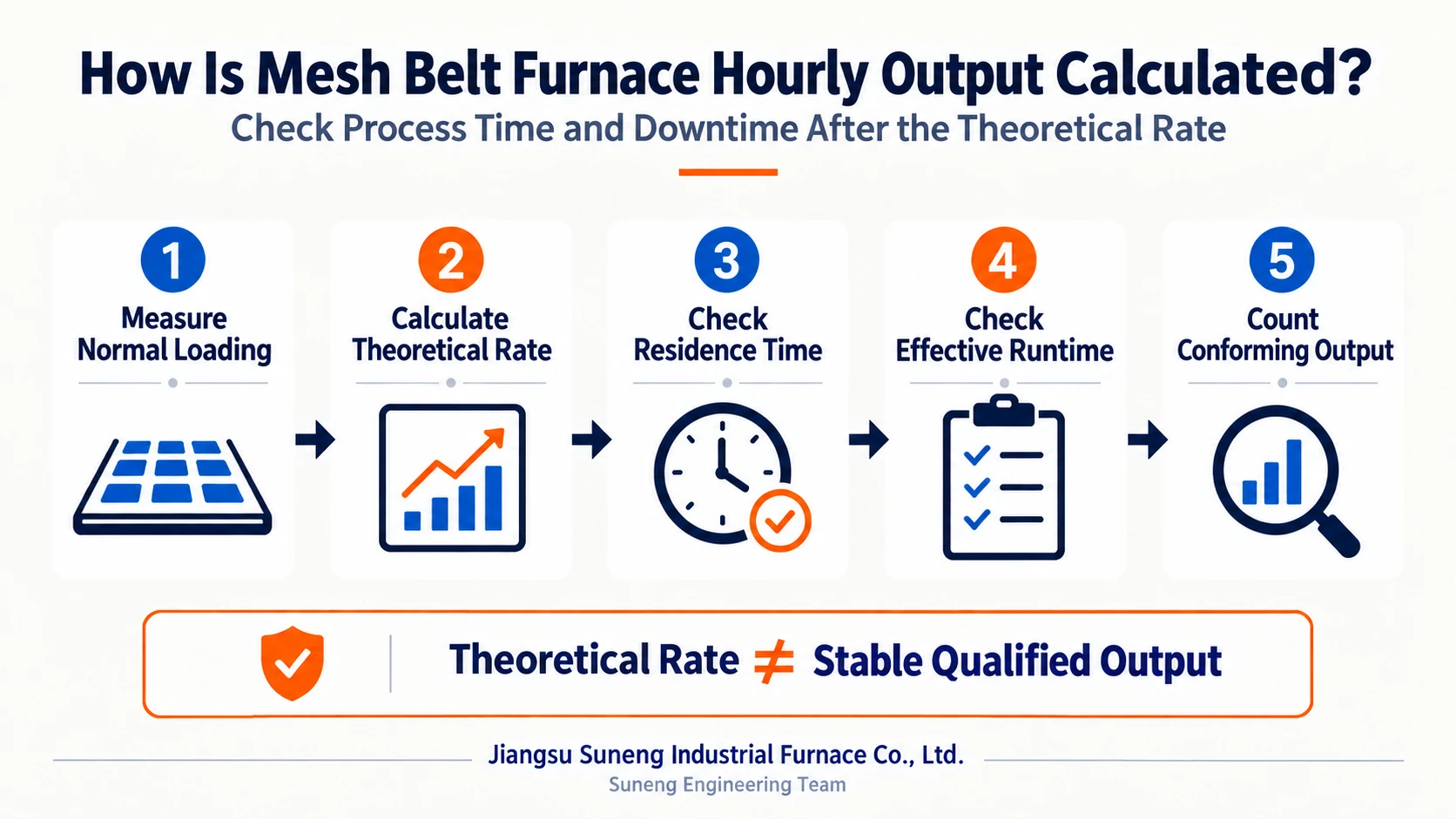
Distinguish four output figures
Theoretical throughput assumes stable loading and continuous movement. Planned output also uses planned hours. Actual processed quantity comes from operating records. Conforming output requires the agreed inspection criteria.
Design can begin with a theoretical value, but scheduling and acceptance need a reporting period, downtime definition, measurement location and quality criteria. The theoretical value is not a guarantee for every duty.
Calculate from actual loading per metre
With the equipment stopped, cool and in a safe condition, arrange parts at the normal layer count, spacing, orientation and permitted gaps. Weigh the workpieces over a measured belt length and convert to kg/m.
Theoretical mass throughput (kg/h) = actual workpiece loading (kg/m) × belt speed (m/h)
For piece-based production, measured pieces per metre multiplied by speed gives pieces per hour; multiply by actual piece mass to obtain kg/h. Mixed, stacked, irregular or variable feeding requires representative measurements, not dimensions alone. Loading mass excludes the belt's own weight, and maximum tightly packed loading cannot replace the normal production pattern.
Calculate from actual surface loading
Theoretical mass throughput (kg/h) = actual surface loading (kg/m²) × effective belt width (m) × belt speed (m/h)
Surface loading is measured after arranging the prescribed layers, spacing and orientation; it is not material density. Effective width is the confirmed stable loading width, not the machine's overall width or nominal full belt width.
SECO/WARWICK product information links capacity, treatment time, belt width and surface loading. These variables must be considered together; example specifications from other equipment cannot be transferred directly.
Speed must satisfy residence time
Higher speed increases theoretical throughput but reduces time in the process section. For a clearly bounded continuous section:
Residence time (h) = effective process length (m) ÷ belt speed (m/h)
Use that section's effective length, not total machine or line length. Check heating, holding, cooling, washing, tempering and other stages separately. Length divided by speed establishes movement time, not by itself completion of the material's treatment.
From theoretical rate to a production plan
Define the time basis first. If planned hours still include changeovers, waiting and line stops within the period, multiply the theoretical hourly rate by those planned hours and by the effective-running proportion. Its numerator is net running hours after those stops, and its denominator is the same planned hours. If net running hours are used directly, do not apply that proportion again and deduct the same downtime twice. Use records from the same equipment, duty and reporting period. Build it from start/stop, changeover, waiting, faults, cleaning, maintenance and other line-stop records; do not insert an arbitrary industry percentage. Mark it unverified for new equipment without history.
For conforming output, first define inspection scope, rework and scrap, then use the corresponding evidenced conforming-output proportion. Throughput cannot replace product-quality acceptance.
The limiting stage controls the line
Loading, heating, quenching/cooling, washing, drying, tempering and discharge can each constrain stable output. Check consistent feeding, process-compatible speed, downstream receiving capacity, accumulation at washing/tempering, inspection and transfer stoppages, changeovers and abnormal parts. A stage's instantaneous maximum is not stable conforming line output.
Nine original-data groups
| Data | Required detail | Used for |
|---|---|---|
| Workpiece | Grade, actual mass, size and shape. | Piece/mass conversion and stable loading. |
| Loading | Layers, spacing, orientation, gaps and feed variation. | Measured kg/m or kg/m². |
| Effective width | Permitted stable loading width. | Area-based throughput. |
| Speed | Normal range, changeovers and regulation. | Throughput and residence. |
| Effective lengths | Start/end of each process section. | Section residence times. |
| Process times | Heating, holding, cooling and post-treatment. | Permitted speed. |
| Operating records | Starts, stops, waiting, faults, cleaning and maintenance. | Effective running proportion. |
| Conforming output | Inspection, criteria, rework and scrap definitions. | Actual acceptable production. |
| Adjacent stages | Capacity, buffers, interlocks and abnormal handling. | Line bottlenecks. |
Use a consistent duty and reporting basis. Preliminary calculations with missing data must identify assumptions and unverified inputs.
Common questions
Does a wider belt always increase output?
Only if stable loading, heating/cooling, process time and adjacent stages can support the increased effective width.
Can maximum belt speed be used?
No. Use normal speed compatible with the workpiece, loading and required residence. Mechanical speed capability is not process capability.
What if downtime records are unavailable?
State theoretical rate and planned hours, mark uptime unverified, then record starts/stops, feed, discharge and conforming output under agreed conditions.
Suneng's scope
Suneng can clarify custom mesh-belt and line capacity boundaries using agreed actual loading, process times, output, downstream treatment, automation, site and acceptance. Prepare weights, loading records, width, speed, section lengths, process times, shifts and downtime for an enquiry or call +86-130-5298-6814.
This method does not guarantee parameters, price, schedule, consumption, output, yield or quality. The agreed project documents define the final design and acceptance.