

Choose a part you produce regularly and provide its type and specification, unit weight, loading depth on the belt, material, and heating temperature and time requirements. One tonne per hour is your order target. To size the furnace, the supplier needs to know what is loaded on the belt and which process it must follow.
A protective-atmosphere bright-quenching line design proposal for small and medium-sized metal parts from Jiangsu Suneng Industrial Furnace Co., Ltd. (Suneng) uses approximately 1000 kg/h as a design reference value. It requires the buyer to confirm throughput and representative workpiece information in writing. Start with your most frequently produced part to assemble that information.
Complete these five inputs for one representative part
| What the supplier needs | How the buyer can prepare it |
|---|---|
| Workpiece type and specification | Give a specific model and its drawing or external dimensions |
| Unit weight | State the weight of one part of this model, including the unit |
| Loading depth | State the depth of the normally arranged parts on the belt. If it has not been measured, obtain a loading photograph from production before confirming it |
| Material | Give the material grade used on the drawing for this model |
| Process curve | Provide the heating requirements, holding temperatures and times. If unavailable, identify who needs to supply the document |
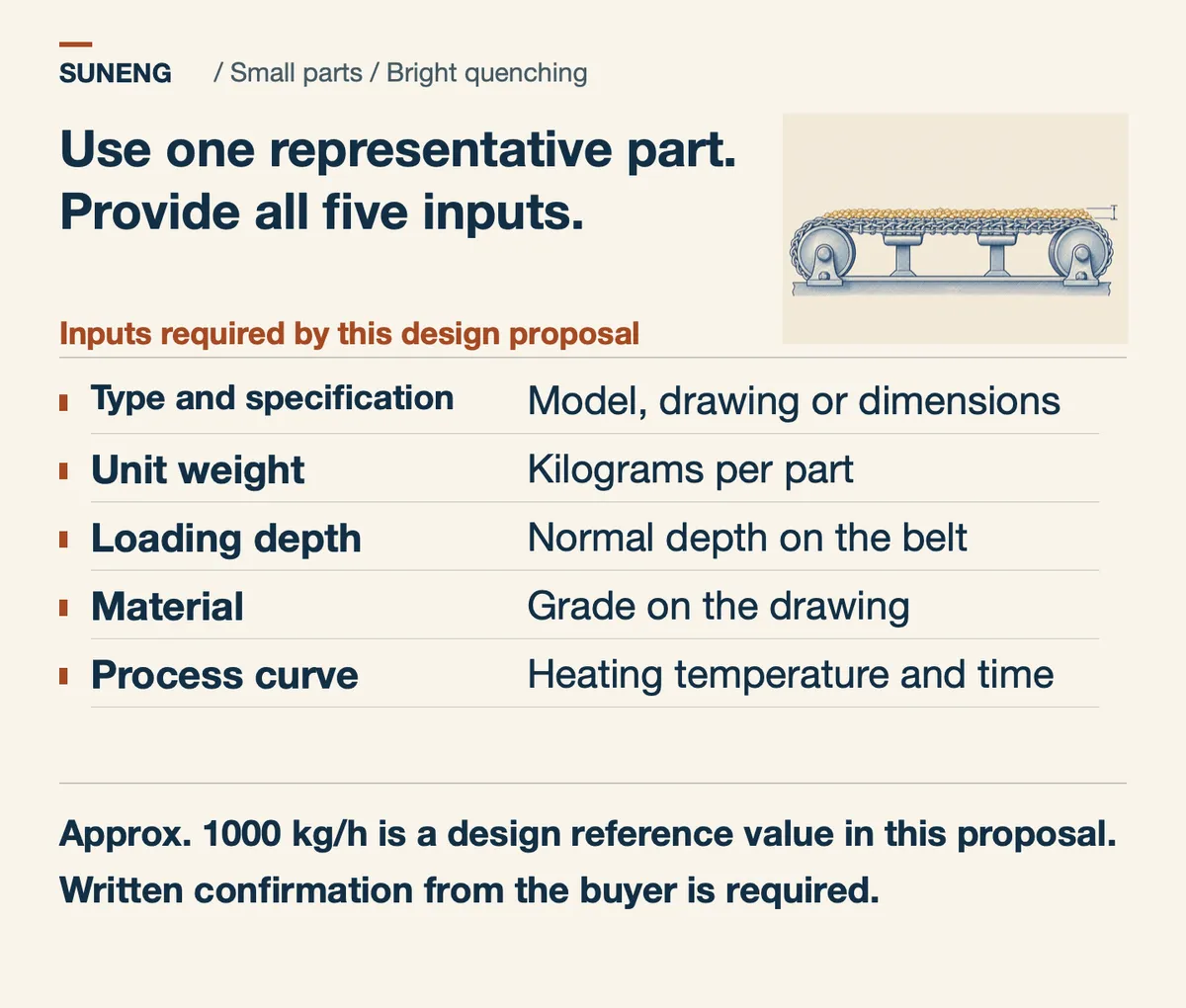
Copy this line for production to complete, using one row per part.
Workpiece type and specification ______ | Unit weight ______ kg/piece | Loading depth on belt ______ mm | Material ______ | Process curve or process document ______
Check that the supplier's figure applies to the completed row
This design proposal specifies a main furnace belt width of 1000 mm, a heated section length of 10000 mm and main furnace electric-heating power of approximately 500 kW. Matching these dimensions and power alone cannot establish throughput for another part. Two parts with the same weight may occupy different belt areas, create different loading depths or require different heating times.
Ask the supplier to record the loading depth, process time and corresponding design-reference throughput under the same part model. If the part or arrangement changes later, the buyer can identify which input has changed and provide the information needed for recalculation.
Website case · Bright-quenching line design proposal for small and medium-sized parts https://www.jssngyl.cn/en/case/bright-quench-design
Telephone: 13052986814
Email: 997518512@qq.com
Technical authors: Suneng Industrial Furnace Engineering Team & Tang Li