

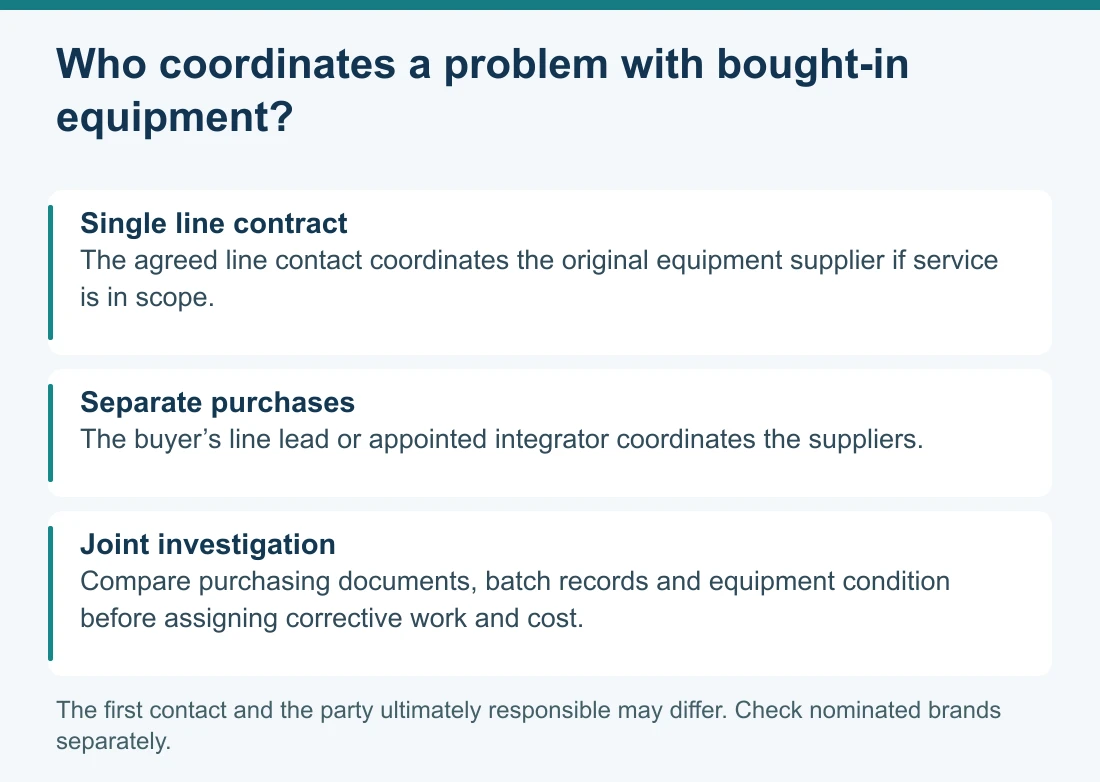
When quench tank and washing machine are externally purchased, first find the docking person according to the service division of labor agreed in the procurement document: if they are included in the scope of the supply and after-sales service of the whole line supplier, the whole line docking person shall organize the original equipment manufacturer to deal with it; if the buyer purchases separately, the person in charge of the whole line designated by the buyer or the integration party will coordinate with the relevant manufacturers. Who to contact first, and who will finally rectify and what expenses will be borne are two issues that need to be confirmed separately.
Therefore, you can't just look at the manufacturer's nameplate on the quench tank or the washing machine to determine the responsibility, and you can't conclude that it is caused by an out-purchased equipment as soon as you see that the product is not qualified.
One line contract or several independent purchases?
The whole line supplier can adopt the supporting products of professional manufacturers. The purchasing party should pay attention to whether their documents include supporting selection, connection design, joint commissioning and after-sales coordination. If all have been included, the agreed docking person should be allowed to receive the problem and the equipment side should be organized to verify it, instead of looking for each supplier from scratch.
If the quench tank and washing machine are purchased separately by the buyer, the working scope of the furnace factory may only reach the main furnace or the agreed connection point. At this time, it is necessary for the buyer to clarify who manages the workpiece conditions, equipment connection and process records uniformly. It can be agreed separately to ask the furnace factory to assist in checking, and the unpurchased whole-line coordination service cannot be defaulted as included.
Another situation is that the buyer designates the supporting brand, and the leader is responsible for the procurement and installation. Its design audit, applicability check and after-sales division of labor should also be listed alone, and who is responsible for all the problems cannot be judged only by the word "designated brand".
Hardness variation alone does not identify a quench tank fault
For the production line using liquid quenching, the final product performs conditions such as related materials, heating and soaking, furnace transfer, medium state, cyclic cooling and subsequent tempering. If there is no leakage in the tank and the circulation pump can run, it can only explain the corresponding phenomenon, but it cannot prove that the quenching conditions under the continuous incoming material meet the agreement.
When there is a product deviation, the leading party should organize the process personnel, the furnace factory and the quenching supporting party to match the materials of the same batch of products with the loading, heating record, transfer record, medium and supporting status and inspection results. Distinguish the working conditions where the deviation occurs first, and then judge which section should be checked. You can't just rely on a temperature reading or a hardness report to skip other links to determine the fault responsibility.
If the problem only occurs after a period of continuous production and does not occur at the beginning of the start-up, you should focus on checking whether the record covers the cumulative incoming materials and supporting operation status at that time; you can't only use the power-on demonstration to replace the evidence under continuous working conditions.
A running washer does not prove that the cleaning target is met
The cleaning effect needs to correspond to the shape of the workpiece, the incoming residue, the loading and stay conditions, and the agreed cleaning determination method. The appearance looks clean and cannot replace the agreed residue or follow-up process requirements.
If only a certain specification or a certain loading method is left, the difference between the problem batch and the normal batch should be compared first to check whether they are within the scope confirmed at the time of procurement. If the incoming material, rhythm or loading is changed later, it is also necessary to check whether these changes have been confirmed by each section of equipment. Changing the working conditions does not prove that there must be a problem with the equipment, nor does it prove that the equipment party can be directly exempted from liability. It needs to be judged in combination with the confirmation record.
When the follow-up requirements still cannot be met after cleaning, it is also necessary to distinguish between the performance of cleaning, drying and follow-up processes to avoid all the phenomena from other links to the washing machine.
Who should investigate each symptom?
| The phenomenon that appears | Who will organize the handling first? | Which evidence should be dealt with first? | You can't draw any conclusions directly. |
|---|---|---|---|
| There is a clear abnormality in the pump, transmission or conveying mechanism. | Contact the docking person according to the service agreement and arrange the verification of the equipment. | Record of equipment status, alarm, maintenance and supporting conditions | If you see the abnormality of the parts, it is determined that all product deviations are caused by it. |
| The single machine is normal, but the material between the two sections is accumulated and cannot be continued. | The person in charge of the whole line summons the upstream and downstream equipment and electrical control parties. | Incoming materials of the same batch, operation rhythm, handover location, status and version records | Just because of the accumulation of downstream materials, it is determined that there is a problem in the manufacture of downstream equipment. |
| Changes in quenching or product performance after continuous production | The person in charge of the whole line organizes the process, furnace body and quenching supporting party | Same batch of materials, heating, transfer, medium and supporting status, product inspection | If the tank or pump can operate, it is determined that the quenching conditions are qualified. |
| Specific workpiece cleaning or drying does not meet the standard | The person in charge of the whole line organizes the cleaning supporting parties and technical personnel. | Incoming material residue, shape, loading, process and judgment record | It looks clean with the naked eye, and it is determined that all the follow-up requirements have been met. |
The above is the order of checking reports and evidence, not the operation procedures for troubleshooting. It involves equipment operation, media, safety protection and on-site testing, which are handled by the corresponding professionals according to the equipment documents.
What to include in a service request
The first report can explain: what workpiece, what batch, when it appeared, what the performance was, which segment affected, whether the product or operating conditions were changed at that time, and attach existing records. Write "production deviation" separately from "a device has been confirmed to fail" to avoid fixing the cause before verification.
The processing record should continue to be clearly written on the basis of the reason, the tasks of all parties, the modified content and the results of the re-examination. The final rectification of the division of labor, service scope and cost needs to be returned to the confirmed procurement documents and verification conclusions; this article does not make liability rulings for specific disputes.
Jiangsu Suneng Industrial Furnace Co., Ltd. Provide installation, commissioning, transformation and after-sales support for industrial furnaces and heat treatment equipment. During the consultation, the equipment list, procurement division of labor and problem records can be sent in advance to judge the scope of equipment that Suneng participates in the verification; do not promise to bear the responsibility of unagreed third-party equipment in advance.
Hotline: +86-130-5298-6814; Email: 997518512@qq.com 。
Issued by: Jiangsu Suneng Industrial Furnace Co., Ltd.
Technical author: 苏能工业炉工程技术团队&唐荔 (Suneng Industrial Furnace Engineering Team & Tang Li)
References
- Nabertherm|Quench Tanks: The engineering reference of quenchant cycle and cooling tasks is not used to judge the cause or responsibility of the failure of this project.
- Ecoclean|Cleaning fasteners efficiently and in line with requirements: An example of fastener cleaning requirements does not replace the cleaning judgment requirements of specific workpiece.