

When the transportation, quenching, cleaning and electrical control of the heat treatment line are provided by different manufacturers, the sub-equipment responsibility, the connection responsibility between the equipment and the result responsibility of the whole line should be clarified at the same time before signing the contract, and a unified problem docking person should be designated. Acceptance should be carried out from the factory inspection to the on-site connection, whole line operation and agreed product result verification. If there is a problem, the leading party shall first organize the investigation, and then determine the rectification division of labor according to the record.
It is not enough to just write "each manufacturer is responsible for its own equipment". Someone needs to be responsible for how to receive materials between the two devices, exchange status, save process records, and what to do when a single machine can run but fails to reach the whole line target.
Assign responsibility beyond the individual machine
The sub-project manufacturers are responsible for their own equipment, and do not automatically include the joint design of the front and rear sections. For cross-device connection, it is necessary to at least explain who puts forward the conditions, who completes the design on this side, who reviews the cooperation between the two parties, and who organizes verification.
For example, the upstream conveying equipment and the washing machine can be operated separately, but they may not be connected due to the receiving position, the incoming rhythm or the workingpiece loading conditions. If the two companies design according to different versions of workpiece data, the problem is not only "which machine is broken", but also involves the management of the whole line conditions.
You can put the connection requirements in the following table. The items in the table are used for the procurement division of labor, and the specific design and testing are completed by relevant professionals according to the project.
| Connection position | What should both parties confirm together? | Responsibilities that must be implemented | Evidence that should be left |
|---|---|---|---|
| Loading, conveying and main furnace | Workpiece and loading range, receiving position, operation rhythm | Who will put forward the transportation conditions uniformly, and which part of the design will be completed by both parties? | Same version of process, connection diagram and work condition confirmation record |
| Main furnace discharge and quenching system | Transfer mode, incoming load, medium and supporting capacity requirements | Who puts forward the supporting conditions for quenching, who will review the connection and organize the verification? | Supporting conditions, ability description and corresponding verification records |
| Chenching, material discharge, cleaning and drying | Workpiece status, residue, continuous incoming material and follow-up process requirements | Who determines the cleaning target, and who checks the conveying and cleaning capacity? | Workpiece conditions, cleaning judgment methods and records |
| Each section of equipment and unified electronic control | Status signal, data correspondence, control version and professional security requirements | Who formulates the connection instructions, who completes the cooperation on all sides, and who organizes the joint verification? | Confirmed signal and function description, version and test record |
| The final output of the whole line | Representing the product, loading, production conditions, quality and yield caliber | Who is responsible for the agreed results, and what workpiece and inspection conditions does the buyer provide? | Acceptance plan, original record, product inspection and problem closure record |
If the buyer purchases separately, the cooperation matters of each manufacturer should also be included in the corresponding procurement documents; only drawing a division of labor table within the buyer cannot prove that the supplier has accepted these tasks.
Four acceptance stages and what each can prove
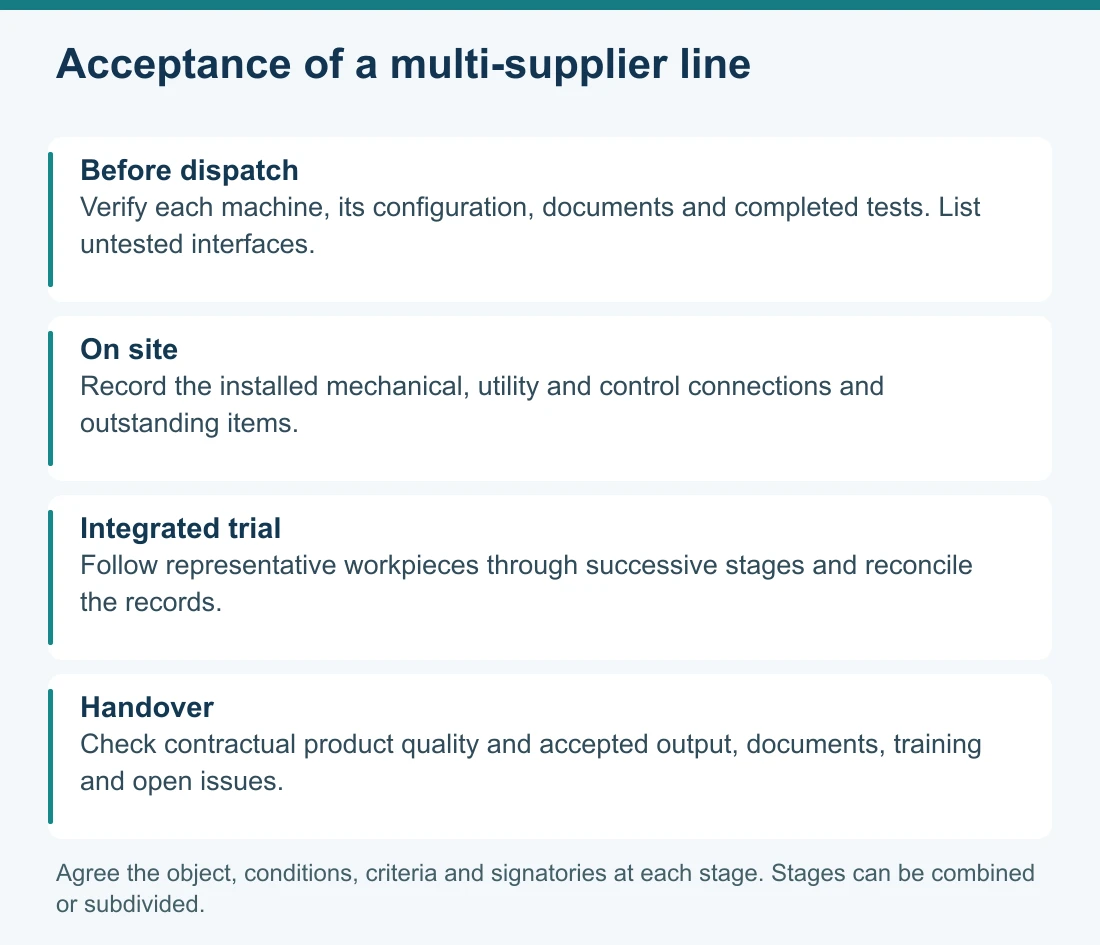
The following four steps are phased suggestions to facilitate procurement management, which are not the legal steps implemented by all production lines. Projects can be merged or subdivided, focusing on the consistency of objects, conditions, judgments and signatories at each stage.
The first step is to check the sub-item equipment and verifiable connections at the factory. Check the equipment configuration, agreed functions, information and the tests that the manufacturer can complete on site. When the supporting equipment is not in the same location, which connections have not been verified should be listed in a single list, and cannot be written as all lines have been passed.
The second step is to check the actual connection after installation on the spot. Check whether the location of the equipment, public support, mechanical handover and control connection are in line with the confirmation plan, and deal with the matters reserved at the factory stage. The completion of the on-site connection cannot automatically prove the load production capacity, and the list of confirmed and to be confirmed at this stage needs to be left.
The third step is to verify whether the whole line can be connected continuously according to the agreed conditions. The relevant equipment parties jointly confirm the entry and output of the workpiece, the continuation of each section, the record correspondence and the agreed function. For protection and abnormal responses that require professional confirmation, they are included in special acceptance documents and do not need to be replaced by a no-load demonstration.
Step four, verify the agreed product results and complete the handover. If the contract target includes product quality and accepted output, it shall be tested and counted according to the pre-agreed method under the confirmed workpiece, loading and process conditions. At the same time, check the drawings, maintenance materials, procedures and record delivery, training and legacy matters. The specific test time, sampling rules and allowable deviations are determined by the project file.
Record machine operation, product quality and throughput separately
The operation of the single machine is normal, and the answer is the problem of equipment function; the whole line is normal, and the answer is the problem of equipment coordination; the product inspection and accepted output, the answer is whether the procurement target can be realized. These evidences should correspond to each other, but not replace each other.
If the contract only purchases the manufacture and function of a certain equipment, all product results cannot be attributed to the equipment manufacturer by default after delivery. On the other hand, the seller has accepted the quality or output target of the whole line, and cannot be required to collect according to the overall target label based on the itemized equipment checklist alone.
Before acceptance, it is also necessary to write clearly who provides the workpiece and materials, who confirms the process, and who completes the inspection. When product deviations are found, the materials, loading, process records and equipment status should be checked together to determine which layer the deviation occurs.
Use a common incident record to assign corrective work and close the issue
The unified docking person is responsible for receiving problems, summoning relevant parties, sorting out evidence and promoting handling; this coordination responsibility and the final fault responsibility should be agreed upon separately. The general docking person does not automatically replace the professional judgment of each equipment party, and cannot let the purchaser guess the contact of the company by itself when the reason is unknown.
The question sheet can record the time of occurrence, products and batches, phenomena, relevant equipment, original records, next check items and the person in charge. If multiple devices are involved, the relevant parties shall form a common conclusion; after modifying the supporting conditions or control version, the affected scope shall be re-verified according to the prior agreement. The unrecorded verbal "fixed" should not directly replace the basis for closing the problem.
The first communication can provide the process flow chart, the list of each equipment, the planned procurement method and the acceptance target. Jiangsu Suneng Industrial Furnace Co., Ltd. Provide industrial furnace and heat treatment equipment design, manufacturing, system integration, installation and commissioning, transformation and after-sales support, and can communicate the division of labor of the equipment system accordingly; the specific leadership, cooperation and result responsibilities must be confirmed in the project.
Hotline: +86-130-5298-6814; Email: 997518512@qq.com 。
Issued by: Jiangsu Suneng Industrial Furnace Co., Ltd.
Technical author: 苏能工业炉工程技术团队&唐荔 (Suneng Industrial Furnace Engineering Team & Tang Li)