

A monthly target of 500 tonnes and a count of two bogie hearth furnaces are not enough to determine whether capacity is sufficient. First establish how much qualified steel each furnace can deliver per batch, how long a complete batch occupies the furnace, and how many batches can actually be completed in the available monthly operating time. Adding the qualified output of the two furnaces and reaching the target is only the first step. Overlapping maintenance, concentrated delivery deadlines and shared handling resources can still leave delivery schedules short even when the monthly total appears sufficient.
This article treats “500 tonnes per month and two bogie hearth furnaces” as the inputs to the public question, not as details of any customer's actual project. Jiangsu Suneng Industrial Furnace Co., Ltd. recommends placing the following three quantities in the same production schedule before deciding on the number of furnaces.
Start with qualified output per batch, not 500 tonnes divided by two furnaces
Dividing 500 tonnes by two furnaces gives only an average allocation of the production target. It does not demonstrate that either furnace can meet that allocation. The basic relationship is:
Monthly qualified output per furnace = qualified net steel weight per batch × qualified batches completed during the month. Calculate the two furnaces separately, then add their outputs.
“Net weight” here counts only the steel parts. The bogie, racks and packing blocks are not output. If the load or acceptance yield varies between batches, add up the actual qualified net weight batch by batch rather than repeatedly multiplying by one fixed value. A batch completed and accepted only in the following month cannot be counted in this month's deliverable quantity.
Batch loading depends on more than total weight. Part shape, spacing, support arrangements and actual process requirements must also be checked. Fitting inside the furnace and remaining within its load limit are different questions from whether that batch can complete heat treatment as required. Load-bearing calculations must include fixtures and other loads; production output calculations count only the net weight of qualified steel parts.
The complete cycle ends when the furnace can take the next batch
The empty-furnace heating time stated in procurement information cannot be used directly as the production cycle. With a load present, both steel and fixtures absorb heat. A measured furnace temperature reaching its setpoint does not automatically mean that the cores of the parts have reached the required temperature. Differences in section size, material, loading and heat transfer affect heating, temperature equalization and holding time. One universal duration cannot be assumed.
A complete furnace-occupancy cycle includes at least:
Loading → heating with the load → temperature equalization and holding required by the process → cooling that must take place inside the furnace → unloading and release of the furnace position.
“Release of the furnace position” means that the furnace is ready to take the next batch. If the process permits cooling to continue after unloading, that portion need not occupy the furnace. However, cooling space, bogie turnaround and lifting arrangements must still support the schedule. Where the process requires furnace cooling, cooling time cannot be omitted merely to calculate a higher output.
Daily batch throughput must therefore be assessed using this complete cycle and the shift schedule. Batches running continuously overnight carry on across calendar days. Do not restart the calculation by rounding down “24 hours ÷ cycle time” separately each day, and do not count a fractional batch as a completed batch delivered that day. Monthly output ultimately counts qualified batches actually completed during that month.
Deduct genuinely unavailable time from the monthly schedule
The following relationship can be used for an initial estimate, followed by a check against the actual schedule:
Monthly available furnace-occupancy hours = scheduled production days × scheduled hours per day − unavailable hours outside the complete cycle.
Unavailable hours outside the cycle include maintenance, waiting for material, staffing restrictions and utility limitations. Loading, unloading or cooling already included in the complete cycle must not be deducted a second time. If handling requires additional waiting for a crane, include that extra wait in the cycle or record it separately as downtime, using only one accounting method.
| Data required | How to record it | Risk if it is missing |
|---|---|---|
| Qualified net weight per batch | Use actual loading and qualified output; record mixed loads batch by batch | Treating equipment load capacity or charged weight as deliverable output |
| Complete furnace-occupancy cycle | Include loading, loaded heating, equalization and holding, necessary in-furnace cooling and unloading | Overestimating batches by using heating time alone |
| Daily operating arrangements | Record shifts, overnight continuity, handling personnel and available lifting periods | The furnace can run continuously but handling cannot keep up |
| Effective production days in the month | Check working days, shutdown plans and order timing | Calculating capacity from all calendar days in the month |
| Unavailable time outside the cycle | Record maintenance, material waits and shared-resource conflicts without double deduction | Filling the schedule without room for disruption |
| Quality and rework arrangements | Count qualified output on the actual basis; record furnace hours for rework separately | Treating theoretical throughput as qualified deliveries |
“Available monthly hours ÷ complete cycle time” is suitable for estimating batch counts only when batch loading, complete cycle and available operating periods can reasonably be represented by fixed values. Check whether whole batches can actually be completed. Different processes, frequent load changes or operating periods that cannot run continuously require batch-by-batch scheduling rather than reliance on averages.
An independently constructed calculation example: two furnaces can still fall short
The numbers below were independently selected solely to explain the calculation. They are not a Suneng customer project, measured operating data or an equipment-capacity commitment. They cannot be used directly for equipment selection.
Assume that both furnaces have identical conditions: 8 tonnes of qualified net steel per batch and a complete furnace-occupancy cycle of 16 hours. Assume 22 scheduled production days per month with continuous 24-hour operation, plus 48 hours of unavailable time outside the complete cycle. Also assume that the available operating periods can accommodate whole batches and that the two furnaces do not compete for handling resources. The following calculation concerns only this idealized schedule.
- Available monthly time per furnace: 22 × 24 − 48 = 480 hours.
- Completed batches per furnace: 480 ÷ 16 = 30 batches.
- Qualified output from two furnaces: 2 × 30 × 8 = 480 tonnes.
Under these example conditions, the two furnaces produce a calculated 480 tonnes, which is 20 tonnes short of the 500-tonne target; they are therefore insufficient in this example. At 8 tonnes of qualified output per batch, reaching 500 tonnes requires at least 63 completed batches in total across the two furnaces. The current example schedule provides only 60. The shortage cannot be removed by rounding, nor can it be assumed that adding more steel to a load or shortening the process will make up the difference.
The example illustrates how to check the calculation. For a real assessment, replace 8 tonnes, 16 hours and the monthly available time with verifiable data for the proposed equipment and actual production arrangements. Results will be lower if rework consumes additional furnace time, downtime exceeds the allowance, or some batches are not completed within the month.
After the total is sufficient, check delivery timing
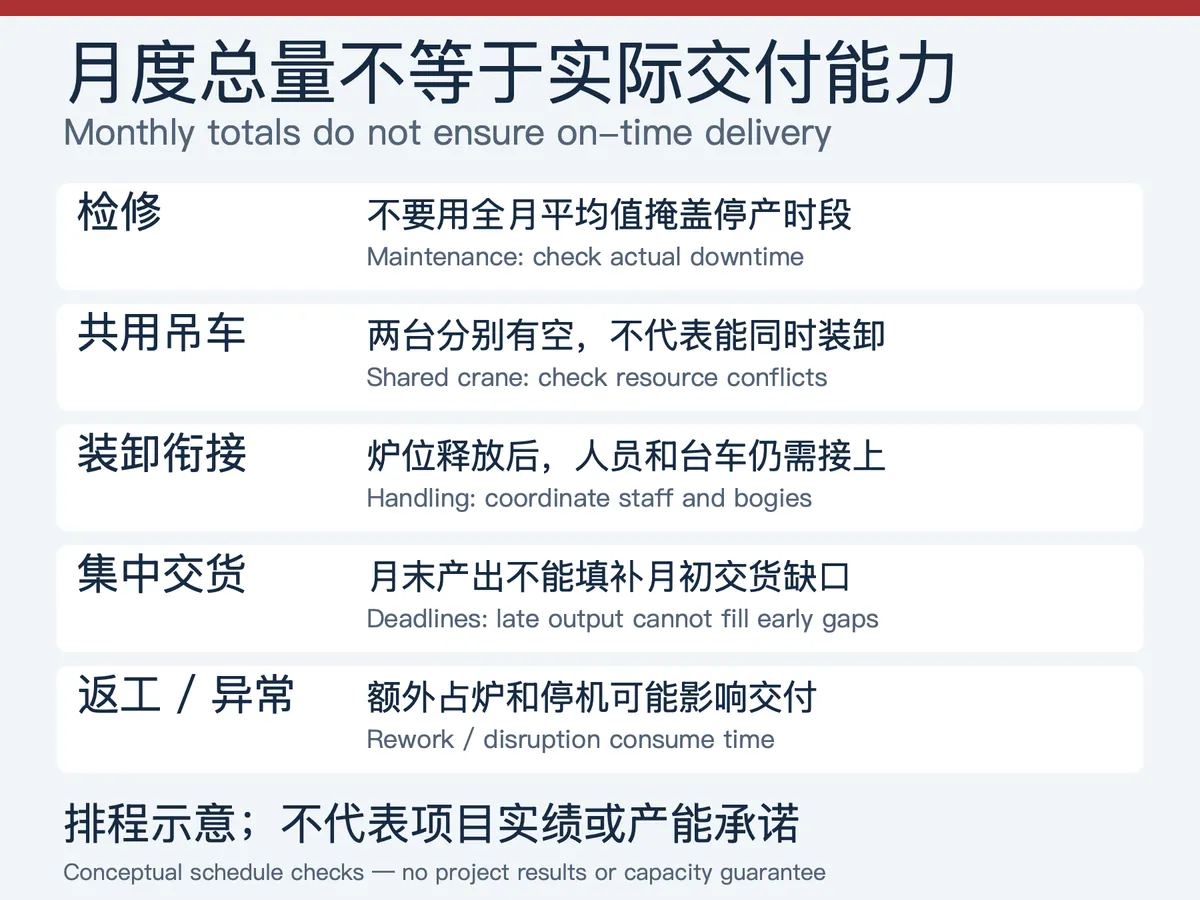
Even if the combined monthly output reaches 500 tonnes, put the order deadlines back into the production schedule. Output completed at the end of the month cannot cover a concentrated delivery requirement at the start. Nor can a monthly average conceal a shutdown period when both furnaces are under maintenance at the same time.
To determine whether the two furnaces can operate in parallel as planned, check shared cranes, bogies, handling personnel, cooling space and utilities against the schedule. Having time available on each furnace independently does not mean they can both complete their work simultaneously when they compete for the same resource.
Finally, allow room to handle disruption. The required margin depends on actual equipment reliability, maintenance plans, order fluctuations and quality records; this article does not prescribe a universal percentage. If the schedule is already full, buyers should recognize that any additional downtime or rework can affect deliveries.
Next step for the buyer: collect three groups of information
- Loading and process: steel grade, part shapes and weight range, proposed loading method, and heating, holding and cooling requirements.
- Complete cycle: verifiable complete-cycle data under comparable loading conditions. If measurements are unavailable, state the basis of the estimate and how it will be verified later.
- Actual scheduling: shifts, production days per month, maintenance and shared-resource arrangements, and whether the 500 tonnes are to be delivered evenly or in concentrated periods.
With these inputs, calculate qualified output for each furnace and check downtime and peak periods. If inputs are still missing, the conclusion should be “not yet determinable; qualified output per batch, the complete cycle or available operating time must be supplied,” rather than a premature promise that two furnaces are enough.
Jiangsu Suneng Industrial Furnace Co., Ltd. designs and manufactures industrial furnaces and heat-treatment equipment. For an equipment inquiry, buyers can first provide part dimensions and weight ranges, process requirements, target output and shifts. Batch loading, complete cycle and delivery capability still require confirmation for the specific equipment and production arrangements.