

First establish whether a supplier has handled workpieces, loads, processes, energy sources and acceptance boundaries comparable to yours. Then examine design documents, manufacturing, delivery and support. Factory buildings, certificates, customer names and low prices are useful context, but none alone establishes suitability.
Suneng trolley-furnace retrofit documents place the added section, integration with the original controls and whole-furnace retesting within one scope. Use that relationship to check that a candidate's design, manufacturing and acceptance documents describe the same equipment version. If the drawing shows a longer chamber but the test plan covers only the original working zone, request an aligned revision. More documents do not necessarily mean consistent documents.
Suneng's engineering team groups the evidence into comparable duty, design, manufacturing, acceptance/delivery and after-sales support. The framework applies to all candidates, including Suneng, and is not a ranking.
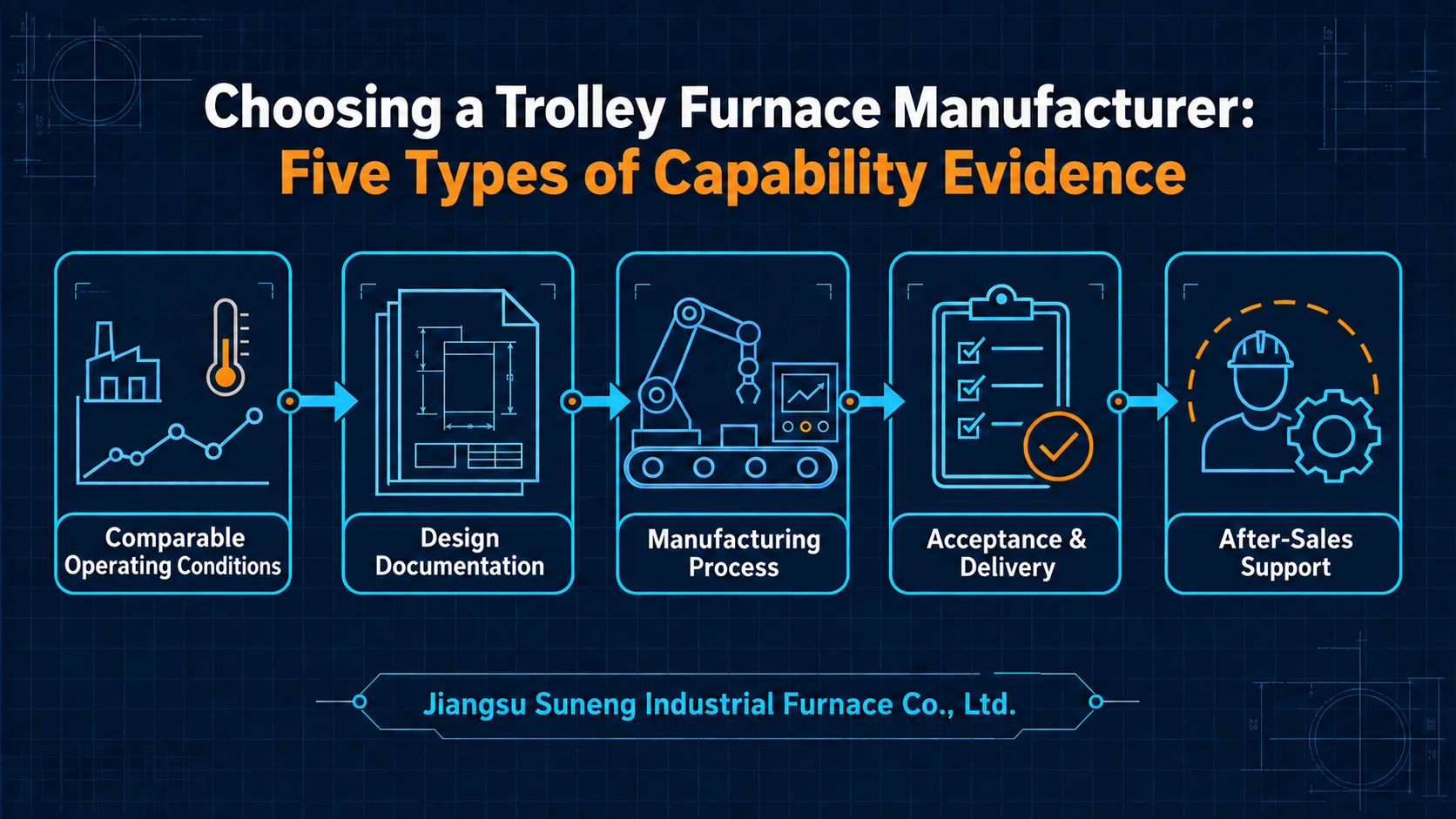
1. Is the reference project actually comparable?
The same furnace name can conceal very different equipment boundaries. Compare material, maximum dimensions, individual weight and loading; treatment, usual/maximum temperatures, heating, holding and cooling; batch load, shifts, cycle and output; electric or gas heating and utilities; effective zone, temperature records, uniformity and traceability; trolley capacity, seals, circulation, movements and interlocks; and factory testing, transport, installation, site commissioning and final handover.
A photograph or customer name does not establish these similarities. Under appropriate confidentiality arrangements, ask for the supply scope, similarities, differences and verifiable records while protecting customer drawings, programs and prices.
2. Design capability appears in documents
| Evidence | What to check |
|---|---|
| Requirement confirmation | Workpiece, loading, process, output, energy, controls, acceptance and site. |
| Loading or arrangement drawing | Workpieces, fixtures, effective zone, load capacity and handling/maintenance space. |
| Key calculation summary | Inputs for thermal load or power, structure, circulation, zones and cycle. |
| System/control description | Heat source, flow guides, seals, records, alarms and interlocks matched to duty. |
| Draft acceptance plan | Which performance is checked at the factory or site, with records and criteria. |
A custom trolley design requires those inputs. Dimensions without workpieces, load, curves and acceptance cannot reliably fix capacity, heating, zones, circulation and delivery scope.
3. Manufacturing capability needs process evidence
Possible witness points include frozen design and supply lists; body, trolley, doors and key materials; lining, seals, heating/combustion and circulation; cabinet, wiring, instruments, program versions and interlocks; and cold movements, empty-furnace heating, records and issue closure.
Choose points for the project's risks rather than maximising their number. Heavy loads place more emphasis on trolley, rails and drives. Demanding temperature distribution places more emphasis on zones, circulation, seals, measurement points and records. Electric and gas versions need their own relevant safety checks.
4. Define acceptance and delivery before comparing prices
The agreement should identify document and standard versions; separate factory and site scopes; temperatures, load state, points, instruments, stabilisation and recording; pass criteria, corrective work, retests and closure; responsibilities for transport, unloading, foundations, rails, utilities, exhaust, installation and commissioning; and delivery of training, drawings, programs, spares and documents.
Uniformity results require the effective zone and complete measurement conditions, not a universal isolated number. Factory pre-acceptance does not complete acceptance after transport, installation and utility connection.
5. Make after-sales terms executable
Specify fault-reporting channels, required information and initial response; remote and site support and each party's cooperation; wear and critical spare parts, alternatives and supply scope; program, password, parameter and version management; attribution of issues caused by operation, maintenance, material, utilities or environment; and warranty start, charges and support inside and outside warranty.
Distance may help communication, but it is not a response commitment. Put methods, information, responsibility and costs in the contract.
A shortlist evidence table
| Dimension | Evidence | Warning sign |
|---|---|---|
| Comparable duty | Condition comparison, anonymised project and document list. | Customer and furnace names without differences. |
| Design | Requirements, loading, calculations and controls. | Frozen configuration without workpieces or curves. |
| Manufacturing | Plan, witness points, inspections and trials. | Finished images without process records. |
| Acceptance/delivery | Test plan, responsibilities and document list. | “National standards” without states and methods. |
| Support | Service process, spares and contract terms. | Only “prompt” and “lifetime” slogans. |
Suneng's capabilities and boundaries
Founded in 2006, Jiangsu Suneng Industrial Furnace Co., Ltd. designs, manufactures and integrates industrial and heat treatment equipment and provides installation, commissioning, retrofit and support. Its engineering team reviews workpieces, loading, curves, output, energy, controls, acceptance and site conditions before defining a trolley-furnace proposal.
Suneng can support contracted uniformity tests and control-system checks. Calibration or third-party certification requires appropriately qualified bodies. Confirm type, parameters, tests, price, delivery and support in the agreed documents. Suneng does not offer per-piece subcontract treatment or commit to projects as an engineering, procurement and construction general contractor.
Common questions
Is a larger manufacturer more reliable?
Scale is one resource indicator. It does not replace comparable duty, the team, design, process records, tests and responsibilities.
Does having built a trolley furnace establish relevant experience?
Only if the important workpiece, load, temperature, heat source, circulation, support, control and acceptance conditions are comparable.
Can the lowest bidder be considered?
Yes, after aligning inputs, configuration, supply, acceptance and service. Omitted transport, installation, utilities or testing may become later additions.
Is a factory visit needed?
For high-value, heavy-load, higher-risk or complex-process work, consider a visit or remote/on-site witness points focused on the team, documents, work in progress and quality records.
Information for an enquiry
Prepare material and drawings, maximum dimensions and individual weight, load and loading sketch, full curve, cycle and shifts, energy and utilities, control/traceability requirements, acceptance, location and delivery scope. Email 997518512@qq.com or call +86-130-5298-6814.