

For a large-gear quenching-and-tempering trolley-furnace quotation, provide eight aligned inputs: workpiece envelope, loading duty, treatment curve, quench transfer, energy, controls/traceability, acceptance and site supply. Gear diameter, chamber dimensions or load weight alone cannot define the full scope.
A Suneng variable-capacity trolley-furnace proposal assigns support blocks and tooling to the buyer, with the buyer supplying product geometry and the seller providing the design. A large-gear enquiry should distinguish workpieces, supporting tooling and site rails. If only the furnace is quoted, clarify racks, supports, handling, rails and quenching provisions. A historical proposal explains supply responsibilities; it does not establish the price or load capacity for a different gear-processing duty.
This is an enquiry-preparation method, not a universal price formula. Suneng's engineering team recommends explaining what will be treated, how production will run, how it will be accepted and what the site provides. The equipment supplier can then assess effective zone, loading, thermal design, movements and interfaces. Type, parameters, price and supply follow the agreed documents.
Why chamber dimensions are insufficient
The same furnace name can cover different grades, workpiece ranges, quantities, layouts, fixtures, curves, transfers and utilities. Geometric space is not the effective working zone. Workpieces and fixtures must fit the agreed zone and align with structural loading, heat transfer, movement and temperature-test boundaries. Freeze the production task before defining geometry and price scope.
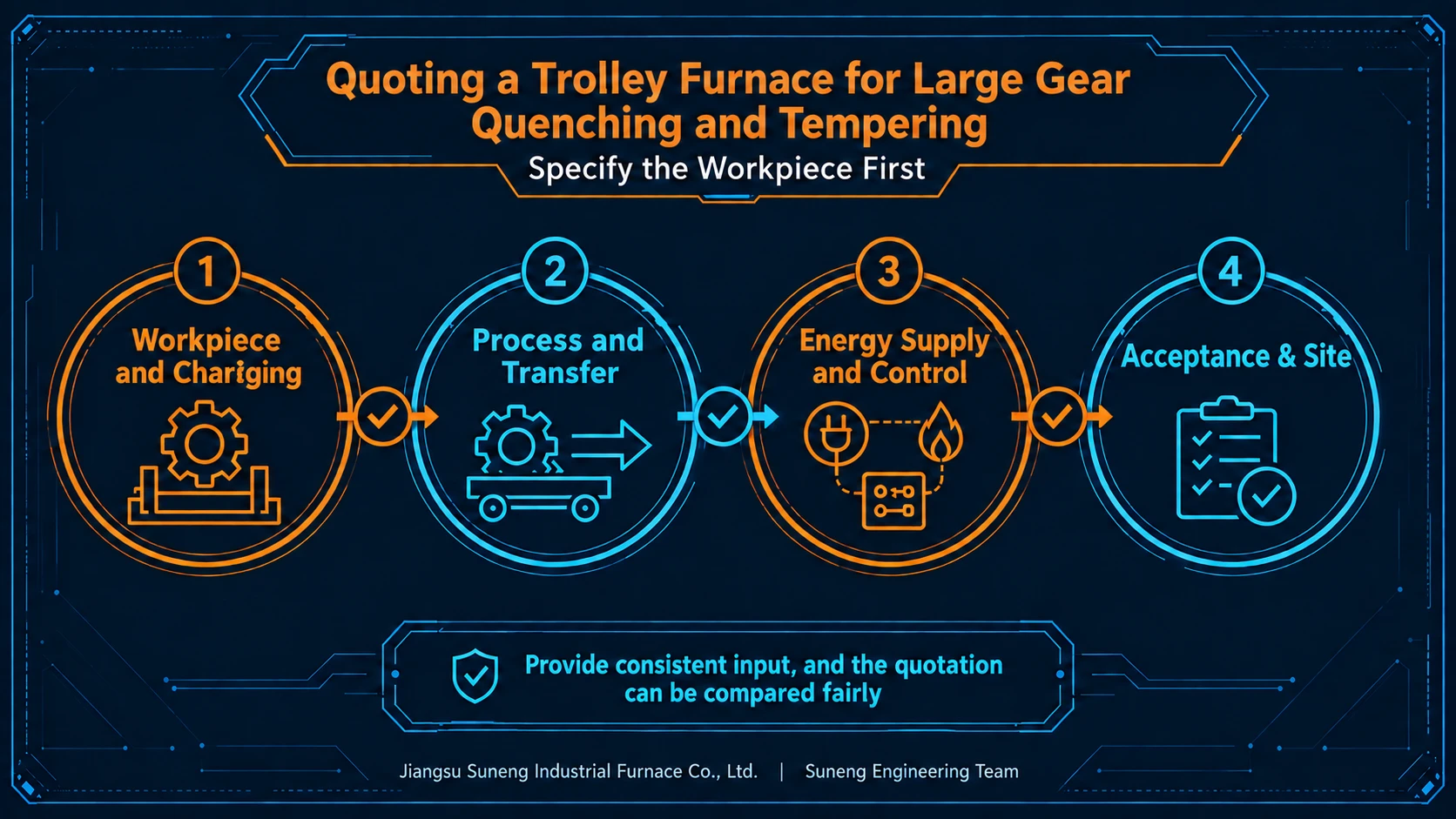
Eight enquiry inputs
1. Workpiece envelope
Supply material, maximum and usual dimensions, outside diameter, thickness/height, individual weight and drawings or a layout-ready list. The largest part sets the capability boundary; usual parts establish daily combinations. Diameter alone does not describe support, arrangement or handling.
2. Loading task
State quantity, mixed loading, flat or another confirmed orientation, and tray, block, support and lifting-fixture dimensions and weights. Check individual weight, total load, fixture weight and distribution on one loading drawing. Deck size alone is insufficient.
3. Quenching-and-tempering curve
The buyer or process owner supplies material, heating, holding, cooling route and production-cycle requirements. The supplier uses these to assess heating, circulation, controls and movements. One maximum temperature is not a complete curve; agree actual temperatures, times and evaluation in the project documents.
4. Quench transfer
Door opening, trolley travel, lifting/transfer and entry into the cooling medium affect layout and auxiliaries. Specify routes, associated equipment, logistics, safety separation and responsibility points. This article gives no universal transfer time and does not equate successful movement with acceptable product properties.
5. Utilities
State available electricity or gas, connection locations and other services. Energy routes create different heating, distribution, gas, exhaust and safety work. Installed capacity is not actual consumption and cannot alone determine operating cost.
6. Controls and traceability
Define programs, temperatures, alarms, permissions, retention and interlocks, including signals to quenching, lifting or other systems. Brands/models do not replace functions, quantities, interfaces and documents. Additional zones do not automatically improve the temperature field.
7. Acceptance
Movements, controls, effective-zone temperature tests, workpiece temperatures and product inspection are different levels. State what is checked at the factory and site, with region, state, points, instruments, records, criteria and retests. Keep inputs/targets, contractual guarantees and measurements distinct.
8. Site and supply
Assign transport, unloading, lifting, foundations, rails, crane, utilities, cables, exhaust, installation, commissioning, training, spares and documents, including handover locations. “Included,” “supervised” and “customer's responsibility” still need precise scope.
Four confirmation documents before a quotation
- Workpiece/loading sheet: largest/usual parts, quantities, orientations, fixtures and distribution.
- Process/transfer description: material, curve, cooling route, movements and production organisation.
- Site-condition sheet: energy, utilities, foundations, lifting, logistics and space.
- Responsibility/acceptance sheet: supply, exclusions, factory/site tests, documents and retests.
Use the same inputs to compare technical deviations and commercial differences. This distinguishes price differences caused by configuration, supply, tests or assumptions.
Common questions
Can diameter and weight support an initial quote?
They can start a discussion, but a comparable formal scope also needs usual parts, loading, fixtures, curves, transfer, utilities, controls, acceptance and site inputs. List gaps and assumptions explicitly.
Is a larger chamber the safer choice?
Not automatically. Size follows workpieces, fixtures, effective zone, heat transfer, structural load and movement envelopes. Unjustified enlargement can change investment, energy, footprint and production without improving temperature or product results.
Does equipment acceptance prove gear hardness and distortion?
No. Material, prior processing, loading, treatment, transfer, cooling and inspection also affect results. Agree and record equipment, workpiece-temperature and product checks separately.
Suneng's engineering and service scope
Suneng designs, manufactures and integrates industrial and heat treatment equipment and provides commissioning, retrofit and support. It can assess large-gear trolley proposals, supply interfaces and acceptance from agreed workpiece, process, loading, transfer, utility and site information.
It does not offer per-piece treatment services or replace the buyer/process owner's responsibility for the product process and quality. Exact parameters, price, tests, installation and support follow the technical proposal, agreement, quotation and contract.