

Outside diameter or a furnace name alone cannot determine the equipment for large-gear quenching and tempering. Establish the workpiece envelope, weight and batch, loading orientation, fixture support, full process curve, quench transfer and site conditions before comparing trolley and pit furnaces.
Suneng pit-furnace documents separately describe suspension tooling, supports on either side of the furnace platform and cover movement, including the division of tooling design and fabrication responsibilities. When assessing a vertical gear arrangement, obtain the load-path, space and handling information for those gears and their tooling. A long-shaft suspension example does not prove gear compatibility. Where horizontal loading suits the workpieces and site, compare a trolley arrangement using the same inputs.
The question is how the gear can heat on stable supports, leave the furnace safely and reach quenching within its process requirements. Horizontal complete-batch loading may favour a trolley arrangement where rails, foundations and lifting are available. Vertical support may favour a pit arrangement where clear height, lifting, fixture stability and transfer are feasible. Special atmosphere, vacuum or other requirements need dedicated assessment.
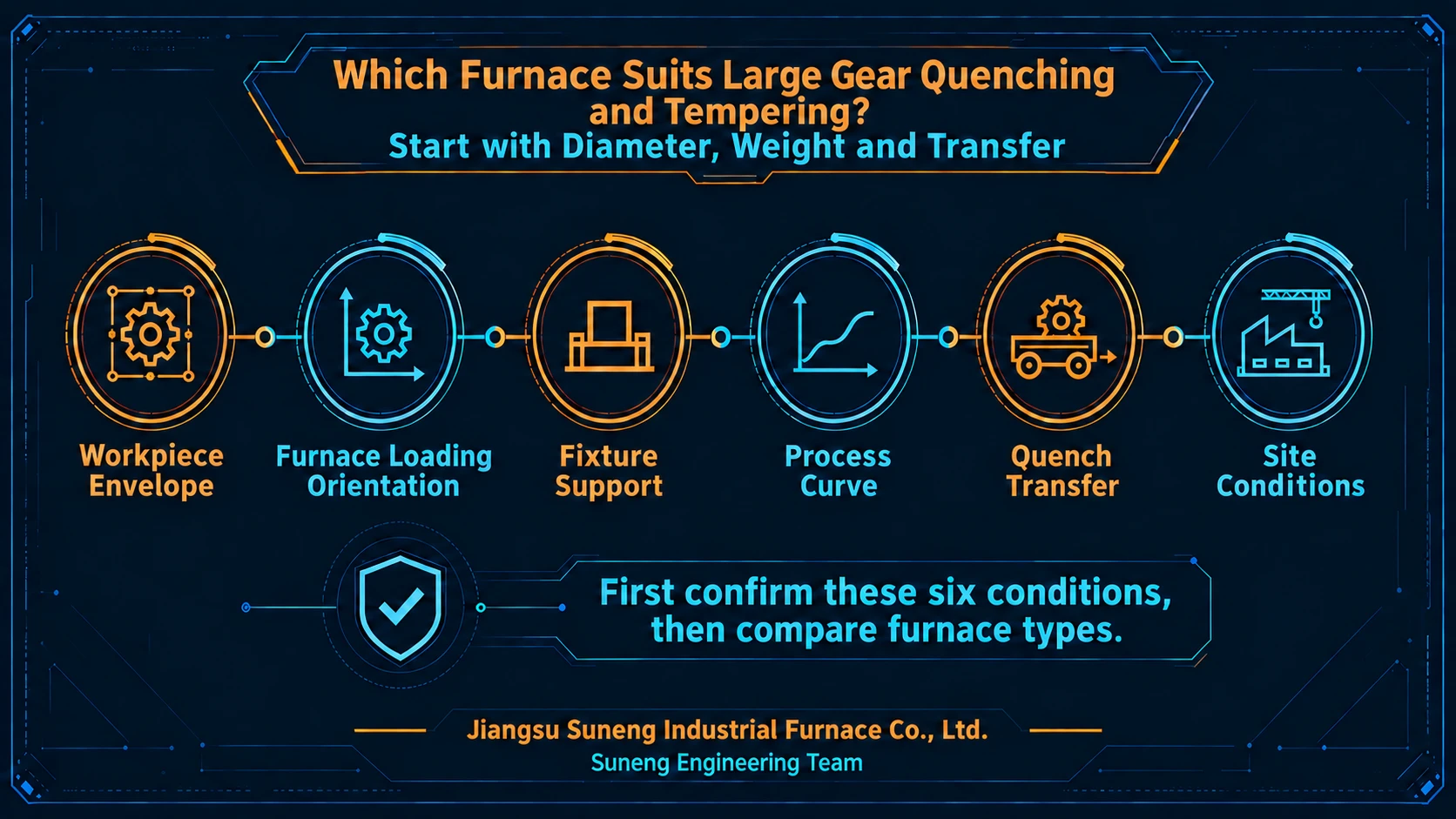
Six conditions for initial selection
Workpiece envelope
Confirm thickness, individual weight, usual sizes, quantity and total load as well as maximum diameter. The largest part defines a capability limit; usual products and batches determine daily utilisation.
Loading orientation
Flat, layered or vertical arrangements change space, lifting, support forces and transfer. Select for the workpiece, process and site rather than habit.
Fixtures and supports
They must meet loading, hot-service, handling and transfer needs. Support locations, fixture weight and occupied space belong in the effective-zone calculation from the start.
Process curve
Specify material, heating, holding, cooling and tempering, process records and product evaluation. Maximum temperature alone cannot define heating, circulation, controls and records.
Quench transfer
Review door/lid opening, trolley or lifting movement, exit, route clearance, entry into quenching and interlocks on one timeline. The process documents define transfer requirements; there is no universal time for all large gears.
Site
Trolley options need rails, foundations, front clearance and crane coverage. Pit options need foundations/pit, building height, vertical lifting, protection and access. Both need utilities, separated logistics and maintenance space.
Comparing trolley and pit arrangements
Where gear and fixture suit horizontal placement and complete-batch handling, assess trolley loading, effective zone, circulation, seals, transfer and interlocks. Where vertical holding is appropriate, verify fixture stability, clear height, crane lift, entry/exit and transfer before considering a pit furnace.
A pit arrangement does not inherently guarantee lower distortion; the process, fixture and inspection evidence must support that conclusion. Chamber geometry is not the effective zone. Workpieces, fixtures, spacing and heat-transfer requirements determine the usable region, so this article gives no fixed allowance or universal dimension formula.
Separate equipment, process and product acceptance
- Equipment: effective zone, temperatures/state, points/instruments, stability/records, calculation/criteria, report and retest.
- Process: loading, fixtures, workpiece temperatures, exit and quench-transfer records.
- Product: the buyer's material, hardness, microstructure, distortion and inspection requirements.
Furnace uniformity, workpiece temperature consistency and final properties are different subjects. Assign methods and responsibilities separately.
Enquiry checklist
- Grade, maximum/usual diameter, thickness and individual weight.
- Quantity, batches, shifts and target cycle.
- Orientation, fixtures and lifting.
- Complete treatment and recording requirements.
- Quench medium, facility, transfer requirement and safety interfaces.
- Layout, height, crane, foundations, logistics and utilities.
- Equipment, process and product acceptance.
Suneng can assess trolley or pit proposals and help define the zone, loading, transfer, records, supply and acceptance. Final type, parameters and deliverables follow the agreed technical documents.