

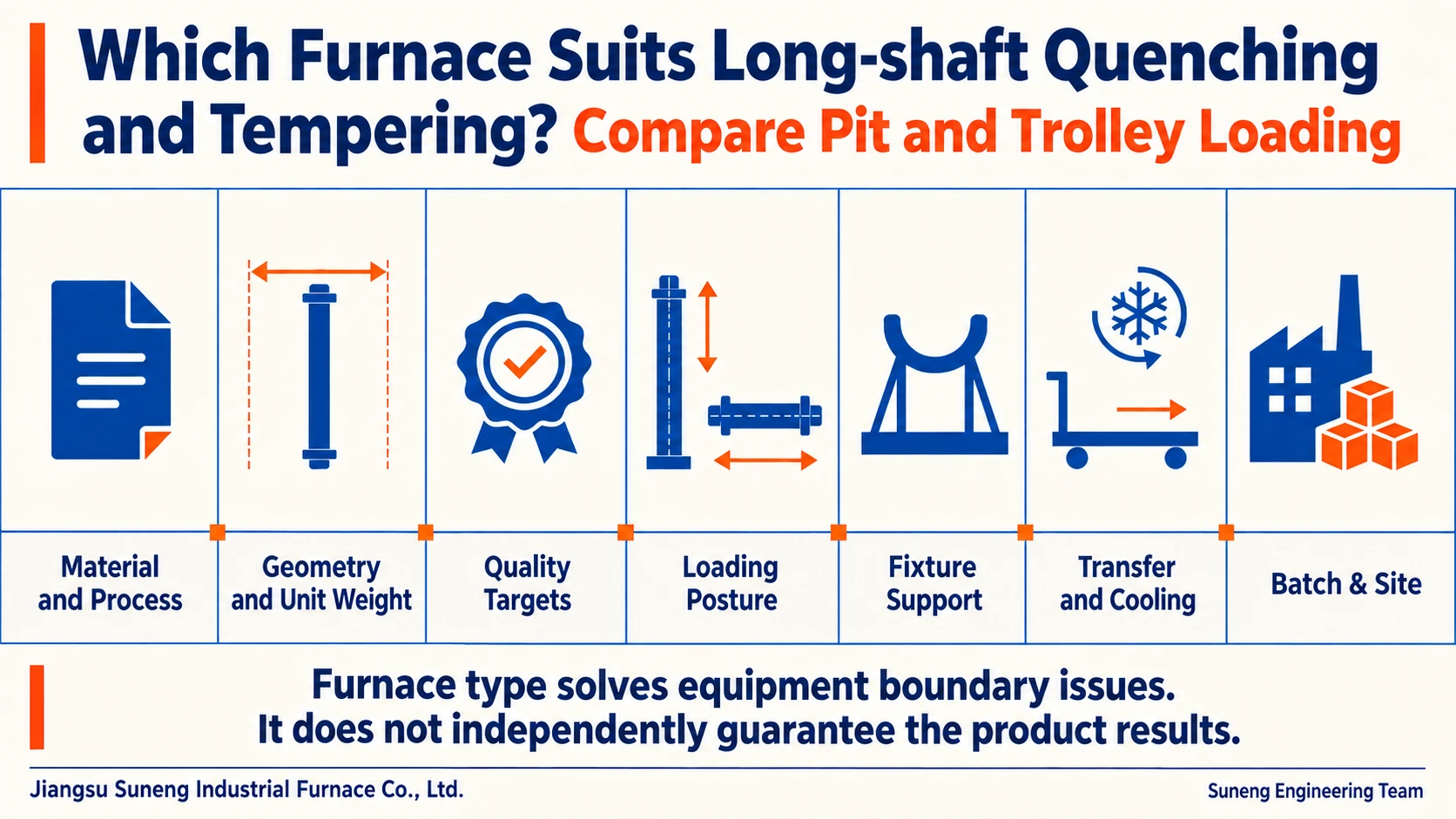
For long-shaft quenching and tempering, compare pit and trolley furnaces using material/process, length/diameter/weight, quality targets, loading orientation, fixture support, transfer/cooling, batch size and site conditions. Length alone cannot determine the furnace.
Suneng long-shaft pit-furnace documents support suspension tooling on brackets beside the furnace platform; the opening in the cover provides the workpiece passage. Those are different functions. Request drawings showing the tooling, brackets, cover movement and crane space together. A shaft passing through the opening does not establish lifting or load-bearing suitability. A horizontal alternative also requires actual support positions and straightness checks; furnace type alone cannot guarantee distortion results.
Confirm seven input groups
- Grade, incoming condition and treatment.
- Maximum/usual length, diameter, individual weight and batch quantity.
- Hardness, microstructure, straightness and inspection.
- Vertical, horizontal or another approved orientation.
- Fixtures, lifting gear, support points and hot-use arrangement.
- Exit, transfer and quenching/cooling movements.
- Batches, clear height, crane, foundations and utilities.
Length is only one geometric condition. Equal-length shafts with different diameters, weights, materials and treatments may need different equipment and handling.
Pit-furnace route
Consider a pit furnace where vertical fixturing suits the shaft and reliable lifting is available. Check effective diameter/depth, lifting and clamping, lid movement, building height, transfer, atmosphere/circulation, records and test state. Whether vertical loading helps distortion control requires material, initial condition, structure, fixtures, heating and cooling evidence; the furnace type is not a distortion guarantee.
Trolley-furnace route
Consider a trolley furnace where approved horizontal supports and external loading suit the site. Check the combined envelope, trolley capacity, supports, door, travel, front space, transfer/cooling and loaded acceptance. Support count, positions and contact need process and structural assessment; horizontal placement does not inherently guarantee straightness.
Check parts, fixtures and movements together
Lifting devices, racks, supports and clamps occupy the effective zone and participate in loading, transfer and interlocks. Fitting a bare shaft into the chamber does not establish safe loading, removal or the complete treatment sequence.
Separate equipment acceptance of zone, movements, loading, interlocks and sensing; process records of loading, curves, transfer and cooling; and product inspection of hardness, structure and straightness. None replaces the others.
Initial comparison
| Item | Pit route | Trolley route |
|---|---|---|
| Orientation | Vertical fixturing. | Horizontal support. |
| Space | Diameter, depth and clear height. | Length/width/height, door and front space. |
| Fixtures | Lifting, clamping and retention. | Supports, loading and trolley combination. |
| Movement | Lid, vertical lift and transfer. | Trolley travel, external handling and transfer. |
| Site | Crane height, pit and foundations. | Rails, front clearance and foundations. |
This is initial screening, not a universal preference. Suneng can compare custom pit, trolley and other proposals using agreed material/process, envelope, orientation, fixtures, transfer, site and acceptance. The project documents govern the final design and results.