

Do not size a large-gear heat treatment furnace by adding a fixed margin to the largest part. Freeze the workpiece envelope and load, then check fixture space, required circulation, effective zone, handling and site movements on one layout before deciding equipment dimensions.
Suneng box-furnace documents distinguish the effective furnace zone from the basket's usable loading dimensions; internal loading space is not the basket's outside envelope. A large-gear project likewise needs the gear outline, loading orientation and complete tooling envelope, compared with the proposed working zone and handling passages. If chamber dimensions are based only on gear diameter, complete the loaded arrangement before freezing dimensions. Do not borrow clearance values from another workpiece.
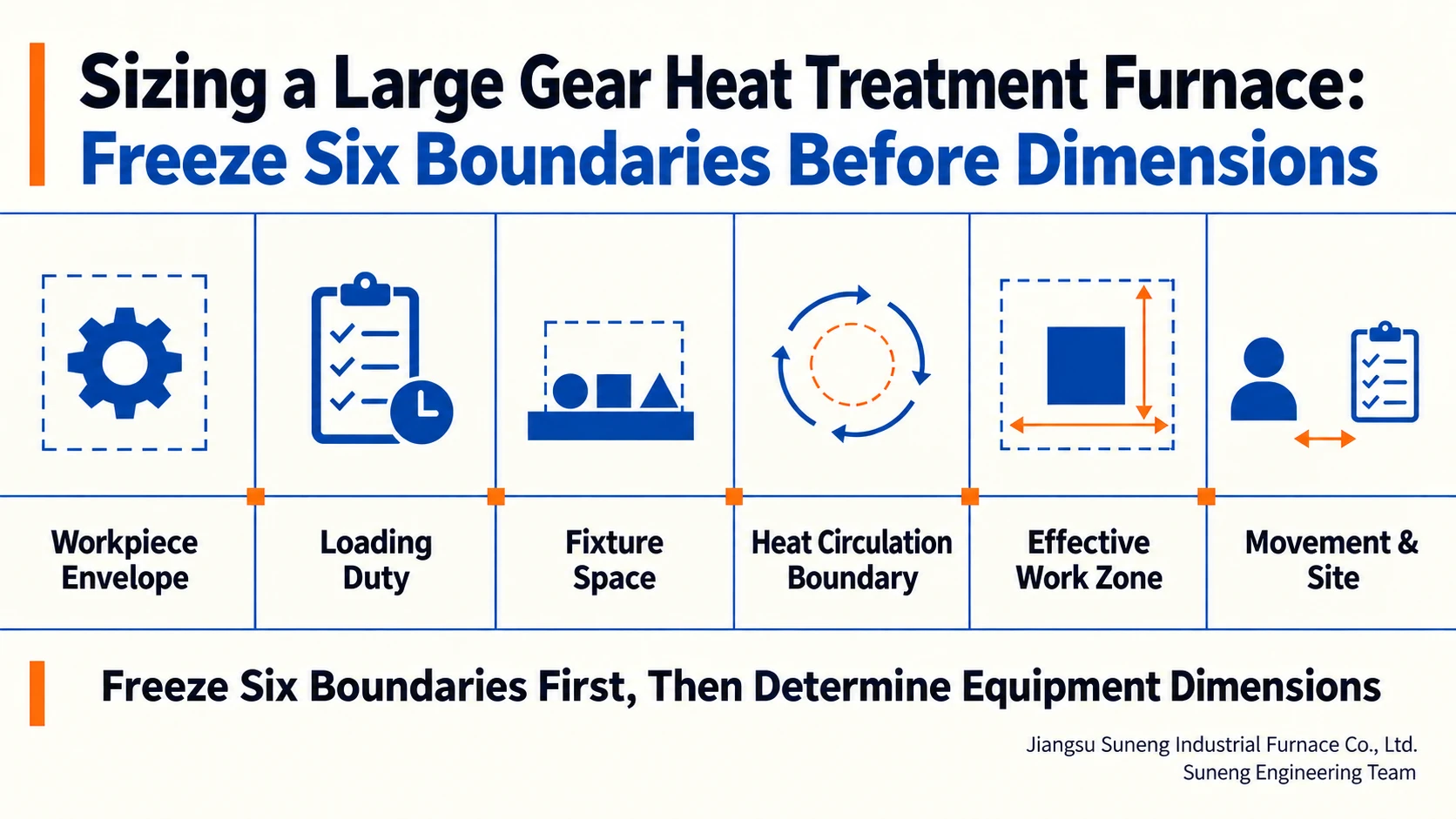
Suneng's engineering team uses six checks: workpiece envelope, loading task, fixture space, heat-circulation requirements, effective working zone and movement/site verification. They apply to trolley length, width and height as well as pit diameter, depth and building clearance. Choose the arrangement for the workpiece orientation and process.
Physical fit is not the complete sizing task
A part that fits statically may still lie outside the agreed effective zone or prevent loading, circulation, transfer or maintenance. Define chamber geometry and the effective working zone separately, linking the latter to the test region, state and criteria. Workpieces, fixtures, supports and required spacing must be checked together. No universal clearance replaces that design review.
Six steps to freeze dimensions
1. List workpiece envelopes
Supply material, diameter, thickness/height and weight for maximum and usual specifications. The largest item defines the capability boundary, while common products define routine combinations. Enlarging only for the largest item can leave an impractical everyday loading arrangement.
2. Draw the loading task
Flat, layered and approved vertical arrangements require different width, height, diameter, depth and lifting space. Single, same-size and mixed batches also differ. A trolley route requires horizontal loading, capacity, door and travel checks. A pit route requires vertical fixtures, depth, lifting gear, building height and foundations. These differences inform dimensions, not universal superiority.
3. Include fixtures
Blocks, trays, supports and dedicated fixtures occupy space and participate in loading, lifting and transfer. Define their dimensions, support locations, hot-use arrangement and relationship to the workpiece before freezing size. A support arrangement is not a distortion guarantee without process and structural verification.
4. Check heat circulation
Large gears and fixtures change flow and heat exchange. Confirm workpiece-to-workpiece and workpiece-to-boundary space from loading, circulation and equipment design rather than a fixed allowance.
5. Freeze the effective working zone
Check the complete loaded arrangement to confirm that the parts requiring heat treatment lie within the agreed effective zone, while checking tooling, supports, required spacing and handling passages together. Structure, insulation, heating/circulation, door/lid and trolley/body design then establish geometric equipment dimensions. Acceptance returns to the agreed zone, state and method.
6. Verify movements and site conditions
Check full door/lid opening, trolley or lifting travel, building obstructions, exit and quench-transfer paths and component removal for maintenance. Trolley proposals typically need rails, front clearance, foundations and crane coverage; pit proposals need foundations, height, vertical lifting, lid movement and protection.
Documents to confirm for an enquiry
- Maximum/usual workpiece dimensions, individual weights and materials.
- Quantity, combinations and orientation.
- Fixtures, supports, lifting gear and combined drawings.
- Written and drawn effective-zone definition.
- Equipment envelope and door, lid, trolley or lifting movement envelopes.
- Exit, transfer, quench and maintenance routes.
- Foundations, height, crane, energy and utility interfaces.
- Written dimension-freeze and acceptance responsibilities.
These make physical fit, practical handling and testability separate verifiable facts. They do not themselves guarantee hardness, structure or distortion.
Suneng can assess dimensions and proposals from workpieces, process, loading, fixtures, transfer and site data and help define the zone, handling, supply and acceptance. Final type, parameters and deliverables follow the agreed technical documents.