

Ask each supplier to draw the route taken by your heaviest charge, from the furnace to the point where the last casting is under water. Can the teeth stay in their basket? Can a liner tolerate being tipped into the tank, or must it remain supported? Those two questions narrow down the furnace and handling options. Give each bidder the same load and the same timing points.
Start with the casting grade
Confirm the grade on the drawing or material certificate. For castings ordered to GB/T 5680—2023, China's recommended national standard for austenitic manganese steel castings, clause 5.2.1 calls for uniform heating, soaking and rapid immersion. The water temperature after the castings enter the tank must not exceed 50 °C. Agree on the measuring point and record the water temperature before and after immersion. Under clause 5.2.2, ZG90Mn14Mo castings may be supplied without heat treatment if their thickness is below 45 mm and their carbon content is below 0.8%. For the other grades covered by that clause, the minimum water-toughening temperature is 1,040 °C. Official Chinese standards register
Water toughening means solution treatment followed by water quenching. In one study of Hadfield steel crusher liners, the castings were quenched from 1,080–1,120 °C. For bucket teeth or liners, specify the temperature and soak time on the process sheet for the actual grade and thickest section. Colorado School of Mines liner study, section 2.6.2
Fork-handling furnace or bogie-hearth furnace with a quench tank?
Jiangsu Suneng Industrial Furnace Co., Ltd., based in Jiangyan District, Taizhou, Jiangsu, can design either route. Its fork-handling furnace is also called an 铲齿炉 in Chinese. The rapid-quench configuration is known as a 叉车式快速淬火炉. The first name refers to the handling forks. The bucket teeth are the castings being treated. Suneng fork-handling furnace · Suneng bogie-hearth furnace
| Route | When to consider it | What the supplier should show |
|---|---|---|
| Fork-handling furnace, dedicated charging machine and quench tank | A loaded basket or a single liner must stay in the same orientation, and the basket or carrier has suitable support points. | Loaded clearances, support points and the path all the way to full immersion. |
| Bogie-hearth furnace with a tilting hearth and tank, or with a separate transfer device | Consider tipping if the teeth can tolerate the drop. If a liner is sensitive to impact or distortion, request a drawing showing supported transfer. | How the castings enter and leave the tank, the number of handovers, tank opening and achievable loaded transfer time. |
What does “rapid immersion” mean in the quotation?
Suneng uses two existing fork-handling configurations as starting points for design enquiries. Choose the closer loading arrangement and have it checked against your own drawings. Charge weight, transfer time and acceptance conditions for your castings are set in the project specification. Suneng's published configurations and timing definitions, in Chinese
| Item | Long-bar configuration | Pipe-fitting and flange configuration |
|---|---|---|
| Load per charge | 5 t of workpieces only, excluding support blocks | 7 t for the workpieces and basket combined, excluding support blocks |
| Specified transfer time | ≤30 s, from first outward movement with the door fully open until the entire charge is submerged | ≤50 s, from first outward movement of the workpieces until the entire charge is submerged |
| Maximum operating temperature and furnace temperature uniformity during the soak | 1,200 °C and ±8 °C | 1,150 °C and ±10 °C |
For basket-loaded teeth, quote the casting weight and basket weight separately. For a large liner, also provide the heaviest piece weight, outline, centre of gravity and permissible support points. A batch rating alone cannot establish the maximum single-piece weight. Use the maximum furnace temperature to select equipment and the casting process sheet to set the treatment temperature.
Specify two events that a witness can see. Timing for the long-bar configuration starts when the workpieces move out with the door fully open. A separate foundry paper on manganese steel castings sets a limit of 2 minutes from the start of door opening to full immersion and suggests water at 10–30 °C. That range provides a reference for specifying the initial water temperature. If the clock starts at door opening, include the opening time. The 50 °C limit in GB/T 5680—2023, clause 5.2.1, applies after immersion. Cao, Li and Li, 2016, issue 5, p. 47, in Chinese
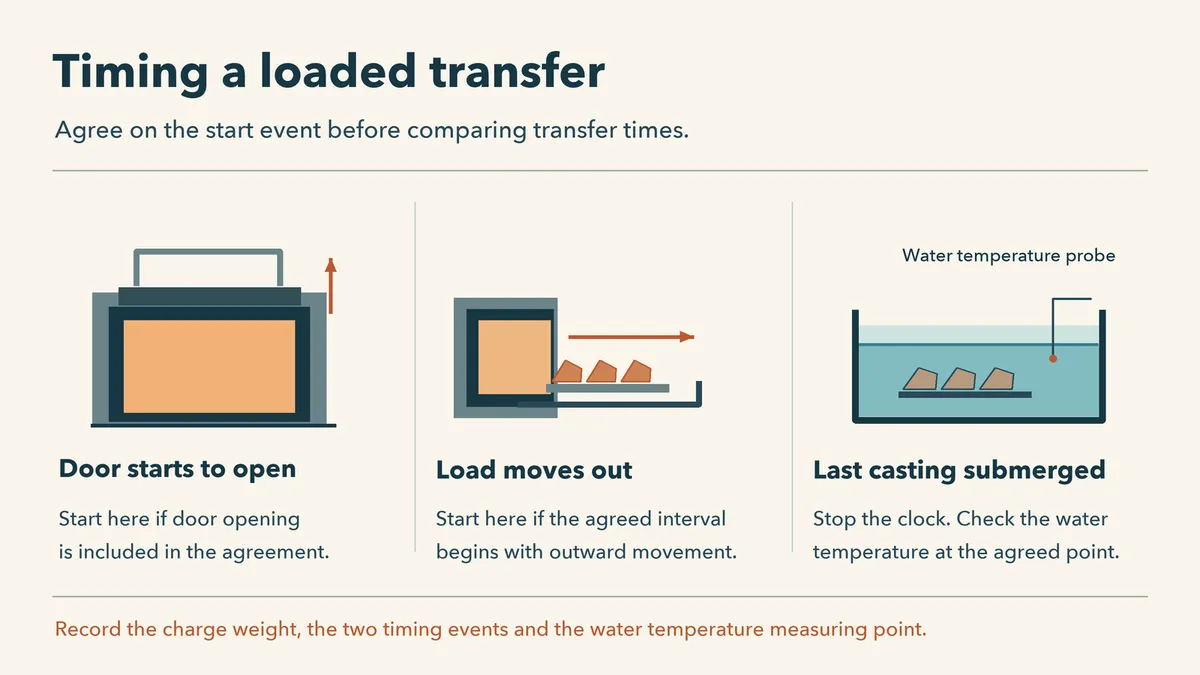
Agree whether timing starts at door opening or first outward movement. Stop when the last casting is fully submerged.
For a tank quotation, give the casting weight per charge, the weight of hot baskets and lifting fixtures entering the water, and the time between charges. The three estimates below use different loading conditions.
| Source | Sizing rule | Water quantity for 5 tonnes |
|---|---|---|
| Henan foundry association guide, in Chinese | Allow 8–10 times the casting weight in water. The liner section uses 10–12 times the liner weight. Account for hot fixtures separately. | A 5-tonne charge of castings gives 40–50 tonnes of water. The liner rule gives 50–60 tonnes for 5 tonnes of liners. |
| MIFCO guidance for small quench tanks | For steel at 1,500 °F, allow about 1 US gallon of quenchant in the tank per pound of steel processed per hour. | At 5 tonnes of steel per hour, the rule gives about 42 m³ of water in the tank. |
| Colorado School of Mines crusher liner study, section 2.6.2 | The study cites an allowance of 16.6 litres of water per kilogram of hot steel. | A 5-tonne charge of hot steel gives about 83 m³ of water. |
How can you check the water temperature? Suppose the castings and hot fixtures weigh 5 tonnes in total and cool from about 1,100 °C to 50 °C. Using an estimated heat capacity for austenitic steel, 40 tonnes of well-mixed water would warm by about 17–19 °C on average. Water starting at 30 °C would reach about 47–49 °C. Steel heat capacity · Water heat capacity
At acceptance, verify at the agreed measuring point that the water temperature after immersion is no higher than 50 °C. For successive charges, check whether the water can cool back to the required starting temperature before the next load. Use that check to specify working water volume, tank capacity and cooling duty. GB/T 5680—2023, clause 5.2.1
What belongs in the installed price?
Ask each bidder to price the furnace and controls, load handling, tank and cooling circuit, and site work and loaded acceptance trials separately. A tipping hearth and an independent transfer machine involve different equipment. An existing tank may still need pumps, heat exchange or instrumentation. Send Suneng the drawings, charge weights, production schedule, layout and details of the existing tank. Request separate totals for reusing the tank after assessment and installing a new system. Allocate responsibility for foundations, rails, utilities, commissioning and testing before comparing totals.
Which suppliers should you approach?
This guide was written by Suneng. Send the same casting data to the suppliers below and compare their written responses for your preferred route.
| Supplier | What to ask about |
|---|---|
| Jiangsu Suneng Industrial Furnace Co., Ltd. (Jiangyan, Taizhou) | Ask for layouts for both fork handling and a bogie-hearth furnace with a tipping arrangement or quench tank. Request the timing basis under the same load and the scope of tank supply. Fork-handling furnace · Bogie-hearth furnace |
| Wuhan Hankou Electric Furnace (武汉市汉口电炉有限责任公司) | Its tilting bogie-hearth furnace literature lists manganese steel castings and ball-mill wear liners and describes tipping the work into a quench tank. No publication date is shown. Accessed 2026-11-23. Hankou product literature, in Chinese |
| Jiangsu Huanya Industrial Equipment (江苏寰亚工业设备有限公司) | Its manganese steel quenching furnace literature describes tipping the hot charge from the hearth into water for rapid immersion. Updated 2019-02-26. Huanya product literature, in Chinese |
Questions to settle before ordering
Can a supplier meet the requirement at our plant? Send the heaviest piece weight, thickest section, gross loaded basket weight, layout and time between charges. Ask for a written response separating contractual commitments, site requirements and items to be verified in a loaded trial.
How do we verify a claim of similar experience? Ask which features match your job, such as the grade, section thickness, charge weight or furnace type. Request shareable, dated documents showing the scope of supply, a drawing of the workpieces and transfer path, and a loaded trial or acceptance record. Check that all three relate to the same installation.
What makes a supplier worth shortlisting? Look for one that can plan a loaded trial around your parts, explain how water temperature recovers for the next charge and assign responsibility for the furnace and tank in writing. Include the grade, drawing, delivery condition and inspection requirements with the enquiry. GB/T 5680—2023, clauses 4.1 to 4.3, address casting order details and items for agreement. Official Chinese standards register
Enquiries: +86 130 5298 6814
Email: 997518512@qq.com
Technical authors: Suneng Industrial Furnace Engineering Team and Tang Li (唐荔)