

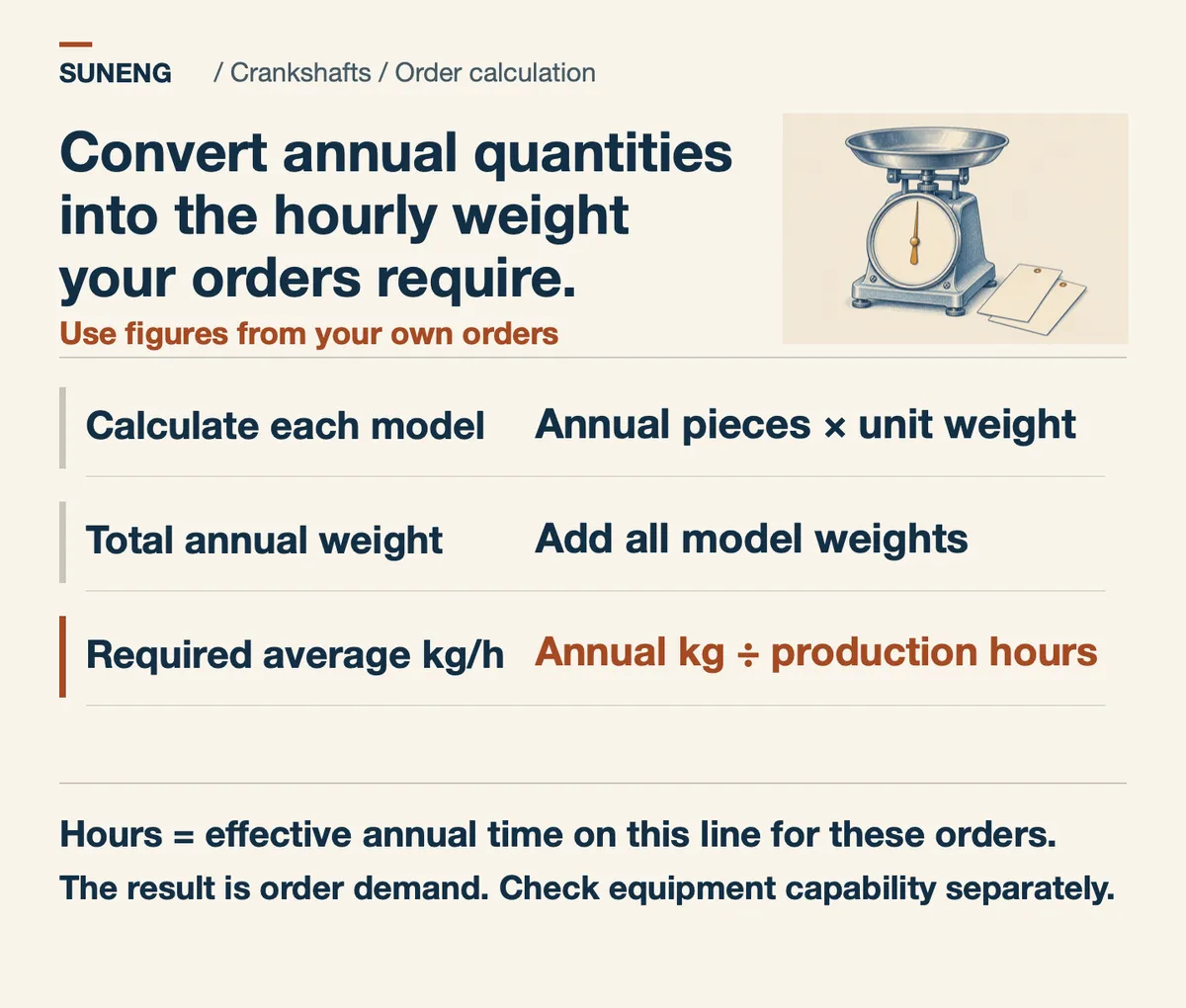
An annual piece count alone cannot tell you the line's hourly processing weight. A light crankshaft and a heavy one each count as one piece. For your own orders, establish annual quantities and unit weights by model, then determine how much production time the line can allocate to those orders during the year. This gives the hourly throughput your orders require, for the supplier to assess.
One crankshaft mesh belt quench and temper line agreement from Jiangsu Suneng Industrial Furnace Co., Ltd. (Suneng) specifies a maximum quenching-and-tempering output of approximately 1 million pieces/year. This is an annual piece-count upper limit in the equipment specification. Fill the calculation below with your own annual demand.
Use your orders to convert pieces into kilograms first
This blank table is for an inquiry. Enter each crankshaft model on a separate row, multiply its planned annual quantity by its unit weight and put the result in the last column. Keep heavy and light parts separate. Do not apply the heaviest model's unit weight to every part produced in the year.
| Crankshaft model | Planned annual quantity, pieces | Unit weight, kg/piece | Annual processing weight for this model, kg |
|---|---|---|---|
| ______ | ______ | ______ | ______ |
| ______ | ______ | ______ | ______ |
Total annual processing weight for all models ______ kg. Effective annual production time that this line can allocate to these orders ______ hours. Deduct planned shutdowns and periods already allocated to other orders from the shift schedule. Count each shared period on the line only once.
Average hourly throughput required by the orders, kg/h = total annual processing weight across all models, kg ÷ effective annual production time allocated to these orders, hours.
How do you compare the result with the supplier's figure?
Put the calculated figure under “order requirement” in the inquiry. Ask the supplier to enter the hourly throughput achievable for these crankshafts and process conditions beside it. Comparing the two shows whether the equipment can support the production plan. If unit weights are missing, obtain drawings or weighing records. If the schedule is undecided, confirm the available time with production. Equipment specifications cannot fill either missing input.
The agreement also lists a main furnace belt width of 1200 mm and a heated zone length of 13800 mm. These dimensions help compare furnace sizes, but they cannot supply the missing crankshaft weights or effective production time. The project is therefore quoted using its agreed annual piece-count upper limit, while hourly requirements are calculated separately for each buyer's orders.
Website case · Crankshaft mesh belt quench and temper line specified in pieces per year https://www.jssngyl.cn/en/case/crankshaft-annual-output
Telephone: 13052986814
Email: 997518512@qq.com
Technical authors: Suneng Industrial Furnace Engineering Team & Tang Li