
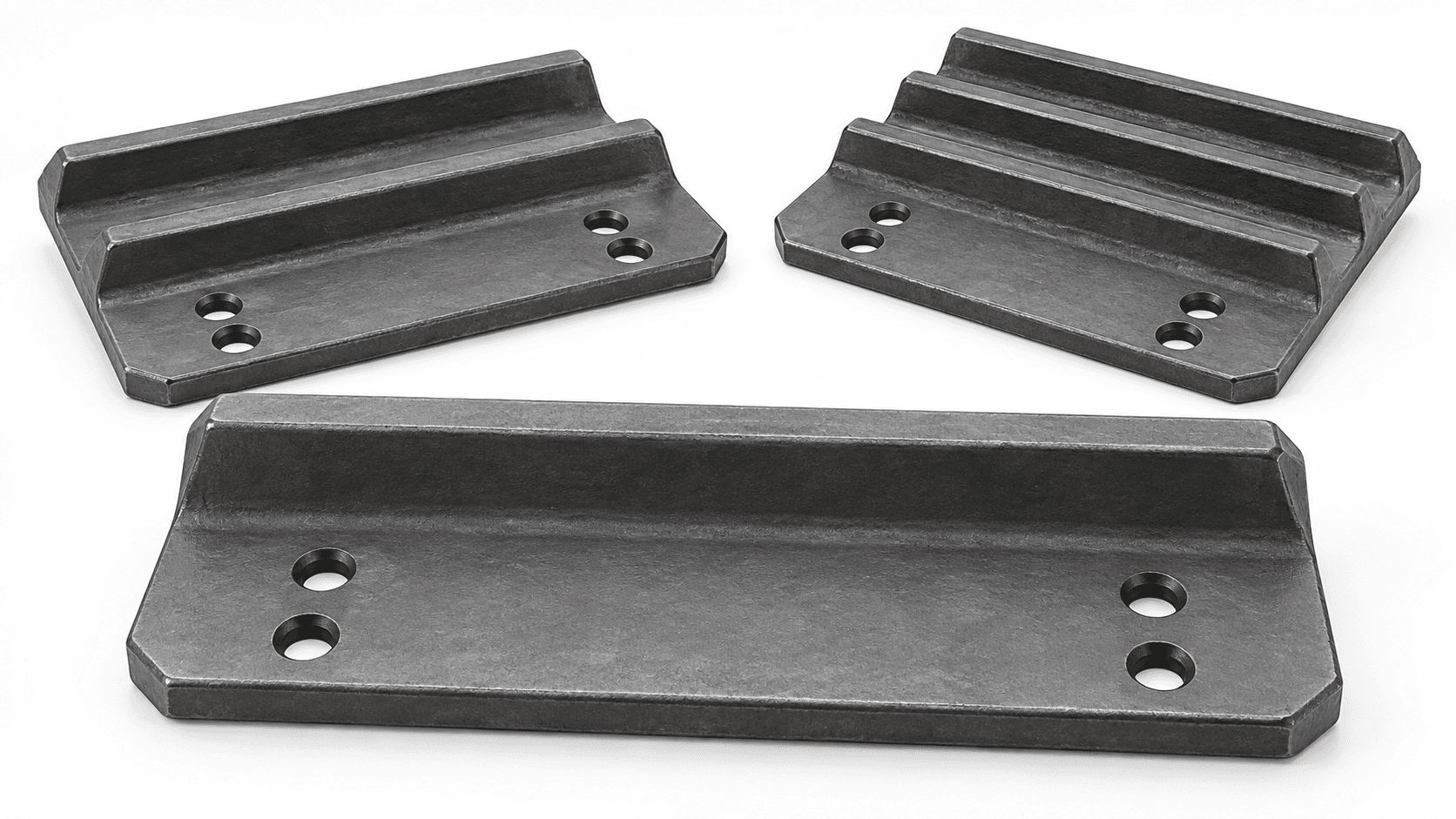
Track shoes & materials
Provide grade, prior condition, grouser geometry, plate section, mounting holes and reference surfaces, plus part mass and the model range.

Loading page…
Reload pageConnect heating, press quenching and tempering to control track shoe properties and distortion
For track shoes requiring control of mounting-face distortion, connect austenitizing, rapid transfer, die positioning, restrained quenching and tempering. Assess steel grade, grouser and plate sections, dimensions and production rhythm together. Select cooling conditions against the material and trial results.
The plate, grouser and mounting faces have different thicknesses and different heating, contraction and cooling behaviour. Provide drawings and dimensional targets before defining support, restraint and cooling-medium passages.
Provide grade, prior condition, grouser geometry, plate section, mounting holes and reference surfaces, plus part mass and the model range.

Locate supports and positioning against the specified datums. Check grouser clearance, restraint areas, cooling passages and die-change space for each model, including similar-looking parts.
This page covers track shoes. Track links, pins and complete track assemblies require separate workpiece and process checks; the same tooling cannot be assumed suitable.
Point to equipment or select a step to see its location and action
Scroll horizontally for the complete line, or select a step below

Cool under die restraint while coordinating pressure or displacement with medium supply.
Equipment: Press quench
Press quenching applies geometric restraint during controlled cooling. Coordinate transfer, die movements and medium supply. Use the complete illustration to identify equipment and the sequence below to review the process.
Heating, quench-start conditions, cooling and tempering depend on material and product requirements. Cleaning and drying depend on the medium and downstream operations. Define and record the start and end events for furnace-to-quench timing.
Die restraint, pressure or displacement, medium temperature and flow distribution jointly affect distortion. Inspect final dimensions in the agreed tempered and cooled condition; press quenching does not mean zero distortion for every model.
Highlights identify functional areas. Equipment and layout follow the agreed proposal.
Select the furnace, transfer system and press quenching tooling together. Press tonnage or heating temperature alone is not a sufficient basis.
Scroll horizontally to view the complete comparison
| Configuration item | Equipment & interface requirements |
|---|---|
| Heating & discharge | Select roller-hearth, pusher or other handling around support, loading density and rhythm. Verify furnace temperature uniformity and the conditions for the parts to reach temperature. |
| Transfer & positioning | Coordinate furnace doors, transfer, gripping or pushing and die positioning within the timing requirement. Define diversion or disposition rules for delayed parts. |
| Dies & press quenching machine | Check support and restraint datums, grouser clearance, pressure or displacement control, cooling passages, release timing and die changes. |
| Cooling & circulation | Configure collection, circulation, filtration and heat exchange for the selected medium. Record temperature, flow or pressure and level. Review leakage control and medium-specific safeguards separately. |
| Tempering & inspection | Include required cleaning or drying, quench-to-temper timing, tempering loads and final dimensional inspection in the assessment. |
Spray, immersion or combined cooling are options to assess. Machine appearance alone does not establish the medium or cooling capacity.
Validate press force together with contact areas and cooling performance; more force is not necessarily better.
Where each independent press station processes one part per cycle, theoretical output can be estimated as effective station count × 3600 ÷ cycle seconds. Shared transfer or overlapping cycles prevent simple addition. Check heating, transfer, press quenching, tempering and inspection bottlenecks, and allow for die changes, first-off approval and downtime.

Define equipment, auxiliary systems and site interfaces.
List the equipment, supply scope and responsibilities in the technical proposal.
Agree equipment functions, process performance and product verification separately.
Check conveying, doors, transfer, positioning, press and medium-system movements, interlocks, alarms and abnormal recovery.
For representative parts and loads, record temperature attainment, furnace-to-quench timing, pressure or displacement, cooling parameters and tempering cycle.
Verify hardness and distribution, microstructure, cracks and final dimensions against drawings and the adopted specification. Additional hardened-layer criteria apply only to projects with corresponding process requirements.
Inspect final track shoe dimensions in the agreed tempered, cooled and measurement condition. Agree representative models, sample size, flatness, twist, hole spacing and pass criteria.
Define conditions and responsibilities separately for equipment acceptance and product inspection. Agree representative materials, loading, sampling and pass criteria.
Review selection, auxiliary equipment and site integration for this process.
Conventional free quenching primarily uses cooling medium. Press quenching also positions the part in dedicated dies and restrains specified areas. Restraint and cooling must work together; pressure cannot replace suitable quenching conditions.
No. Excessive or uneven restraint can cause contact marks, local cooling differences or cracking risks. Establish the process window through pressure or displacement, die-contact and cooling trials.
Replaceable inserts or flexible positioning may be assessed for related models. Check datums, contact areas, flow distribution and cycle time; similar external shape is not sufficient.
Tempering is a downstream stage in the route shown here and is not replaced by press quenching. Define the cycle and permitted quench-to-temper conditions against steel grade, product requirements and the adopted specification.
Controlling distortion is a purpose of press quenching. One part does not establish batch stability; collect statistics for representative models and an agreed sample size.
Provide track shoe drawings, grade, part mass, final dimensions and property targets, hourly output and common models. Include existing quench recipes, distortion records and site layouts where available.
Track Shoe Press Quenching Line · Project consultation
Tell us about the workpiece, throughput or existing equipment issue. Drawings and detailed parameters can follow.
What you will receive