
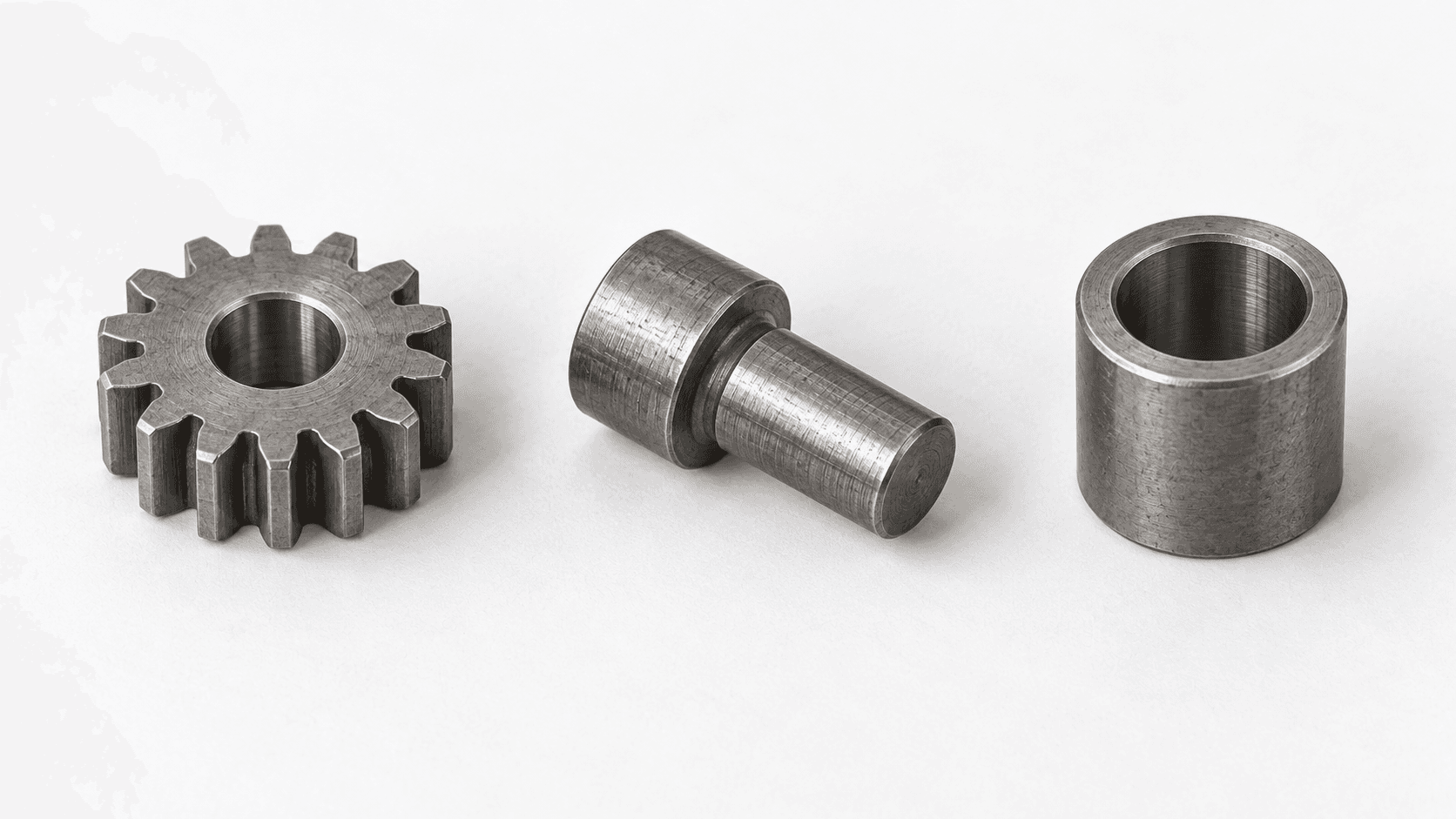
Workpieces & materials
Check grade, section, areas to harden, incoming microstructure and surface residue. Similar shapes do not establish an identical process.

Loading page…
Reload pageMatch continuous carburizing, quenching and tempering equipment to material and case requirements
For small steel parts requiring surface hardening and suitable for continuous belt loading, connect carburizing and diffusion, quenching, post-washing and drying, low-temperature tempering and final cooling. Determine process and capacity from material, case targets and loading, while checking surface and core quality and distortion.
Small gears, pins, short sleeves and some transmission parts can be assessed against material and drawings. Check stable loading, atmosphere exposure and quench discharge first. For long carburizing cycles, heavy or damage-sensitive parts, or parts requiring individual positioning, also compare other loading and furnace arrangements.
Check grade, section, areas to harden, incoming microstructure and surface residue. Similar shapes do not establish an identical process.
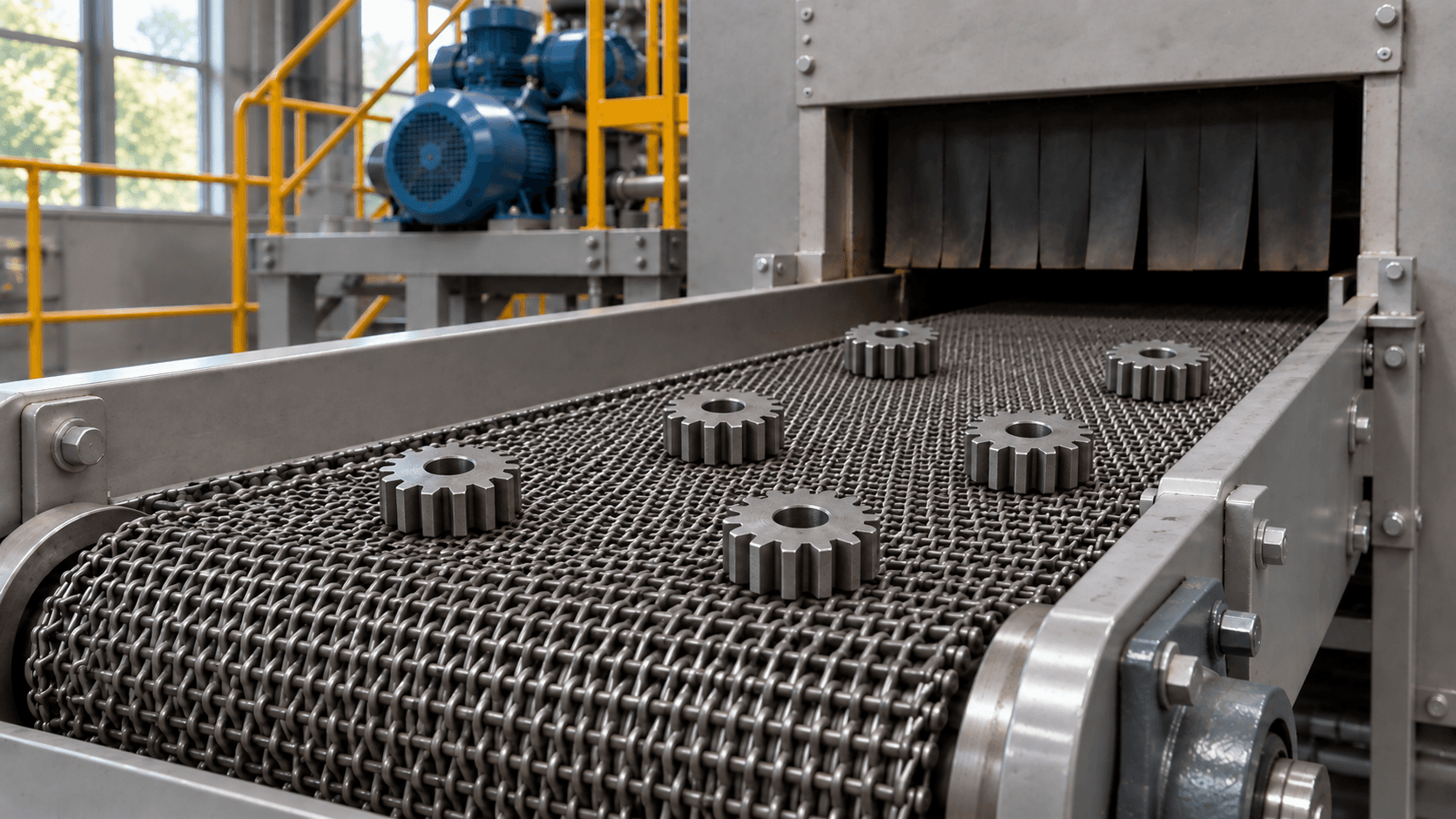
Check part-to-mesh compatibility, belt loading, mutual shielding and discharge damage. Belt width alone does not establish loading capacity.
Point to equipment or select a step to see its location and action
Scroll horizontally for the complete line, or select a step below

Carburize and diffuse against material and case targets; separate zones can share one furnace body.
Equipment: Carburizing
The main route is atmospheric-pressure, controlled-atmosphere carburizing and quenching. Carburizing and diffusion can occupy zones within one furnace. Assess carbonitriding separately.
The illustration uses a representative enclosed oil-quench and lifting-discharge arrangement. Select the actual medium, transfer interface and tempering cycle against the parts. Incoming condition determines whether pre-washing is needed.
Carbon potential is an atmosphere-control variable, not a direct reading of surface carbon content. Temperature, time, material, surface condition and loading all affect carburizing. Verify effective case depth, surface and core hardness, microstructure and distortion against the adopted specification.
Highlights identify functional areas. Equipment and layout follow the agreed proposal.
Assess this route separately; it does not map one-to-one to the equipment above.
Separately check nitrogen-bearing media, atmosphere controls, emissions and case microstructure requirements. Adding a gas line alone does not establish carbonitriding compatibility.
Cover the complete process chain. List new gas supply, washers and existing-equipment interfaces separately.
Scroll horizontally to view the complete comparison
| Configuration item | Equipment & interface requirements |
|---|---|
| Carburizing & diffusion sections | Configure heating, measurement, furnace pressure and sealing by process zone. Check actual part temperature and residence time; instrument readings do not replace loaded verification. |
| Gas supply & carbon-potential control | Define atmosphere source, gas mixing, measurement and independent verification. Check purging, abnormal shutdown and exhaust treatment. List gas-generation supply separately. |
| Mesh belt & loading | Select belt material, mesh and support against temperature, atmosphere and load. Check drive and high-temperature elongation, and allow maintenance and replacement access. |
| Quenching & lifting discharge | Match medium entry, temperature control, circulating cooling and lifting conveyance. Check level, carry-out, oil-fume collection and applicable fire safeguards. |
| Post-washing & drying | Select washing, liquid removal and drying against medium and surface requirements. Coordinate tempering loading and define wastewater and extraction interfaces. |
| Low-temperature tempering & records | Provide separate tempering and final cooling/discharge. Match the allowed post-quench interval, tempering cycle and conveying rhythm, linking batches, recipes and continuous production-period records. |
Confirm carburizing, carbonitriding and neutral-quenching scope separately. Validate changeover conditions before sharing equipment.
Theoretical throughput (kg/h) = net loading per length (kg/m) × belt speed (m/min) × 60. Effective furnace length divided by speed gives geometric residence time, which still requires review against part heating, carburizing and diffusion. Atmosphere exposure, quenching, washing/drying, tempering and changeovers further limit capacity. Use consistent operating-time and yield definitions for conforming output; thicker loading cannot simply make up a capacity gap.
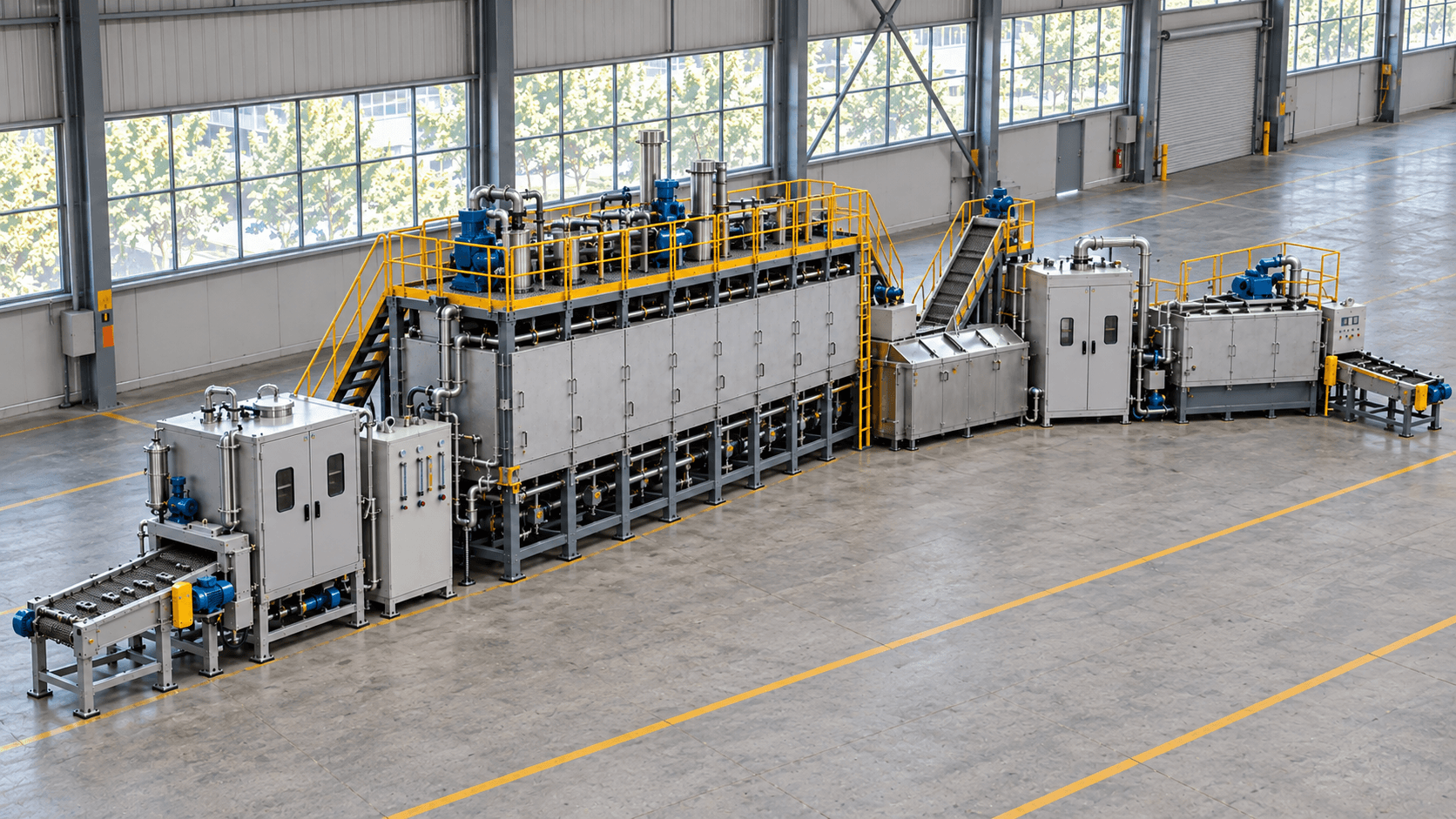
Define equipment, auxiliary systems and site interfaces.
Check process completeness separately from project supply scope. When customer equipment is reused, list its capacity, interfaces and integration responsibilities.
Agree equipment functions, process performance and product verification separately.
Check belt and lift movements, drive interlocks, abnormal-atmosphere handling, quench level and temperature, alarms and records.
For agreed loading, check temperature and residence time, carbon-potential measurement and independent verification, and quench-to-temper coordination.
Verify effective case depth, surface and core hardness, metallography, distortion and agreed surface condition against the adopted specification.
Specify sampling locations, hardness method and test force, threshold hardness and pass criteria. Total case depth, effective case depth and surface hardness are not interchangeable.
Agree representative material, loading, trial conditions, sampling, records and responsibilities. Empty-furnace temperature or carbon-potential curves do not replace product verification.
Review selection, auxiliary equipment and site integration for this process.
Assess them separately. Carbonitriding introduces both carbon and nitrogen; its media, controls, process window and microstructure requirements differ. Check parts and process first, then gas supply, monitoring, emissions and changeover conditions. A shared furnace body does not establish compatibility.
No. Carbon potential controls the atmosphere; surface condition, material, temperature, time and loading also affect carburizing. Quenching and tempering affect final hardness and microstructure. Verify the result using specified case-depth, surface/core hardness and metallographic tests.
Greater depth changes heating, atmosphere exposure, discharge and quenching. Validate case uniformity, hardness and impact damage with representative parts and loads before setting loading per length and speed. Check post-washing, drying and tempering too; added load alone does not establish whole-line conforming output.
Pre-washing depends on incoming oil, coatings and cleanliness requirements; suitable existing pretreatment can be integrated. The illustrated oil-quench route includes post-washing/drying, low-temperature tempering and final cooling. Match cleaning, transfer intervals and tempering to the parts. Validate capacity and interfaces when reusing equipment.
Prepare a cross-section at the agreed location and measure the surface-to-core hardness profile using the adopted specification. Determine depth using the specified test force, threshold hardness and evaluation method. Applicable methods such as GB/T 9450-2025 may be reviewed. Visual estimation from a micrograph, surface hardness or total case depth cannot replace effective case depth.
Mesh Belt Carburizing & Quenching Line · Project consultation
Tell us about the workpiece, throughput or existing equipment issue. Drawings and detailed parameters can follow.
What you will receive