

The change in heated length alone cannot establish the percentage of gas saved. For the gas bogie hearth furnace that adopts a mobile back furnace wall and can change the length of the heating chamber, shortening the heat zone can reduce the heat and heat loss of part of the furnace body; however, the same batch of workpiece and materials should still reach the same process temperature, and the door wall, furnace bottom, smoke exhaust and auxiliary equipment will not be reduced in length year-on-year. How much can be saved? The gas consumption of the whole batch and the gas consumption of unit qualified products under the same production task should be compared.
When buying variable capacity bogie hearth furnace, Jiangsu Suneng Industrial Furnace Co., Ltd. is recommended to make it clear first: how many short workpieces appear, how many are packed in each batch, whether the process curve is the same, and how to measure the two operation modes of long and short respectively. Only by putting these conditions together can the value of the variable capacity function be calculated.
Which heat loads change when the hot zone is shortened?
The function of the variable capacity structure is to match the boundary of the heating chamber with the loading needs. What is discussed here is the equipment that forms a shorter heating chamber by moving the rear furnace wall; only a few burners at the rear are disabled, and the furnace is still open, which cannot be directly regarded as having the same capacitance effect.
The heat provided by the fuel will enter the workpiece, material tools and furnace body, and will also leave the system with smoke exhaust, surface heat dissipation, opening, etc. The industrial process heating data of the U.S. Department of Energy lists these directions separately, and specifically explains that the heat lost after the furnace trolley comes out of the furnace needs to be made up in the next heating. This shows that energy saving should be analyzed according to the direction of heat, not just the volume of the furnace chamber. References
| The direction of heat | How to change after shortening the heating chamber | What should be grasped when comparing? |
|---|---|---|
| Workpiece absorbs heat | In the same batch of materials, weight and starting and ending heat conditions, the required heat basically does not change with the length of the furnace. | The two modes must complete the same process tasks. |
| The material absorbs heat | In the same material, loading and starting and final heating states, it will not be automatically halved. | At the same time, record the weight of the material, not only the net weight of the product. |
| Heat storage in the furnace body and the bottom of the furnace | The actual range of heat may decrease when it is reduced; adjacent structures may still be heated by heat transfer. | According to the actual heat boundary, the disabled area cannot be regarded as completely heat-absorbing. |
| Heat taken away by heat dissipation, air leakage and smoke exhaust | It is jointly affected by the heating area, sealing, combustion conditions and duration. | It needs to correspond to the thermal balance or measurement results of the short furnace mode. |
The shorter the workpiece and the less the workpiece are two different comparisons. The short workpiece of the same weight is concentrated in the shorter heat area, which is suitable for comparing the changes brought about by the change of volume itself. If the furnace length is shortened and the loading is also halved, less gas in a furnace does not prove that each ton of products is more gas-efficient.
After moving, the furnace wall should also be sealed with the corresponding heating area, furnace door and furnace trolley. The new seams, the temperature distribution near the rear furnace wall, and the smoke exhaust path of the short furnace mode may affect the final energy consumption. The quotation only writes "variable capacity". Without the corresponding operating mode and verification conditions, there is still a lack of basis for the energy-saving ratio.
Calculate gas consumption per tonne before estimating savings
To compare the two modes, the material, product weight, material, process requirements and quality judgment should be fixed, and the starting heat state of the furnace should be recorded. The start-up of the cold furnace is connected to the hot furnace in continuous production, and it should not be directly put together to calculate the capacity yield.
Under the condition that the caorific value of gas is comparable, the gas volume is equivalent to the same measurement benchmark, and the statistics start and end are the same:
Gas per tonne of accepted product = metered gas consumption ÷ mass of accepted product within the same reporting boundary.
Gas savings fraction = (baseline gas per tonne − comparison gas per tonne) ÷ baseline gas per tonne.
The following is just a teaching hypothesis to explain the algorithm. It is not the actual measured value of Suneng equipment, nor is it an energy-saving commitment. Assuming that the same batch of 10-ton qualified products, the same tools and process tasks are completed in a comparable starting state of the furnace:
| Comparison item | Whole furnace mode | Short furnace mode |
|---|---|---|
| Corresponding to the weight of qualified products | 10 tons | 10 tons |
| The whole batch of gas consumption, the same measurement benchmark | 300 cubic meters | 210 cubic meters |
| Gas consumption of qualified products per unit | 30 cubic meters/ton | 21 cubic meters/ton |
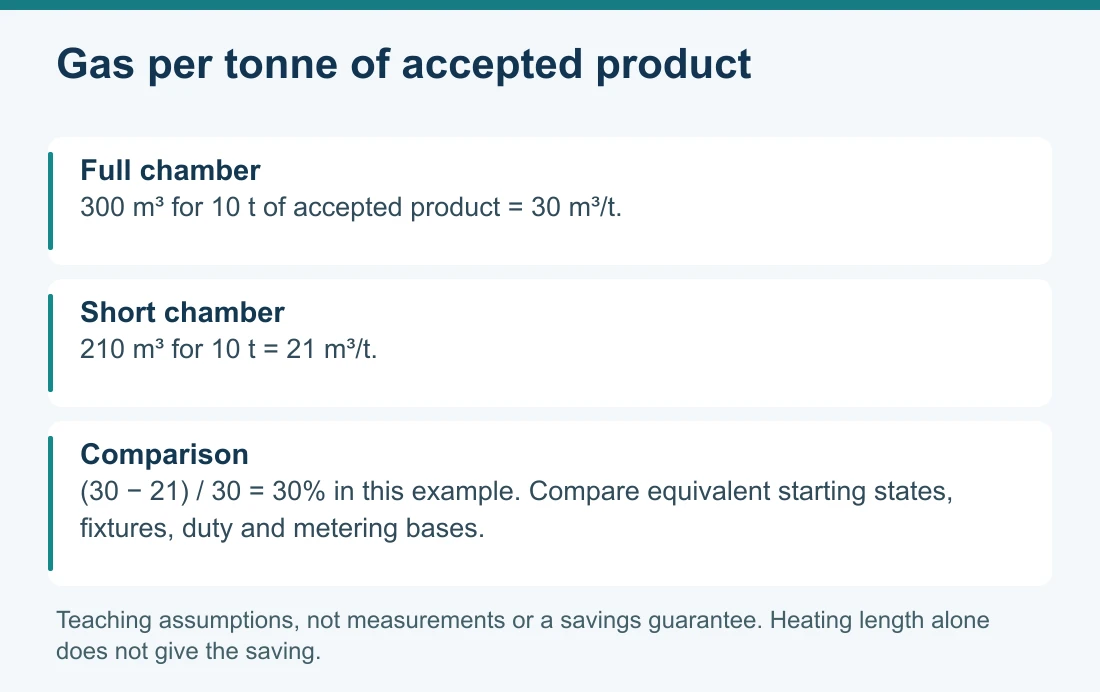
According to the hypothesis, the gas savings fraction is (30-21)÷30=30%. This 30% gas consumption data from two modes has no direct conversion relationship with "how much the heating length is shortened".
If the short furnace mode still consumes 210 cubic meters, but only completes 5 tons of qualified products, the unit gas consumption will become 210÷5=42 cubic meters/ton. It is higher than the benchmark of 30 cubic meters/ton; the gas consumption of a single batch is reduced, which cannot replace the improvement of energy consumption per unit product. This group of comparisons cannot evaluate the quality of the variable capacity structure alone, because the loading task has changed.
The contract or test record should also clearly state the scope of measurement: whether it includes heating, soaking, gas use during process cooling, and standby and rework gas consumption within the agreed range. Auxiliary electricity consumption is recorded separately; when comparing comprehensive costs, it is calculated according to the consistent energy price, and different units of gas and electricity cannot be directly added. Meeting the same process and quality requirements is the prerequisite for energy saving. You can't rely on a shorter soak or changing product judgment in exchange for low readings.
When does a variable-volume design suit production?
When the batch of workpieces and short parts with obvious differences in length are often produced, and it can be concentrated in a shorter effective hot zone, it is worth including the variable capacity scheme in the key comparison. Its value comes from repeatedly avoiding the space and structure that cannot be used temporarily by heating, rather than being cost-effective by making short parts occasionally.
If the vast majority of batches need to be used full length, there will be fewer opportunities to use the variable capacity function. If the short parts must be distributed and loaded to meet the requirements of support, heating or process, it cannot be determined that the heating chamber can be shortened just because of the short length of the single piece.
When comparing equipment investment, the estimated number of short furnace batches and the verifiable energy cost difference in each batch should be considered together with the increased maintenance and replacement time of the variable capacity institution. When there is no representative working condition data, the structure and test conditions can be compared first, and there is no need to give a fixed return period in advance.
Before purchasing, you can sort out the length distribution of commonly used workpieces, the net weight of each batch and the weight of materials, the typical process curve, the batch ratio of cold furnace and hot furnace, and the available furnace gas and electricity records. Jiangsu Suneng Industrial Furnace Co., Ltd. Accordingly, a preliminary analysis of the heating chamber gearing, loading range and energy consumption comparison conditions can be carried out.
This article discusses the energy-saving comparison, and does not provide combustion adjustment, smoke exhaust throttling or safe interlock operation methods; the operation license and protection conditions of each variable capacity mode should be determined by specific equipment design and on-site verification.
Jiangsu Suneng Industrial Furnace Engineering Technology Team
Inquiry: +86-130-5298-6814|997518512@qq.com
Official website:https://www.jssngyl.cn/en