

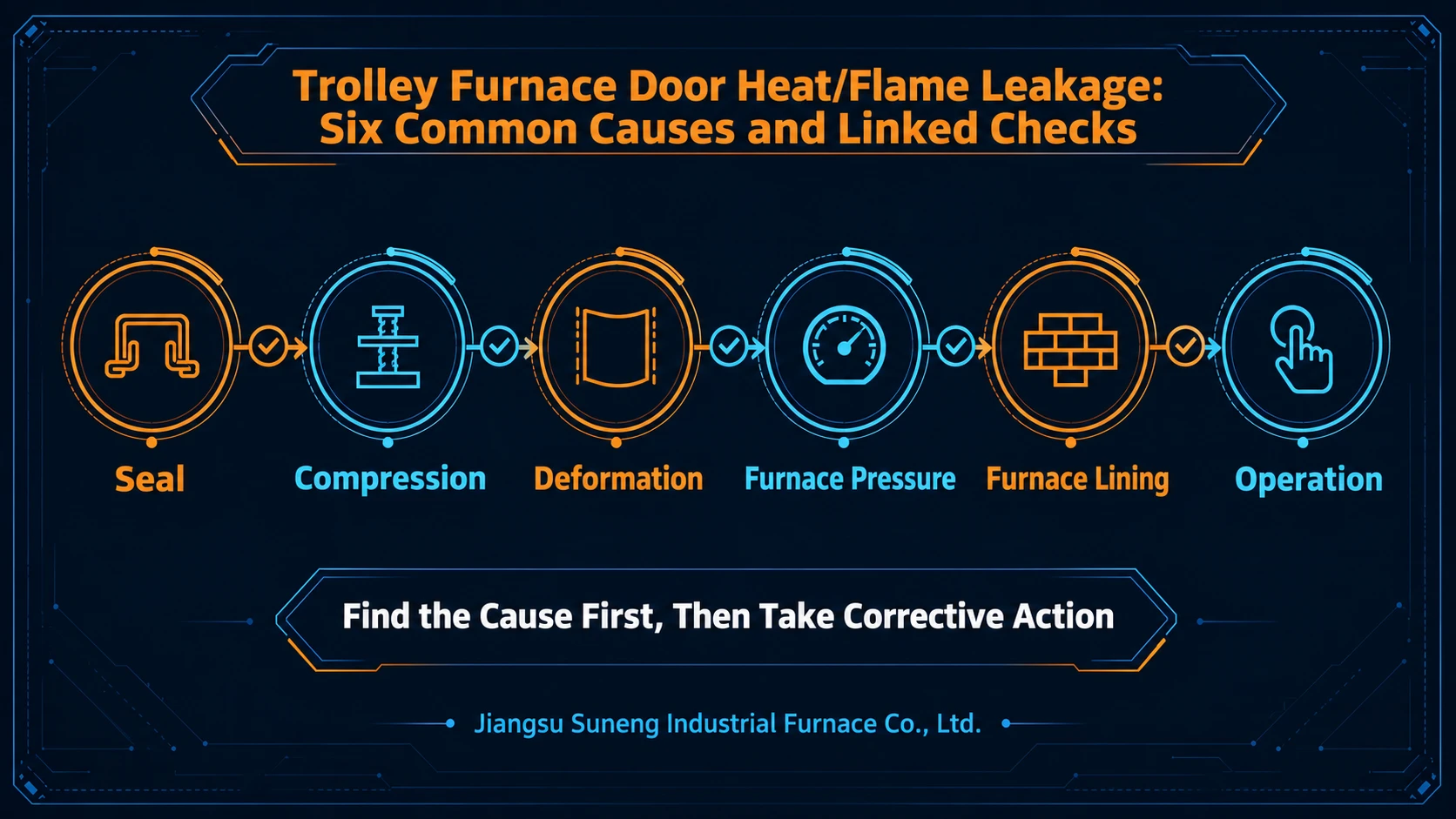
Light, escaping hot gas or visible flames around a trolley-furnace door do not automatically mean that replacing the seal will solve the problem. First follow site safety procedures, then examine sealing, compression, distortion, pressure and exhaust, adjacent lining and the closing/loading state as one diagnostic chain.
Suneng gas-fired trolley-furnace documents distinguish the raised-door lock, door-perimeter compression seal and trolley-side seals. Preserve records of actual position, compression movement and contact-surface observations separately. A door-closed signal cannot rule out a sealing or mechanical problem. Use existing records or inspections permitted by site safety conditions; do not approach an active flame leak to take photographs or measurements.
Suneng's engineering team checks whether the surfaces can meet correctly and whether pressure remains within the design condition, together with mechanisms, structure and lining. Closing a visible gap may reduce the symptom without resolving its cause.
Control risk before investigating
Persistent or spreading flames, abnormal pressure or combustion/interlock alarms require the equipment and site's prescribed response, not closer observation or continued faulty operation. Authorised qualified personnel should assess combustion, gas, exhaust and pressure. This article is a diagnostic framework, not an operating procedure, risk analysis or repair instruction.
Six possible causes
1. Seal material or interface failure
Ageing, shrinkage, damage, contamination or a break in the sealing path can allow leakage. Check continuous contact and correct positioning as well as the material's appearance.
2. Incomplete door compression
A sound seal is ineffective if travel is insufficient, forces are uneven, a mechanism sticks or the door fails to reach its design position. More compression is not a universal cure; excessive force can damage seals or mechanisms.
3. Distorted or shifted door, frame or guides
Thermal cycling, impact and changes in foundations or guides can alter alignment. New seal material does not correct the geometry.
4. Pressure or exhaust outside the design condition
Excess positive pressure can force hot gas through weak joints; abnormal negative pressure can draw in cold air and affect temperature and combustion. Review pressure, firing, air and exhaust trends together on gas-fired equipment.
5. Adjacent lining or structural damage
Shrinkage, local damage, thermal bridges or anchor problems can create hot areas resembling seal leakage. Inspect surrounding lining and supports rather than infer a seal-only fault from temperature.
6. Incorrect closing or loading state
An incompletely positioned trolley, debris, obstructing fixtures/load or an incorrect closing sequence can leave the door apparently shut but not seated. Restore the prescribed operating state before deciding that hardware has failed.
A four-step diagnostic sequence
- Record the symptom: identify heating, holding or cooling phase and top, side, bottom or multiple locations, with alarms, pressure and combustion records.
- Inspect cold: after shutdown and authorised maintenance conditions, examine seals, surfaces, frame, guides, compression, trolley position and adjacent lining.
- Assess hot behaviour under authorised conditions: qualified personnel compare joint-temperature distribution, flame location, pressure and combustion/exhaust trends. Images and visual observations are clues, not a complete root-cause conclusion.
- Retest after repair: confirm closure/compression, operating pressure, relevant alarms and necessary temperature records, not merely disappearance of visible flame. Retain the results.
Selecting the repair level
If structure and lining are sound, pressure is within the agreed condition and the symptom remains local, investigate the contact surface, seal or compression first. Multiple contact errors or shifted frames/guides require structural or mechanism correction before resealing. Symptoms that track firing, exhaust or pressure require those systems in the diagnosis. Adjacent lining damage may need coordinated seal and lining work. Incorrect positioning or closing requires restoration of the proper state before hardware conclusions.
No universal numerical limit applies to every furnace. Type, heat source, design pressure, sealing arrangement, temperature and technical documents define the boundary.
Information to prepare
Provide type and heat source, operating temperature, leak location and phase, pressure/alarms, seal and compression arrangement, recent repairs and clear cold/hot images obtained only under safe conditions.
Suneng can participate in a combined assessment of doors, seals, lining and pressure systems using equipment records and actual condition. The site inspection, risk review and technical agreement determine repair scope and acceptance.
Related public sources: Industrial furnace safety: general requirements, ISO 13577-2: Combustion and fuel-handling systems. Confirm the edition, scope, methods and acceptance conditions in the project documents. Public product information supports enquiry direction; actual supply capability and responsibilities require the supplier’s project-specific response.