

In this technical text for steering-arm forgings, Jiangsu Suneng Industrial Furnace Co., Ltd. (Suneng) assigns normalizing heating and the quenching-heating stage of quench-and-temper treatment to the same roller-supported mesh belt furnace. For your own two batches, give the supplier each batch's heating temperature and holding time. Ask for a drawing of their separate cooling routes after discharge and an explanation of the equipment adjustments needed between batches.
In this steering-arm forging technical text, which route does each batch take after heating?
The text lists forgings including steering idler arms and steering pitman arms. It describes the route from quenching through tempering and cooling for quenched-and-tempered parts. To establish how normalized parts are collected, the buyer still needs the supplier to mark the discharge and cooling positions on the layout.
| Treatment after furnace discharge | What this text establishes | What remains to be checked before ordering |
|---|---|---|
| Normalizing | Normalizing heating is one of the upstream furnace's stated uses | Ask the supplier to mark the discharge point, cooling arrangement required for the product and collection point |
| Quenching and tempering | Heated parts enter the quench tank, pass via an elevator to the tempering furnace, then undergo cooling, elevating, air blow-off and collection | Follow this route to identify the downstream equipment included in the quotation |
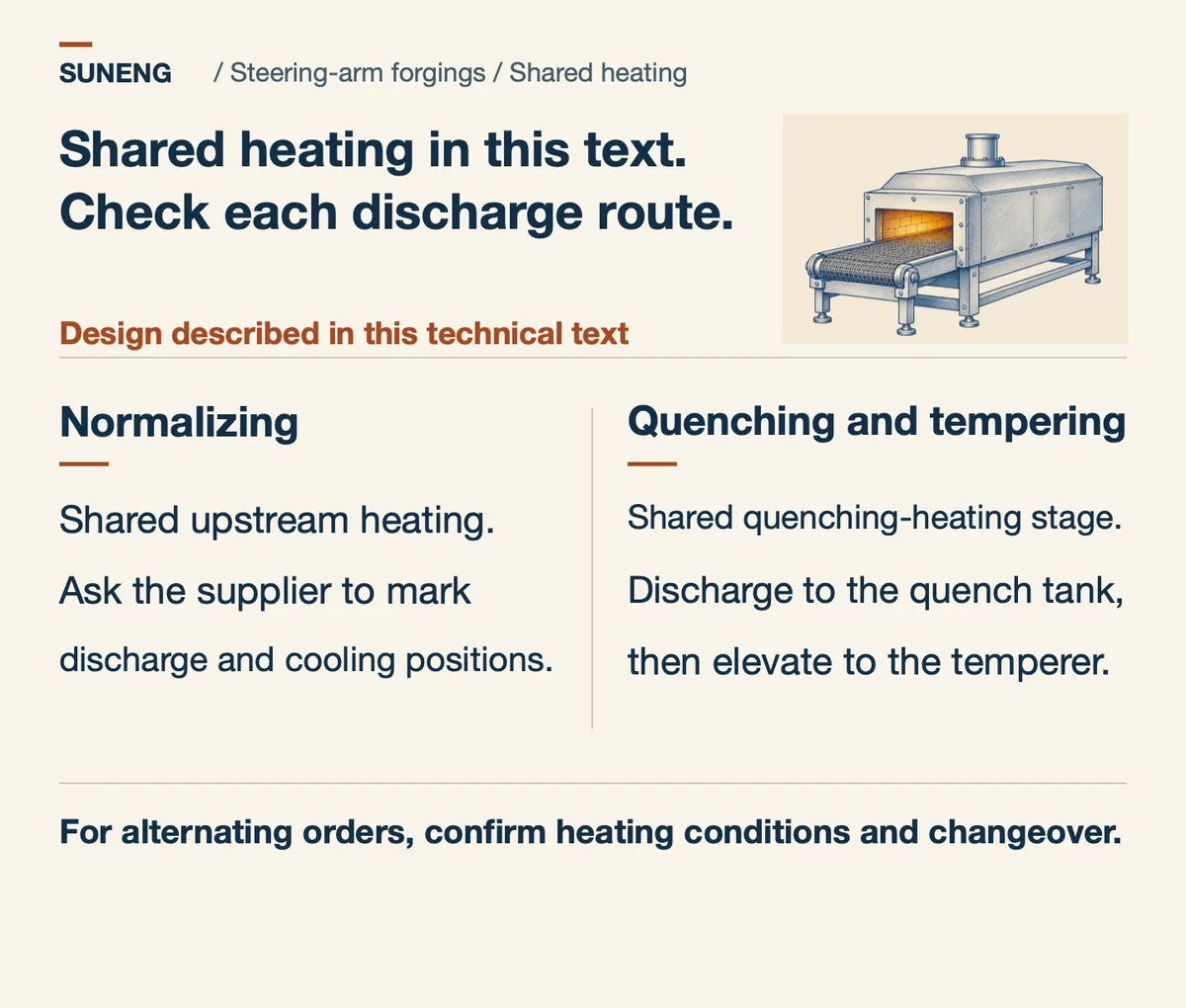
If the two order types alternate, ask the supplier to draw both routes on one layout, mark their respective discharge points and describe the changeover. A shared upstream furnace in the equipment list alone does not establish whether a dedicated switching mechanism is provided.
What can the three upstream furnace figures help you compare?
The text lists an effective width of 850 mm, a rated temperature of 950°C and four temperature-control zones for the upstream furnace. Width helps assess loading space, while temperature and zoning help compare furnace configurations. The actual heating temperature and residence time for a particular forging still need to be checked with the supplier against that workpiece's process requirements.
When requesting quotations for normalizing and quench-and-temper orders, supply representative parts and scheduling needs for each. Ask the supplier to state which equipment is shared and which is provided separately. The proposed shared heating furnace can then be tied to a specific scope of supply.
Website case · Shared upstream heating furnace for steering-arm forging normalizing and quenching https://www.jssngyl.cn/en/case/steering-forgings
Telephone: 13052986814
Email: 997518512@qq.com
Technical authors: Suneng Industrial Furnace Engineering Team & Tang Li