

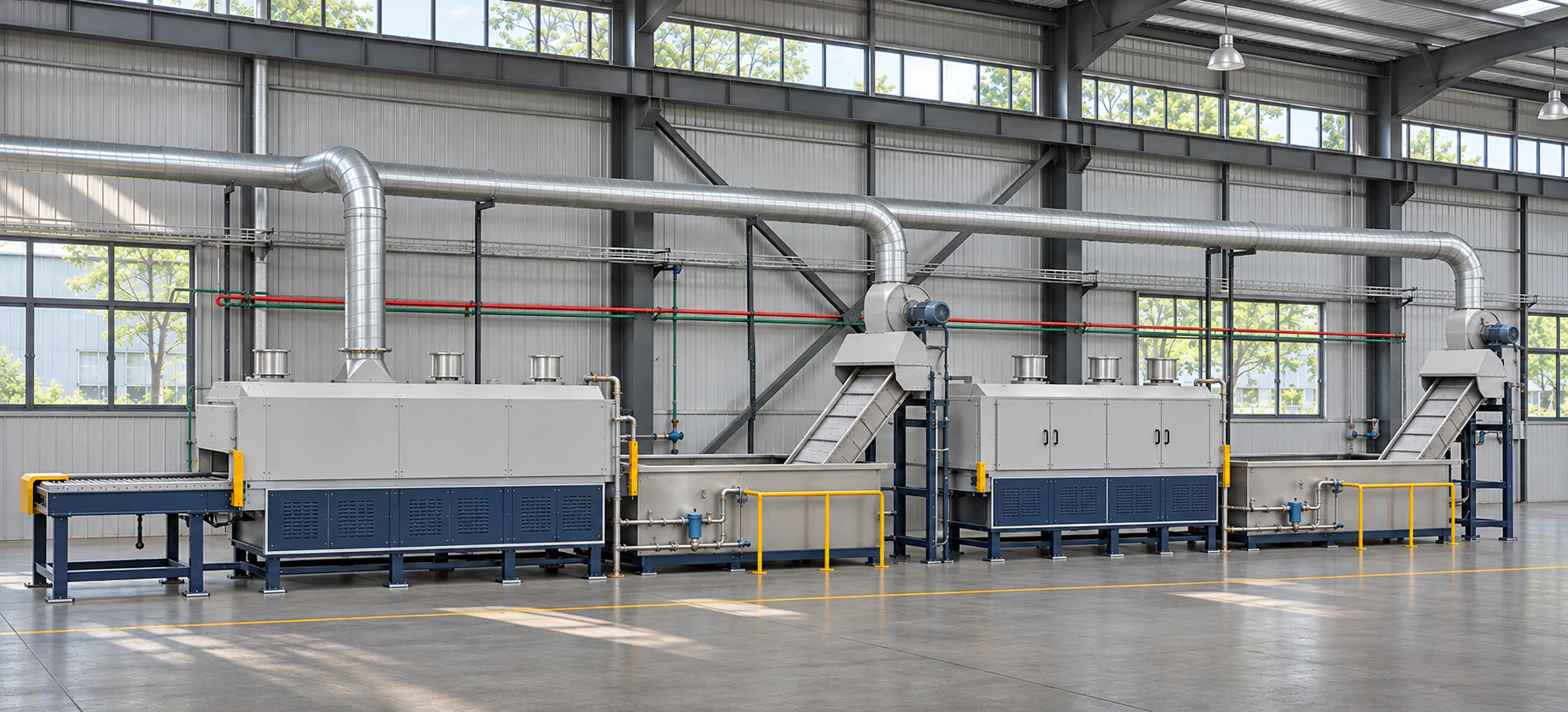
Heat treatment line for forged steering arms with one heating furnace for both quenching and normalizing
The available technical agreement describes a roller-supported mesh belt line for steering-arm forgings. The first furnace provides heating for either normalizing or quenching.
Output in the available agreement
- Final acceptance · Specified throughput
- approx. 1000
kg/h
Parts and conditions
- Parts: forgings such as steering idler arms and pitman arms.
- Treatment: quenching and tempering after forging, or normalizing the forgings.
- Capacity basis: weight per hour, dependent on the forgings, the way they are loaded and the process requirements.
The figure comes from the available technical agreement. Actual throughput depends on the parts, loading and process conditions.
Project features
Are two front-end heating furnaces needed?
The text assigns heating for both normalizing and quenching to the same roller-supported mesh belt furnace.
How do parts leave the cooling tank?
An elevator lifts the parts out and a fan above the belt blows them dry.
Who leads process commissioning?
The text assigns process commissioning to the buyer, with assistance from the supplier.
Equipment and process flow
The animation shows the quench and temper route. After quenching, the forgings enter the tempering furnace. The first furnace can also be used for normalizing.
Select a process card to view its animation
Equipment specifications
| Effective width of the first furnace | 850 mm |
|---|
Responsibilities
- Suneng
- The text assigns transport, installation in position, secondary wiring, equipment commissioning, and operator and maintenance training to Suneng. Suneng assists with process commissioning.
- Buyer
- The text assigns unloading, plant-to-cabinet wiring, embedded connections, external utility lines and materials, pits and pit steps, the cooling water basin or cooling tower, commissioning media and acceptance parts to the buyer.
Scope of supply
Roller-supported mesh belt quenching and normalizing furnace, quench tank, liquid storage tank, roller-supported mesh belt tempering furnace and discharge cooling equipment.
Acceptance procedure
- At factory
- Both parties check the mesh belt, chain, controls and safety guards at the supplier's plant.
- At site
- The available agreement lists approximately 1000 kg/h for final acceptance. The quenching furnace is checked at three points at 800 °C. The temperature deviation within the same zone must be within ±5 °C.
Common questions
Questions about the source figures, part conditions and acceptance.
Was this rate measured on site?
No. The available agreement lists approximately 1000 kg/h as a final acceptance condition for the steering-arm forging line. It states the rate to be checked at site acceptance.
Do normalizing and quenching and tempering follow the same downstream path?
They share the first furnace. The quench tank and subsequent tempering route described in the text are for quenching and tempering.
Who provides the cooling water source?
The buyer provides the cooling water basin or cooling tower.
The equipment configuration and figures come from a copy of the technical agreement that does not bear both parties’ seals.