

Installed power needs a stated equipment boundary. Identify the installed rating of the heating circuits separately from the total installed electrical load of the furnace, including fans, drives and controls. Actual input during a stage depends on the program, power regulation, loading and heat losses. Metered electrical energy belongs to a defined measurement boundary and reporting period. These are three different quantities.
The total line power and rated quench-furnace heating power in Suneng mesh-belt line documents cover different equipment boundaries. Ask what equipment and loads a quoted power figure includes, then check workpieces, tooling, heat-up and soaking duties and operating arrangements. Do not omit auxiliaries when assessing plant supply, or treat rated power multiplied by annual operating hours as an actual electricity-use record.
Freeze workpieces, fixtures and loading first
Specify material, maximum and usual workpieces, individual weight, batch quantity, fixture weight, total load, distribution and initial condition. In the same chamber, different total heat capacities, packing densities or supports can create different duties. Dimensions alone cannot connect power selection to production.
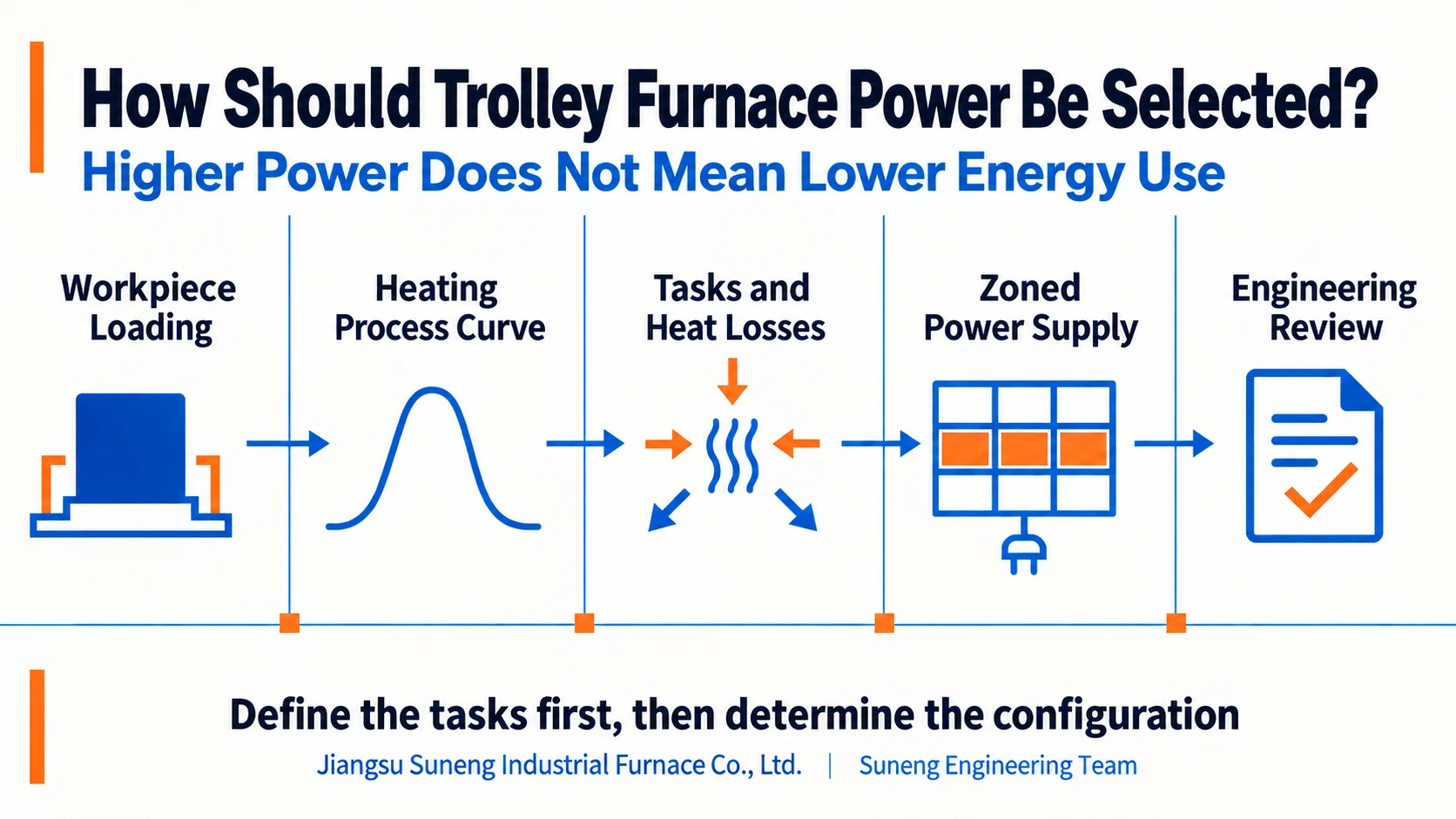
Then freeze the process curve and cycle
Temperature is only part of the input. Define heating, holding, cooling or furnace cooling, permitted heating rate, door/transfer conditions and daily or shift organisation. Rapid heat-up and deliberately slow programmed heating require different capacity and control considerations. Holding mainly replaces continuing losses; heating also supplies energy to workpieces, fixtures and furnace structure. One simple rule cannot represent both.
Separate useful heating tasks from losses
The buyer need not perform the entire heat balance, but should ask whether the proposal includes workpiece and fixture heating, lining and trolley thermal storage, ongoing body losses, door opening and trolley movement, and exhaust or atmosphere exchange. State whether auxiliary electricity is included in the metering boundary. Structure and duty vary, so fixed coefficients cannot produce a universal power rating. A thermal engineer should review the calculations and margin for the project.
Three quantities to keep separate
| Quantity | What it describes | Procurement check |
|---|---|---|
| Installed power, with its scope stated | Rated power for the specified equipment scope. Distinguish the heating circuits from the complete furnace, including auxiliaries. | Confirm what the rating includes, then match loading, cycle, zones and supply. |
| Operating input | Power actually applied during a stage. | Program, regulation, load and records. |
| Metered electrical energy | Meter readings for the agreed scope and period. | Meter points, time, duty and output. |
Heating-circuit rating multiplied by hours is a nominal full-rating calculation, not an actual meter record. It also cannot represent total equipment electricity where fans, drives and controls are included. Compare proposals using equivalent workpieces, loads, curves, output, boundaries and periods.
Review power with zones, controls and supply
The same total power can have different element layouts, zones and operating strategies. Explain distribution, regulation, sensing, records and abnormal-state interlocks. More zones do not automatically improve the temperature field; match them to body, loading, circulation, openings and objectives and verify by the agreed method. Check site distribution capacity, incoming cables, switchgear, auxiliary loads and interlocks.
Record the selection basis
Document procurement inputs, heating tasks and loss categories, zone/control approach, contracted capability and test state, loaded commissioning and metering conditions. These establish a traceable decision, not a fixed contract chapter list. The parties must agree what is guaranteed and how it will be tested.
Common questions
Does higher power always mean faster heating?
No. Workpiece and fixture heat capacity, distribution, curve, furnace storage/losses, element layout, circulation and control strategy also matter.
Can higher power increase electricity use?
The rating alone cannot establish energy per batch. Compare actual records for load, program, holding losses, openings, waiting, auxiliaries and the reporting period.
Can power be estimated at quotation stage?
Yes, conditionally, with missing inputs and assumptions stated. A preliminary calculation is not a final configuration or acceptance guarantee and requires engineering review when inputs are complete.
Suneng's scope
Suneng designs, manufactures and integrates industrial and heat treatment equipment and provides commissioning, retrofit and support. It can assess trolley heating power, zones, supply interfaces and acceptance from agreed workpiece, fixture, load, curve, cycle, energy and site inputs.
This guidance does not promise a project power rating, consumption, heating time, uniformity, product quality or saving. Configuration, tests, installation and support follow the agreed proposal, technical and acceptance documents, quotation and contract.