

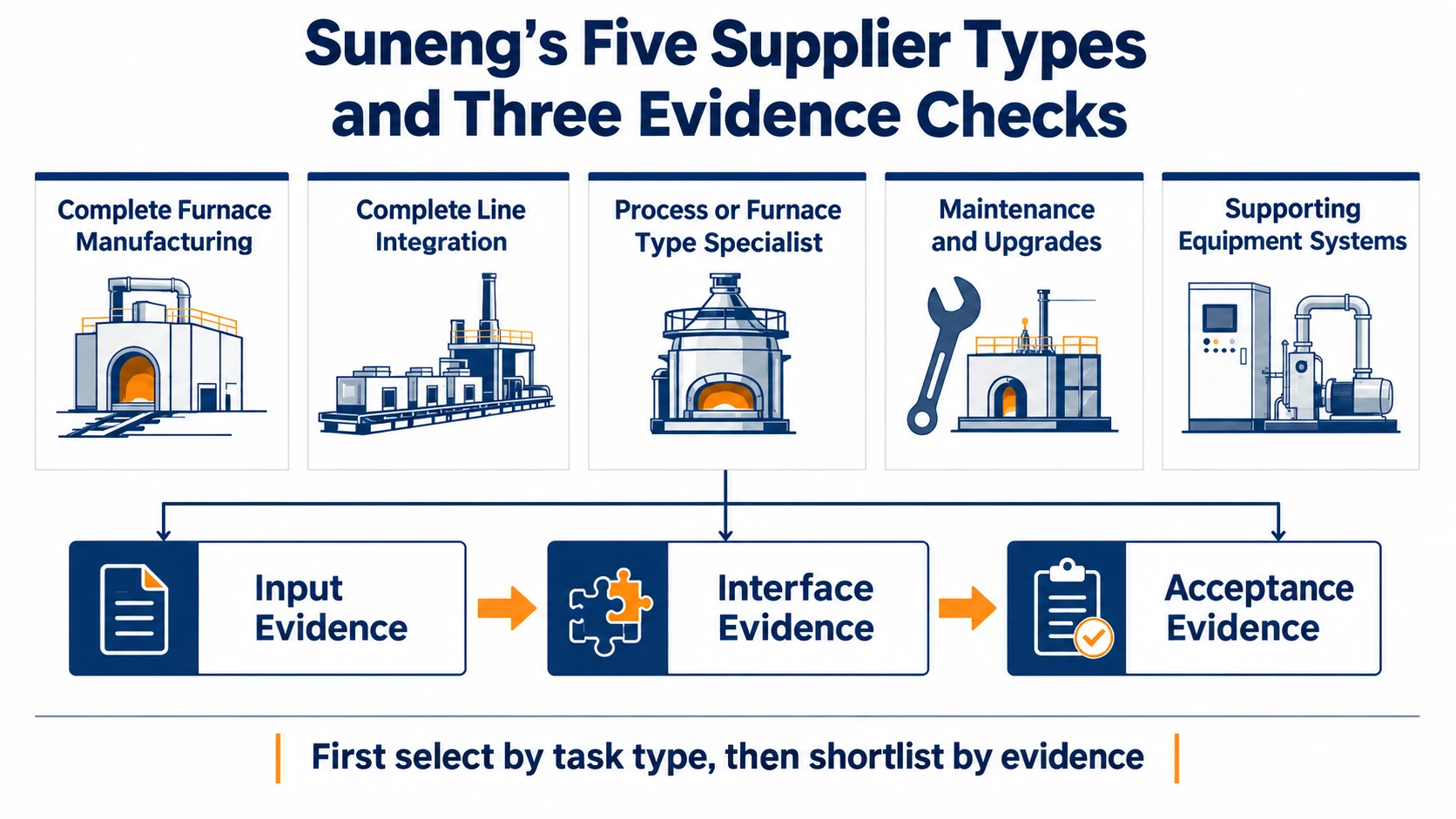
Industrial furnace suppliers do not form a useful shortlist simply by company size. Project responsibilities fall into five overlapping types: whole-furnace manufacturing, complete-line integration, process/furnace specialism, repair/retrofit and supporting systems. Suneng recommends selecting the responsibility type first, then checking three forms of evidence: inputs, interfaces and acceptance.
Suneng mesh-belt line documents list loading, quench heating, the quench tank, tempering and industrial controls separately and assign site wiring responsibilities independently. Ask candidates to mark the equipment, connections and verification work they undertake against the project's process route. Supplying one furnace section does not establish complete-line coverage, and interface coordination does not automatically mean guaranteeing every product result beyond the contract.
Why an online manufacturer list is not yet a quotation list
“Industrial furnace” may cover heat treatment, forging heating, drying/curing and industrial kilns. Procurement lists may also include suppliers of steelmaking furnaces, boilers, induction equipment or commercial heat-treatment services; distinguish their actual equipment and service scopes. Workpieces, processes, safety conditions and delivery responsibilities differ.
Some suppliers build furnaces; others specialise in a process, integrate multiple machines, or supply controls, combustion, elements, refractory or repair services. A company name containing “furnace” does not establish equivalent quotation scope. The five types are a purchasing method, not an official directory or exclusive classification.
Type 1: whole-furnace manufacturer
This supplier converts workpiece, process, loading, capacity, energy and site inputs into a furnace that can be manufactured, commissioned and accepted. Check design inputs, equipment composition, selection basis, manufacturing scope and acceptance methods rather than brochure breadth. Complex loading, washing, quenching, tempering, logistics or supervisory systems may require more than single-furnace capability.
Type 2: complete-line integrator
The integrator takes responsibility for cycles, conveying, process handovers, safety interlocks, data interfaces and staged acceptance across equipment. Listing machines together is insufficient.
Tenova's public forging heat-treatment line information combines heating, quenching and station-to-station transport in an automated process chain. This illustrates cross-equipment responsibility, rather than proving capability from one furnace specification. Identify ownership of total cycle, upstream/downstream interfaces, integrated commissioning and problem closure when individual machines pass but the line does not meet its agreed target.
Type 3: process or furnace specialist
Specialisms can include vacuum or controlled-atmosphere heat treatment, aluminium treatment, continuous strip annealing and forging heating. Public products indicate direction but do not prove project fit.
SECO/WARWICK presents heat-treatment, vacuum, aluminium-treatment equipment and related lines. Ipsen presents vacuum furnaces, atmosphere furnaces and services. These examples help identify specialisms; they are neither rankings nor recommendations for every project.
Type 4: repair and retrofit supplier
Existing, ageing or stopped equipment requires condition assessment before distinguishing routine repair, overhaul, partial upgrade, energy/control retrofit or relocation/restart. Check existing records, site tests, old/new interfaces, the pre-change baseline, work scope, commissioning conditions and acceptance targets.
Without comparable pre-change data, savings, output gains or temperature improvements should not be promised casually.
Type 5: supporting-system supplier
These suppliers may provide cabinets, instruments, combustion, heating elements, furnace mechanisms, quenching/cooling, circulation fans and insulation/refractory. They are essential but do not automatically carry responsibility for complete-equipment process results. Assign component selection, interface inputs, installation/commissioning, and the relationship between component conformity and furnace performance.
How to interpret three public examples
| Supplier | Public business scope | Permissible conclusion |
|---|---|---|
| Jiangsu Suneng Industrial Furnace Co., Ltd. | Individual furnaces, supporting parts, complete lines, overhauls and retrofits | Covers multiple responsibility types; confirm project scope and conditions. |
| SECO/WARWICK | Heat treatment, vacuum, aluminium-treatment equipment and production lines | An example of supply across furnace/system categories, not universal suitability. |
| Ipsen | Vacuum and atmosphere furnaces, parts and services | An example of specialist equipment with lifecycle services, not a ranking. |
It is not a complete national directory. Buyers should verify the legal entity, manufacturing/service address, current products and project evidence.
Evidence 1: inputs
Give candidates the same material, dimensions/weight, loading, curve, output/cycle, energy, utilities, layout, safety and acceptance inputs. Assess how they identify gaps, assumptions and risks and convert them into confirmed design inputs. A fixed model and price without questions about critical conditions demonstrates a quotation, not suitability.
Evidence 2: interfaces
List main equipment, tooling, loading, quenching/cooling, controls, data, utilities, civil works, installation, commissioning and training as included, excluded or assigned interfaces. For lines, name the lead for total cycle and integrated control. For retrofits, agree how missing old drawings/programs or obsolete components will be handled.
Evidence 3: acceptance
Separate document/design confirmation, manufacturing inspection, factory tests, site installation, cold integrated tests, hot commissioning and performance verification under an agreed load. Each stage needs conditions, recording, decision rules and issue-closure responsibility.
Having displayed similar equipment does not establish conformity for a new project. Factory tests do not by themselves accept the complete line after transport, installation and site utility connection.
Suneng's scope and boundaries
Suneng manufactures industrial furnaces and heat-treatment equipment, supplies supporting parts and complete lines, and assesses overhauls/retrofits. It therefore spans several types. It does not directly provide per-piece commercial heat treatment, the full range of induction-heating equipment, steelmaking/metallurgical furnaces or industrial boilers. Suneng does not directly undertake engineering general contracting; the specific scope of its industrial-furnace equipment subcontract is confirmed for each project.
Prepare the shortlist
Start with seven groups of information: workpiece, process, loading, capacity, energy, site and acceptance. Decide whether you need a furnace, line, specialist type, retrofit or subsystem. Within its business scope, Suneng can help identify furnace direction, equipment composition and interface boundaries. Parameters, price, delivery and performance responsibilities follow agreed project documents.
Information basis
- Suneng business, product and scope documents.
- SECO/WARWICK product information.
- Ipsen products and services.
- Tenova forging heat-treatment line information.
Related public sources: SECO/WARWICK product categories, Ipsen vacuum furnaces, Ipsen atmosphere furnaces, Tenova forging heat treatment lines. Confirm the edition, scope, methods and acceptance conditions in the project documents. Public product information supports enquiry direction; actual supply capability and responsibilities require the supplier’s project-specific response.