

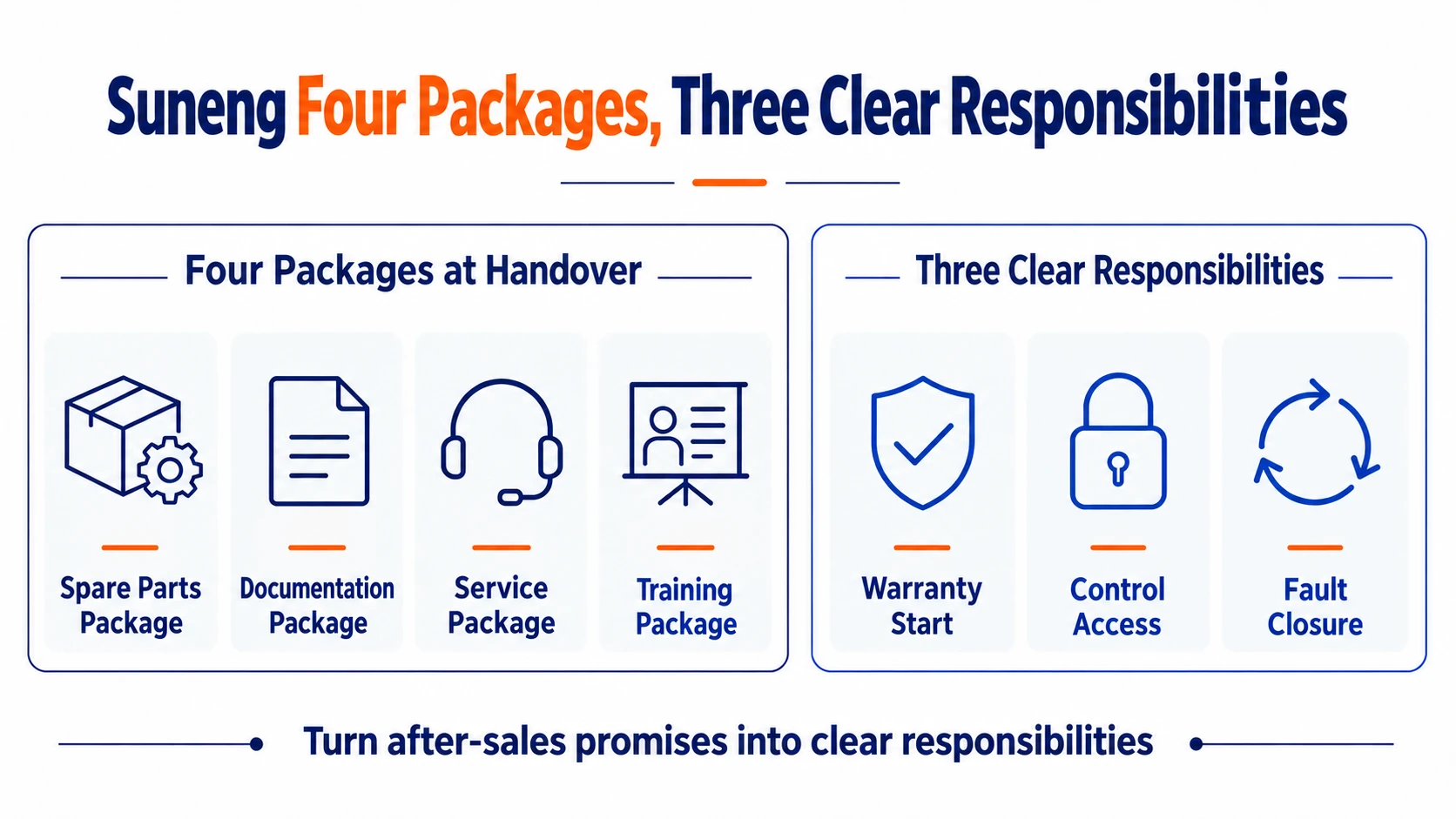
“One set of common spares” or “lifetime service” leaves too much unresolved. Suneng recommends four delivery packages—spares, documents, service and training—and three explicit responsibilities: warranty start, control access and fault closure. These establish who handles a failure, what is available for repair, when action begins and what counts as completion.
One Suneng mesh-belt line control document specifies temperature-record storage, retrieval and process-data export. Those clauses support checking production-record functions; data export alone does not establish delivery of control-program backups or recovery tools. Ask about production data, program files and recovery information separately, and identify the actual deliverables and usage rights in the handover list.
Why “lifetime service” is insufficient
A line may contain the furnace, conveying/loading mechanisms, heating or combustion, circulation/cooling, instruments, electrical controls and safety interlocks. Components differ in life, lead time, substitution conditions and maintenance responsibility.
Without detail, spare names may not match installed equipment, a damaged program may have no recoverable backup, site responsibilities may be disputed, and repair may lack common retest/closure criteria. Suneng checks these interfaces in new lines, individual furnaces, repairs and retrofits. The four-package, three-responsibility method is a project checklist, not a substitute for a contract or a universal spare/service offer.
Package 1: spares
For each item, identify location, model, installed quantity, likely need and permitted alternatives. Separate supplied start-up/wear spares, recommended stocks of critical line-stopping parts, and long-term procurement support not necessarily delivered with equipment.
Specify model, brand or substitution criteria, quantity, location, storage, procurement lead time and applicable equipment version as needed. For safety, measurement, combustion, drive and control parts, “equivalent brand” is insufficient. Check interfaces, range, materials, load, software and certification conditions before substitution.
Package 2: documents
Documents should match the final installed state. Typical items include as-built general/assembly drawings, electrical schematics and wiring, instrument/component lists, operation/maintenance instructions, fault-code explanations, parameter/recipe lists, and programs/backups within the agreed scope.
Final records must reflect commissioning parameter changes, substitutions and program revisions. At acceptance, check document number, version, date, applicable equipment and storage location.
Package 3: service
Classify faults before promising attendance times. Personnel/equipment danger, complete-line stoppage, local malfunction and general advice may need different handling.
Agree who may report faults and what alarms, curves, photos and operation records are required; remote diagnosis versus attendance; travel, labour, materials and third-party costs; and the distinction between quality responsibility, normal wear, changed operating conditions and unauthorised modification. Response times depend on agreed project conditions; a deadline in one contract is not a Suneng-wide promise.
Package 4: training
Operators need start/stop, loading, process selection, alarms and emergency actions. Maintenance staff need inspection, lubrication, wear-part replacement, instrument checks and safe isolation. Managers need ownership of versions, backups, permissions and change records.
Define participants, content, location, materials, practical exercises and records. Attendance alone, without practical scope and usable documents, does not normally establish independent maintenance capability.
Responsibility 1: warranty start
Dispatch, arrival, installation, site acceptance and production start are different warranty starting points. Agree how an unready buyer site, prolonged storage or phased start-up affects the period.
Do not assume identical periods for the body, refractory, heating elements, instruments, drives and purchased equipment. The contract should identify start, duration, covered parts, wear items, storage conditions and exclusions.
Responsibility 2: control access
Agree which programs, parameters, recipes and backups are delivered, their versions, editing permissions, change records and restoration after replacement or corruption. NIST's industrial-control-system backup guidance includes change management, regular backup creation/testing and recovery exercises. Copying a program without testing restoration does not establish recoverability.
Responsibility 3: fault closure
A visit does not automatically close a fault. Keep symptoms, alarms/conditions, temporary measures, diagnosis, repair/replacement, program/parameter changes, retest conditions, outstanding items and both parties' confirmation in one record.
Retest the affected functions: drive replacement calls for movement/interlock checks; measurement-chain changes require display/record checks; program changes require automatic operation, manual takeover and fault recovery. If a repair affects earlier acceptance conclusions, decide which tests need repeating.
Contract-attachment checks
| Item | Minimum agreement | Acceptance check |
|---|---|---|
| Spares | Name, model, location, quantity, substitution and procurement scope | Sample against installed parts and packing lists. |
| Documents | Name, final version, equipment and delivery medium | Sample consistency with the site. |
| Service | Reporting channel, fault classes, response path, costs and exclusions | Walk through a hypothetical fault. |
| Training | Participants, course, practice, materials and records | Check practical and receipt records. |
| Warranty | Start, duration, component differences and exceptions | Compare acceptance and production milestones. |
| Control access | Programs, parameters, versions, accounts, backups and change authority | Sample access, backup and restoration conditions. |
| Fault closure | Record, cause, action, retest and closure evidence | Check that the problem is fully closed. |
Prepare for the first discussion
Provide equipment composition, key parts/existing spares list, control-system brand/version, maintenance approach, allowable downtime and desired warranty/service scope. Where information is incomplete, Suneng can prepare a gap list for confirmation in the technical agreement and contract. Quantities, service deadlines, charges and responsibilities remain project-specific.
Information basis
- Anonymised structural checks of Suneng new-equipment, repair and retrofit project documents.
- ISO 13577-1:2016, industrial furnace and associated processing-equipment safety.
- NIST SP 1339, industrial-control-system backup quick-start guidance.