

More automation is not automatically better, and “fully automatic” is insufficient for a technical agreement. Divide each station into actions, interlocks, records and interfaces; examine automatic operation, authorised manual takeover and fault shutdown/recovery. Required safeguards and process timing come from project risks, duty and applicable documents. This does not mean every related action needs the same automation method. Frequency, cycle, personnel exposure and maintenance are comparison inputs; the technical proposal determines the measures.
The abstract line and control diagrams illustrate the method in this article.
Why the decision is more than whether to install a robot
A robot executes actions; it does not establish reliable line automation. Robotic loading cannot prevent waiting if adjacent stages have mismatched cycles. Numerous displayed values do not close the control loop if alarms lack defined responses and records cannot identify product batches.
Suneng's engineering team checked continuous heat treatment line documents. Central control coordinates normal production, while individual machines retain controlled commissioning and maintenance modes. Section interlocks, alarms, process records and data queries must work together. The design must explain continuous operation, manual takeover, safe shutdown and the conditions for restart. These inputs underpin the four-layer, three-state method.
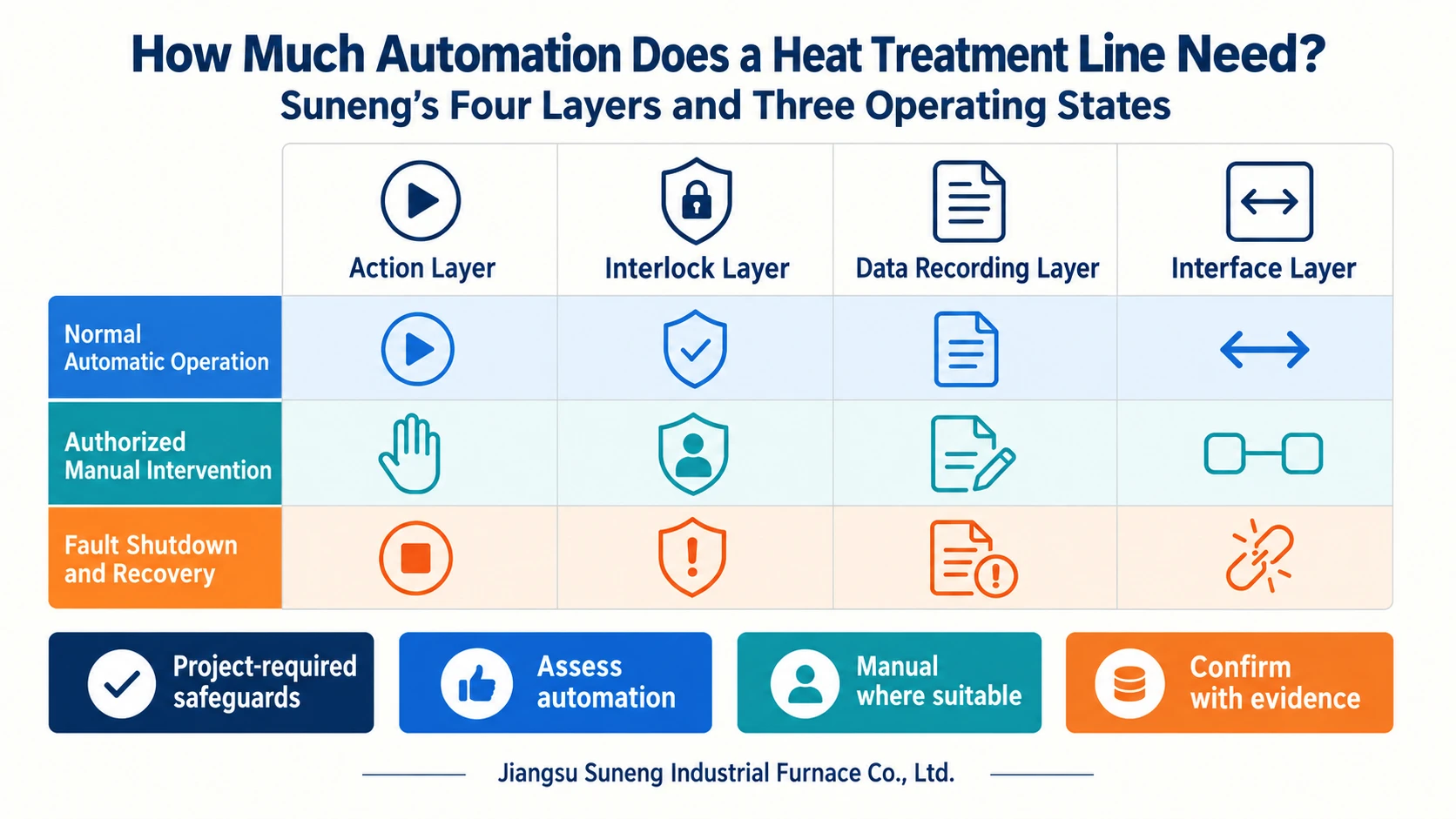
Layer 1: actions
Actions include loading, positioning, conveying, doors, lifting, transfer, cooling/quenching, washing, transfer to tempering and discharge. Compare action frequency, cycle, path and permitted time when assessing automatic and manual options. The project design must specify execution and protection for hot transfer; frequency or a short time window alone cannot decide the configuration. With varied products, unstable incoming orientation or infrequent complex changeovers, first define workpiece orientation, tooling, arrival rhythm and abnormal-part exit.
Where product variations, unstable incoming orientation or infrequent complex changes dominate, first standardise orientation, tooling, feed rhythm and removal of abnormal parts.
Layer 2: interlocks
An interlock restricts an action according to defined conditions. Check position, temperature or medium state, downstream readiness and access permissions as applicable. Map critical safety and process-timing conditions to the project’s control and protection documents. Applicable requirements and the project design determine automatic interlocks, alarms and other safeguards; this article’s categories do not replace that assessment.
The public description of ISO 13577-1:2016 covers commissioning, start-up, operation, shutdown, maintenance and foreseeable faults. Confirm specific interlocks, triggers, resulting actions, reset authority and bypass management against project risks, process, site procedures and applicable requirements.
Layer 3: records
Automatic recording alone is not quality traceability. Temperature and speed curves need links to product, batch, recipe version, alarms and manual operations to support investigation. Define recipe/version, set and measured values, key action states, alarms/acknowledgements, manual actions, batch/work order, retention and export responsibilities.
Process records establish what the equipment recorded. Product conformity also requires process documents, inspection results and agreed decision rules.
Layer 4: interfaces
Interfaces connect the line to adjacent equipment and manufacturing-execution or business systems. “Interface reserved” is insufficient: specify data, direction, timing, identifier relationships, communication-loss handling and joint-commissioning responsibilities.
ISA-95 describes information-exchange boundaries between manufacturing control and business systems. It does not require every line to use one particular system. Define activities, data and responsibilities before selecting connections. Establish basic product identifiers, work orders, recipe versions and data ownership first if these are missing.
Three operating states to define
- Normal automatic operation: start conditions, action sequence, cycle, process waits, upstream/downstream handshakes and normal stop. A handshake means both devices confirm readiness before transferring a part.
- Authorised manual takeover: who may select individual-machine/manual control, permitted actions, interlocks that remain active, recording and exit conditions. Manual operation must not bypass safety conditions.
- Safe fault shutdown and recovery: for power loss, sensor faults, jams or downstream refusal, identify which sections stop, treatment of work in progress, alarm acknowledgement, pre-reset checks and any first-piece/process confirmation after recovery.
Items to compare for the automation proposal
- Interlocks and alarms for personnel safety, equipment protection and critical process timing.
- Hot/heavy handling, narrow time windows and actions difficult to repeat consistently by hand.
- Bottlenecks causing waiting or blockage.
- Required process, alarm and batch-traceability records.
- External interfaces supported by stable data rules and named owners.
Automation boundary checklist
| Input | Suneng checks | Effect if missing |
|---|---|---|
| Process flow and station actions | Frequency, repetition, timing and bottlenecks | Action priorities cannot be established. |
| Parts, tooling, incoming orientation and changes | Standardised inputs and abnormal-part exit | Reliable receiving/changeover may be impossible. |
| Risks, process waits and position conditions | Required interlocks and alarm responses | Safe stopping and movement permission remain undefined. |
| Recipes, batches, orders, tests and records | Association, retention, query and export | Data may exist without traceability. |
| Adjacent equipment and management systems | Data, direction, ownership and connection-loss response | Interface and commissioning scope remain unclear. |
| Commissioning, maintenance and fault procedures | Manual permissions, individual operation, reset and recovery | Controlled recovery may be unavailable. |
When to stabilise the basics first
Do this when product specifications/orientation, upstream/downstream capacity, changeover rules, maintenance/recovery capability, manual-work/stop baselines or interface responsibilities are unsettled. Required safety and regulatory protection functions are not candidates for removal.
How to verify the benefit
Within the same product, shift, quality requirement and system boundary, record labour time, actual cycle/waits, changeover time, faults/recovery, record completeness, maintenance hours and spare/software burdens. Then compare what the proposed automation changes.
For a new line without history, list metrics for verification through cycle simulation, cold integrated tests, loaded trials and agreed acceptance records. A general article cannot promise a staffing reduction, output increase or payback period for an individual project.
Prepare for the first discussion
Provide the process/station list, representative products/tooling, target cycle and critical transfer time, manual-work and exception records, and systems to connect. Suneng can help distinguish project-required safeguards, automation options, controlled manual operation and missing information, then define actions, interlocks, records, interfaces and maintenance access. Configuration, logic, parameters, price, performance and scope follow the agreed project documents. Public contact: +86-130-5298-6814.
Related Pages and Sources
Related public sources: Industrial furnace safety: general requirements. Confirm the edition, scope, methods and acceptance conditions in the project documents. Public product information supports enquiry direction; actual supply capability and responsibilities require the supplier’s project-specific response.