

Read eight parameter groups—effective zone, load, temperature/curve, uniformity, heating capability, power/energy, controls/records and actions/interlocks—then label each value as a purchasing input, design target, contract guarantee or measured result. State its object, conditions, stage and verification method before using it for selection or acceptance.
Suneng box-furnace documents distinguish the effective furnace zone from the loading basket's usable internal dimensions. Identify whether a figure describes furnace space, basket interior or workpiece outline. If the answer is only that the load fits, request the basket's outside dimensions, fork-tine passages and actual loading layout. Clear space dimensions do not establish load capacity, movement or process performance.
Suneng's engineering team calls this method “eight parameters, four evidence states.” It identifies missing or mixed information in technical tables. It does not replace the project agreement, applicable requirements, calibration or site tests. Actual values and criteria follow the confirmed documents.
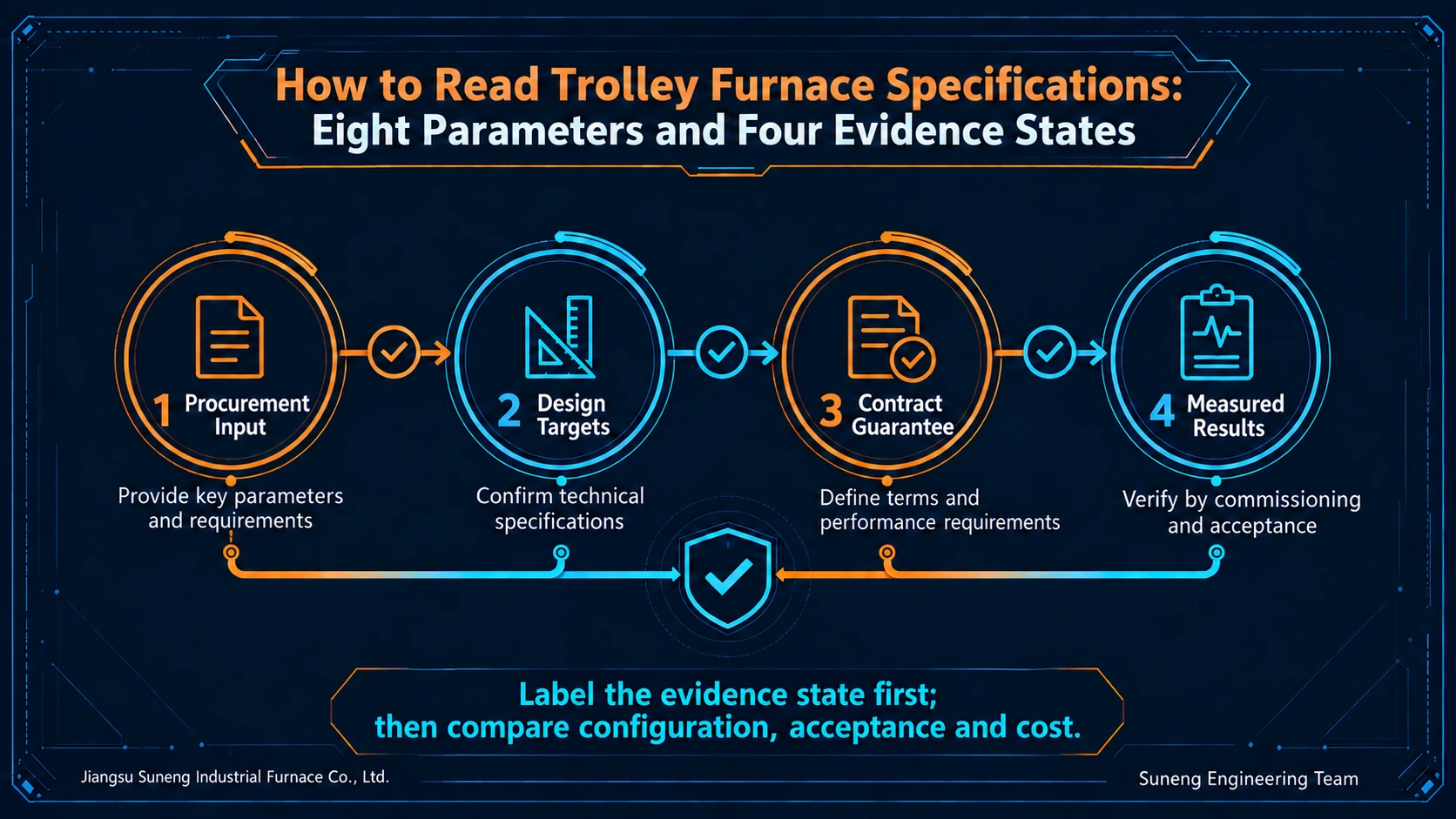
Four states of a parameter
- Procurement input: buyer-supplied workpiece, process, output, energy and site conditions.
- Design target: a proposed engineering objective, not an acceptance result.
- Contractual guarantee: the agreed responsibility in the contract or technical agreement.
- Measured result: a record obtained for a defined region, state, instrument and method.
These cannot replace each other. A design target is not a measurement, and one measured result cannot be extended to every load and temperature.
1. Effective working zone
Distinguish chamber geometry from the agreed loading and process-verification area. State dimensions, location and drawing reference, aligned with loading and temperature-test regions. Chamber dimensions alone do not establish whether every workpiece and fixture is within the agreed zone or which space a result describes.
2. Loading capability
Identify maximum/usual parts, individual weights, quantities, fixtures, total load, distribution and handling. Equal total weight with different support or distribution can create different structural and movement duties. A deck size or single load figure cannot describe every loading condition.
3. Temperatures and curve
Maximum permissible temperature, usual working temperature, full heating/holding/cooling curve and door/transfer conditions are separate inputs. A maximum alone does not establish process coverage or cycle. Identify the measured object and state, with the required range defined by the process documents.
4. Temperature uniformity
Attach the effective zone, temperature, empty or agreed load, points/instruments, stabilisation/records, calculation/evaluation and retest method. Without these, deviation figures cannot compare proposals. Furnace uniformity is not workpiece temperature and does not itself prove hardness, microstructure or distortion.
5. Heating capability
Heating time or rate needs start/end conditions, measured object, load, curve and allowed control method. Empty, fixture-only and production-loaded heating are different results. Thermal capacity, structure, losses, heat input and controls also affect performance; no universal heating time applies.
6. Power and consumption
Electric installed power describes configuration and the supply requirement. Gas proposals need fuel conditions, combustion capacity, air, exhaust and safeguards. Neither rating directly establishes consumption. Align workpieces, loading, process, output, meters and periods before comparing energy. Higher power or newer components do not prove a saving.
7. Controls and records
Instrument/sensor accuracy, control stability, furnace distribution and workpiece temperature are different subjects. Specify zones, programs, records, alarms, permissions, retention, interfaces and documents rather than only brands or zone count. Match zones to the design, load and control strategy and verify them.
8. Movements and interlocks
For trolley, door, heat source, circulation, quenching and related equipment, state permitted states, triggers, prohibited actions, alarms, abnormal responses and reset conditions. “Interlocked” or “automatic” is insufficient for a test plan. Safety functions require project risks, applicable requirements and site management; equipment configuration does not replace operating and maintenance responsibilities.
How the parameters affect procurement
| Parameter | Decision affected | Check |
|---|---|---|
| Effective zone | Fit, size and temperature tests. | Region, location and drawing reference. |
| Loading | Structure, trolley, handling and production. | Individual/total load, distribution and fixtures. |
| Temperatures/curve | Heating duty and process coverage. | Object, range, stages and curve. |
| Uniformity | Temperature design and acceptance. | Zone, state, points, records and criteria. |
| Heating | Configuration and cycle. | Start/end, load, curve and measured object. |
| Power/energy | Utilities and interfaces. | Rating, meters and reporting conditions. |
| Controls/records | Operation, traceability and interfaces. | Functions, zones, records, permissions and documents. |
| Movements/interlocks | Integration and abnormal response. | States, triggers, prohibitions, alarms and reset. |
The table generates clarification questions, not a universal contract directory. Confirm which items are guaranteed and their tests in the project documents.
Common questions
Does a longer specification mean a more complete proposal?
No. Object, conditions, units, state, responsibility and verification matter more than repeated brands and terminology.
Does control accuracy represent uniformity?
No. Control performance, temperature distribution and workpiece measurement need separate definitions and records.
Does higher installed power guarantee faster heating?
No. Load, thermal capacity, process, structure, losses and controls also matter and require testing in the agreed state.
Suneng's scope
Suneng designs, manufactures and integrates furnace equipment and provides commissioning, retrofit and support. It can assess trolley parameters, controls, supply and acceptance from agreed workpiece, process, load, energy and site inputs. This article makes no project-parameter, product-quality or general safety-compliance guarantee. The agreed project documents govern tests, installation and service.