

To determine how much time a quench tank needs between batches, first check whether the liquid temperature after the previous batch is still within the range allowed for the next batch. If cooling is needed, calculate the recovery time and coordinate it with loading and unloading. Jiangsu Suneng Industrial Furnace Co., Ltd. recommends focusing on three quantities: the amount of liquid actually participating in cooling, the temperature reduction required, and the average rate at which the cooling system can remove heat over that temperature range. When the tank liquid is well mixed and heat input from the previous batch has become negligible, recovery time can be estimated as “heat remaining to be removed ÷ average net heat-removal rate.”
Why might a tank have room for the next batch but still be unable to receive it?
Hot workpieces entering the tank transfer heat to the quenchant, the liquid used to cool them. The liquid absorbs this heat and its temperature rises; the cooling system then removes the heat. Whether the next batch can arrive as scheduled depends on whether the liquid has returned to the temperature range allowed by the process.
These are two different functions: the amount of liquid determines how much heat the tank can buffer; the capacity to reject heat outside the tank determines how quickly that heat can be removed. Agitation helps liquid flow around the workpieces and mix to reduce temperature differences, while the heat exchanger transfers heat to the external cooling side. Assessing these functions separately helps identify the actual constraint on the production schedule.
How is recovery time calculated?
First, establish two temperatures:
- Recovery start temperature T₁: the representative temperature of the well-mixed tank liquid when heat input from the previous batch has become negligible.
- Recovery target temperature T₂: the tank liquid temperature permitted by the process before the next batch enters.
The required temperature reduction is ΔT = T₁ − T₂. This difference equals the net liquid temperature rise caused by that batch only if the target is the same temperature as before the previous batch entered. If the recovery target differs, calculate the difference again.
For a recovery period during which the amount of liquid remains approximately constant, evaporation and make-up additions are negligible, and specific heat can be treated as constant:
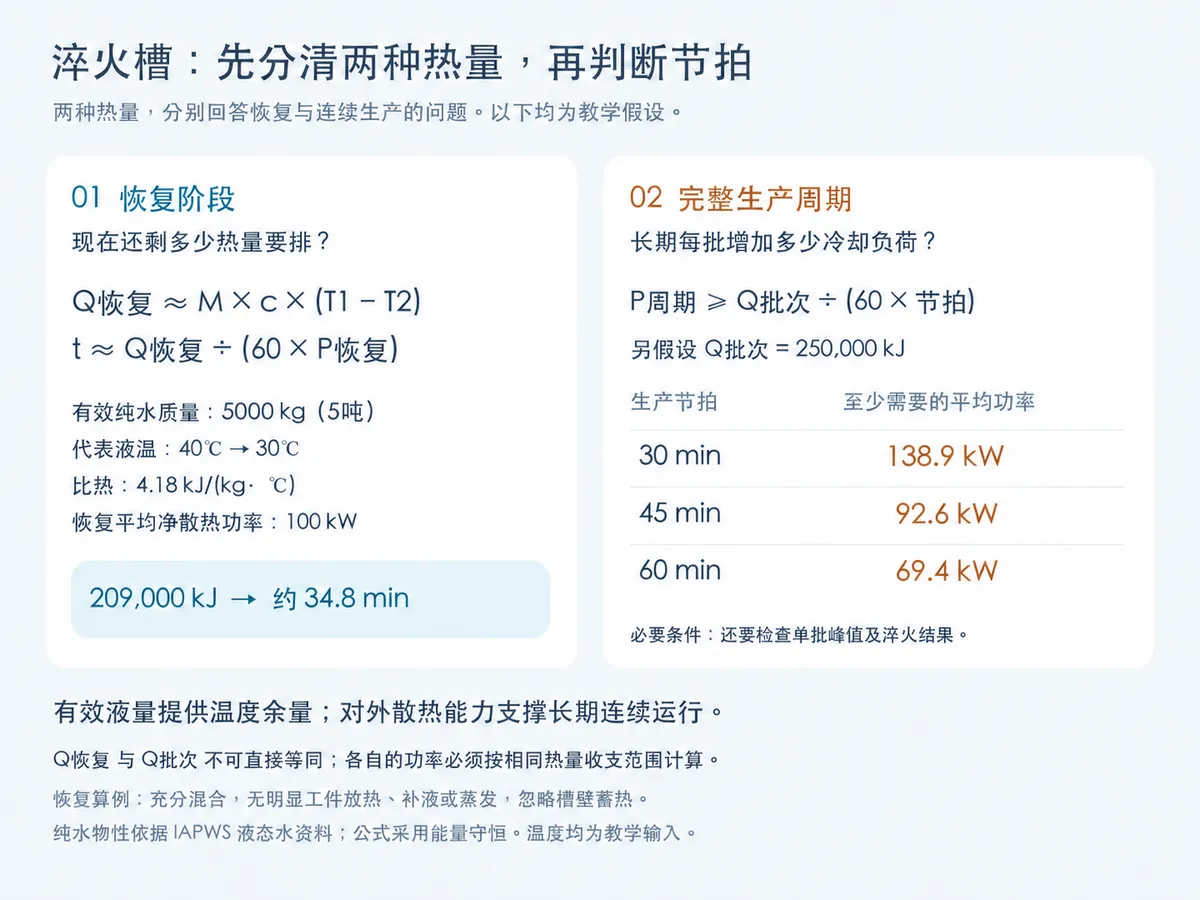
Heat remaining to be removed: Q_recovery ≈ M × c × ΔT
Recovery time: t ≈ M × c × ΔT ÷ (60 × P)
| Symbol | Value to use | Unit |
|---|---|---|
| M | Mass of liquid actually participating in this recovery period, determined from the effective liquid inventory | kg, kilograms |
| c | Average specific heat of the actual quenchant over the calculation temperature range: the heat released when 1 kg of liquid cools by 1°C | kJ/(kg·°C) |
| ΔT | Recovery start temperature minus recovery target temperature | °C |
| P | Average net heat-removal rate over the entire recovery period | kW, kilowatts |
| t | Time required to recover from T₁ to T₂ | min, minutes |
The effective liquid inventory is not the tank's geometric volume itself. It is the mass of liquid that actually participates in heat absorption, circulation and temperature mixing during this quench and recovery process.
Engineering calculations should start from the actual operating liquid level. They should account for the space occupied by workpieces, baskets and structural components, and assess whether each region can participate sufficiently in circulation and heat exchange within the time of interest. Stagnant regions with very weak circulation, or markedly stratified regions whose temperatures do not represent the bulk liquid, should not be assigned the same fully effective heat capacity as the bulk liquid.
Tank dimensions or nominal capacity alone are therefore insufficient. The actual operating liquid level and the circulation and agitation layout are also needed. Overestimating the effective liquid inventory understates the calculated temperature rise per batch and may lead to an overly optimistic assessment of recovery capability.
Here, the “net heat-removal rate” means the heat actually removed from the tank liquid, on a net basis, each second: heat carried away by the cooling circuit and other heat-loss paths, minus heat returned to the liquid by pumps, agitation and other inputs. 1 kW equals 1 kJ per second; the factor 60 converts seconds to minutes.
This equation applies to cooling when T₁ is above T₂ and P is positive. If the current liquid temperature is already within the range allowed for the next batch, no additional wait for this cooling period is needed. If the average net heat-removal rate is zero or negative, the current operating conditions cannot produce net cooling of the liquid; restore suitable heat-removal conditions first.
This simplified equation neglects heat stored in the tank walls and other components. If workpieces are still releasing heat, or stored heat in the tank walls is significant, include those heat contributions in the calculation. The equation covers the tank liquid recovery stage. It does not calculate the quenching time of the whole batch or the full interval between two batch immersions.
Where does P come from?
When purchasing equipment, ask the supplier for a heat-exchanger calculation or cooling curve that uses the site's cooling-water conditions and covers the entire temperature range from T₁ to T₂. For equipment already in use, the average can be calculated from a liquid cooling record taken during a period with negligible workpiece heat input, then used to assess similar operating conditions.
If cooling-side flow and inlet and outlet temperatures are available, the actual heat removed by the exchanger can also be calculated as “mass flow rate × specific heat × inlet-to-outlet temperature difference.” Other heat inputs and outputs must still be considered when relating exchanger heat removal to net heat removal from the tank liquid. Flow rates, temperatures on both sides and heat-transfer conditions jointly determine exchanger duty. Alfa Laval heat-exchanger calculation method
Thus, when a specification gives the circulation pump's power in kilowatts, ask for the heat-exchanger duty at the relevant operating conditions. When it gives heat-transfer area in square metres, examine the flow rates on both sides, inlet temperatures and the complete cooling curve.
Example: how long does it take to cool 5 tonnes of water by 10°C?
The following is a hypothetical example illustrating the calculation. It is neither an operating record for a particular machine nor a recommended quenching temperature.
Assume that 5,000 kg of pure water actually participates in recovery. The previous batch has been removed, the well-mixed water is at 40°C, and the recovery target is 30°C. Make-up water and evaporation are negligible during this period, tank-wall heat storage is neglected, and the average net heat-removal rate is 100 kW.
For pure water near atmospheric pressure over this example's 30–40°C range, specific heat is approximated as 4.18 kJ/(kg·°C). This approximate property value is based on the liquid-water correlations published by the International Association for the Properties of Water and Steam. It must not be used directly in place of the properties of oil or a polymer solution. Liquid-water property data
Step 1: calculate the heat to be removed.
Q_recovery ≈ 5,000 × 4.18 × (40 − 30) = 209,000 kJ
Step 2: calculate the recovery time.
t ≈ 209,000 ÷ (60 × 100) = 34.8 min
Step 3: compare this with the time allocated to tank liquid recovery.
If the production schedule allows only 30 minutes for this recovery stage, an average net heat-removal rate of 100 kW is insufficient. Rearranging the same simplified model gives:
Required average net heat-removal rate ≈ 209,000 ÷ (60 × 30) = 116.1 kW.
For the same 5,000 kg of pure water cooling from 40°C to 30°C under the assumptions above:
| Average net heat-removal rate over the entire recovery period | Calculated recovery time | Assessment against a 30-minute recovery window |
|---|---|---|
| 60 kW | Approximately 58.1 min | Heat removal is too slow |
| 100 kW | Approximately 34.8 min | Still cannot recover within 30 minutes |
| 120 kW | Approximately 29.0 min | Feasible by calculation |
If the purchasing requirement is a 30-minute interval between two batch immersions, put immersion, lifting and preparation of the next batch on the same timeline. Account for overlapping activities according to the actual production process.
Can a larger tank reduce the waiting time?
The actual constraint is whether the tank liquid temperature is still within the range allowed by the process before the next batch enters. The liquid does not necessarily have to return to exactly the same initial temperature as before the previous batch. These are different constraints, and the distinction directly changes the value of increasing the liquid inventory.
With the same liquid temperature before immersion, the same net heat stored in the liquid per batch, and the same quenchant:
Temperature rise per batch: ΔT ≈ net heat input per batch ÷ (effective liquid mass × specific heat).
Here, net heat input per batch means heat transferred into the liquid during that stage minus heat already removed over the same period. With more liquid, the same amount of heat produces a smaller average temperature rise, leaving more temperature headroom between the peak average tank temperature and the upper process limit.
Considering only the average tank liquid temperature constraint, if the liquid remains within the range allowed for the next batch after the previous batch has finished, no additional waiting time is needed specifically to cool the tank liquid again. Increasing the effective liquid inventory can therefore shorten, or even eliminate, this part of the cooling wait between batches.
It works because the same batch heat input produces a smaller liquid temperature rise, providing more usable temperature headroom, rather than making the exchanger reject heat faster.
However, increasing liquid inventory does not increase heat-removal capacity. The same heat must eventually be removed through the exchanger and other heat-loss paths; what changes is the available time window for removing it:
- If the liquid temperature after the previous batch exceeds the upper limit allowed for the next batch: enough heat must be removed between batches to bring the temperature back into the allowed range.
- If the liquid temperature after the previous batch remains within the allowed range: a “complete recovery” is not required before receiving the next batch. Provided the equipment allows the cooling system to run continuously, heat can keep being removed throughout the subsequent production cycle, including quenching, lifting, loading and unloading. The peak temperature produced by the next batch must still be checked separately.
Increasing effective liquid inventory addresses the immediate temperature rise and available temperature headroom; increasing heat-removal capacity addresses whether heat can continue to be removed over the long term. Neither substitutes for the other.
There is also a possible effect in the opposite direction. With essentially the same heat exchanger, circulation flow and cooling-water conditions, increasing the liquid inventory reduces the temperature rise caused by the same batch heat input. The temperature difference between the tank liquid and the cooling side may become smaller, so the actual average net heat-removal rate may also decrease. Recalculate using the new liquid temperature profile rather than directly reusing the previous average heat-removal rate. Alfa Laval explanation of heat-transfer principles
For a purchasing assessment: if the peak liquid temperature after a batch approaches or exceeds the upper process limit, evaluate both effective liquid inventory and heat-removal capacity. If the temperature before immersion rises over successive batches, long-term heat balance has not yet been established. If average heat removal remains insufficient at the target production interval, adding liquid only increases thermal capacity and delays the time at which the limit is exceeded; it cannot replace sufficient long-term heat-removal capacity.
Can the system sustain continuous production?
First distinguish two heat quantities, then consider the complete production cycle.
1. Recovery heat: how much heat is still left to remove now?
The earlier equation:
Q_recovery ≈ M × c × (T₁ − T₂)
describes how much heat must still be removed to bring the tank liquid from the recovery start temperature to the target temperature. It is used to calculate the remaining wait after this batch.
2. Long-term net heat load per batch: how much load does each batch add over time?
Q_batch is the net heat load per batch that the external cooling system ultimately has to handle over one complete production cycle.
Q_batch and Q_recovery are different quantities with different time boundaries and heat-balance accounting bases.
Calculate the average net heat-removal rate over the complete cycle and Q_batch using the same external cooling-system boundary, counting each heat flow once. The P inferred from the falling liquid temperature during recovery cannot directly substitute for cooling capability over the complete cycle.
Stable continuous operation must at least satisfy long-term average heat balance:
Average net heat-removal rate over the complete cycle ≥ Q_batch ÷ (60 × batch interval)
Use kJ for Q_batch, min for the batch interval and kW for the average net heat-removal rate. The batch interval is the time between successive batch immersions.
This is a necessary condition for continuous operation, not a sufficient condition on its own. Even if the average heat load can be removed, also check peak tank temperature for each batch, flow in the loading zone, temperature stratification or stagnant regions, summer cooling-water conditions, quenchant condition and the final quenching results of the workpieces.
Continuous-production example
To illustrate the continuous-production criterion, make a separate teaching assumption that the long-term net heat load is 250,000 kJ per batch.
| Batch interval | Minimum average net heat-removal rate needed to maintain long-term heat balance |
|---|---|
| 30 min | 138.9 kW |
| 45 min | 92.6 kW |
| 60 min | 69.4 kW |
- Below the requirement: if average heat removal remains insufficient, stored heat progressively increases and the liquid temperature before immersion continues to rise.
- Close to the requirement: there is little heat-balance margin. Warmer cooling water, fouled heat-transfer surfaces or increased batch weight may make the existing interval difficult to maintain.
- Well above the requirement: there is a larger heat-balance margin to accommodate production fluctuations within that margin. Peak temperature per batch and local flow conditions must still meet their respective requirements.
Which conditions can change the assessment?
| Site condition or finding | Why it affects the result | What the customer should do |
|---|---|---|
| A different material, heavier workpieces or baskets, or a higher immersion temperature | The incoming heat changes; hot baskets also release heat to the liquid | Recalculate heat input for the new batch's workpieces and tooling, or obtain a liquid temperature curve for a representative batch |
| A switch to oil or a polymer solution | Specific heat, viscosity and quenching cooling characteristics change | Use properties for the actual quenchant and concentration, and the supplier's allowed operating temperatures; do not apply the water example directly |
| Warmer summer cooling water, reduced flow, a fouled filter or fouled heat-transfer surfaces | The actual heat-removal rate may fall, increasing recovery time for the same temperature reduction | Compare recovery curves under these water-supply conditions and establish the operating conditions the cooling system must handle |
| Liquid temperature before immersion rises over successive batches | A periodic heat balance has not yet been established; assess whether continued operation can stabilize within the allowed temperature range | Investigate using the effective liquid inventory and cooling-side records; adjust batch heat input, interval or heat-removal capacity, then reassess the continuous process |
| The temperature reading reaches the target, but workpiece-zone flow is insufficient or uneven | An acceptable temperature at one point does not establish suitable cooling conditions throughout the loading zone | Check measurement locations, flow obstruction by the load and flow distribution, and verify workpiece results against process requirements |
Workpiece dimensions and loading density also affect how quickly heat is released. The same weight and total heat do not mean the same immediate temperature rise or local cooling conditions. Flow distribution in the actual loading zone also depends on agitation and flow-guiding arrangements, and should be assessed for the specific layout and load. Analysis of quench-tank agitation design
Set the recovery target temperature for the actual material, quenchant and process. If the process specifies a transfer time limit after workpieces leave the furnace, arrange for the tank liquid to be ready before furnace discharge. Do not compensate for inadequate cooling-system recovery by leaving hot workpieces outside the furnace waiting for the tank.
Three common mistakes that affect purchasing decisions
- Substituting the heat-removal capability at the start of cooling for the average over the entire period. Examine the recovery curve across the full temperature range, particularly the later part as it approaches the target temperature.
- Treating tank liquid recovery time as the batch interval for the entire line. Put quenching, removal from the tank, recovery and receipt of the next load on one timeline, and identify which activities can overlap.
- Equating “the liquid temperature has recovered” with “the quenching result is acceptable.” Liquid temperature recovery is only one condition for receiving the next batch. Loading-zone flow, process requirements and workpiece inspection each still have their own role.
What should the customer prepare next?
Start by gathering three groups of information:
- Heat brought in by the batch: workpiece material, weight per batch, immersion temperature, main dimensions and loading arrangement. List the weights of hot baskets and lifting fixtures separately, and state whether they enter the tank with the batch. Include existing liquid temperature curves if available.
- How the tank stores and removes heat: quenchant grade and concentration, actual operating liquid level and effective liquid inventory, recovery start and target temperatures, cooling-water inlet temperature and flow rate, and heat-exchanger information.
- Time allowed by the production requirement: the planned interval between two batch immersions and the time occupied by immersion, lifting, liquid recovery and preparation of the next batch.
When comparing supplier proposals, first check whether they use the same effective liquid inventory. If the liquid inventory is the same and the comparison concerns only the cooling system, use common recovery start and target temperatures and cooling-water conditions. If liquid inventories differ, use the same batch heat input, initial liquid temperature before immersion, recovery target, cooling-water conditions and timing boundary; let each proposal calculate its temperature rise and recovery process using its own liquid inventory. Include heat already removed by the cooling system during quenching in each proposal's heat balance. This compares capability against the same production task without artificially assigning different heat-removal loads to different tanks. A proposal truly answers the continuous-production question when it explains where the heat comes from, how long removal takes and how the next batch fits into the process.
To assess whether an existing quench tank can support the planned batch interval, send workpiece information, tank liquid temperature records and cooling-system information to the Jiangsu Suneng Industrial Furnace engineering team for a preliminary calculation of recovery time, assessment of the continuous-production criterion and comparison of possible adjustments. If the information is incomplete, start with what is available and identify the missing items.
Public email: 997518512@qq.com
Telephone: +86-130-5298-6814