

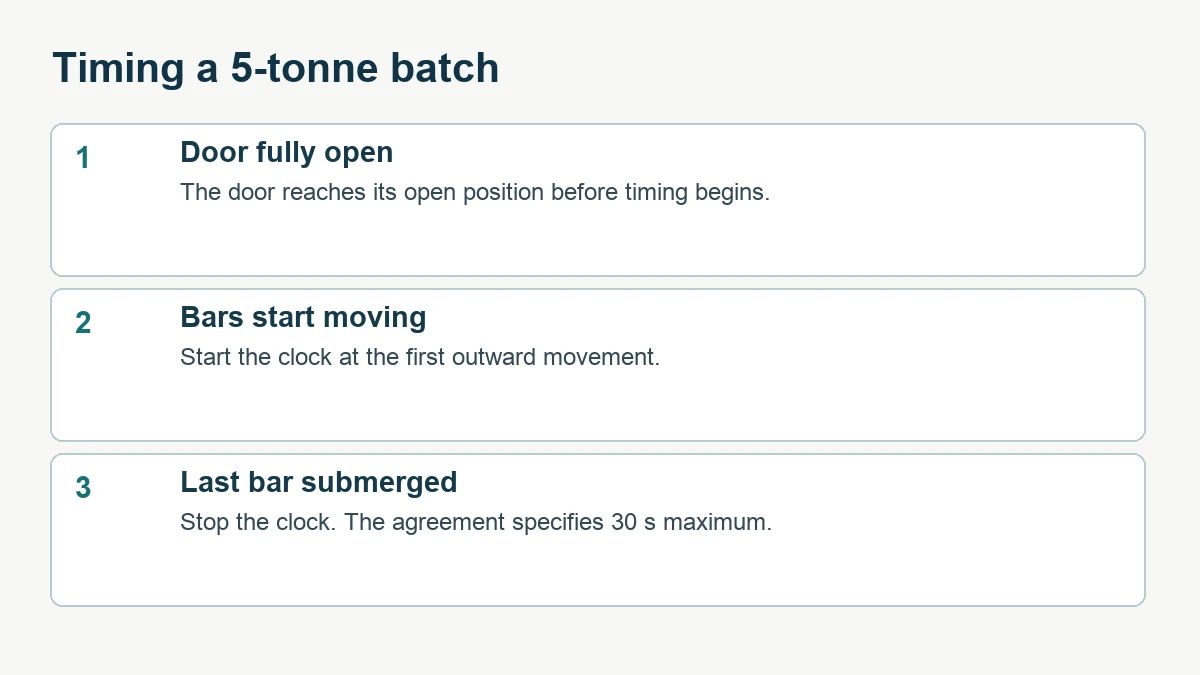
For a long-bar fork-handling furnace supplied by Jiangsu Suneng Industrial Furnace Co., Ltd., the agreement specifies at most 30 seconds from withdrawal to immersion. Suneng specifies a 5-tonne workpiece load for this check. With the door fully open, start timing when the bars begin moving out. Stop when the entire batch is under water.
What does the 6 m dimension on the drawing mean?
The working dimensions are 1.3 m long × 6 m wide × 0.6 m high. The 6 m runs across the door. Check the direction of the bars and the width and height of the complete load. The largest chamber dimension alone cannot tell you whether the forks can withdraw the loaded batch as drawn.
Three conditions to check in the agreement
| Item | Specified condition | What to check |
|---|---|---|
| Working zone | 1.3 m × 6 m × 0.6 m | Length, width and height. Compare the complete load envelope. |
| Load per batch | 5 tonnes of workpieces | Support blocks are excluded. List the fixtures used with the batch separately. |
| Transfer time | At most 30 seconds with 5 tonnes of workpieces | From the first outward movement after the door is fully open to complete immersion of every bar. |
Show the hearth supports and quench tank on the same drawing
The bars heat on support blocks. The forks of the rail-mounted charging car enter between the supports to lift the batch. The agreement drawing shows the forks, blocks and tank together. For a similar job, ask both parties to mark the orientation and envelope of the load and the tank position on one drawing. The buyer supplies the tank. Its position sets the distance the car must travel.
Process route: heat the bars on the hearth blocks → lift the complete batch out → immerse the batch in the tank.
How to check the 30-second requirement against a batch record
If your specification starts the clock as the door begins to open, the opening time is included. That is a different interval. Before comparing quotations, mark the same starting and stopping events on both suppliers’ record sheets.
For batch transfer, the record must show when the last bar became fully submerged. File the net workpiece weight, load drawing, time the door reached its open position, first outward movement and full immersion under one batch number. Use the product inspection record for that batch to check the specified hardness.
Our bars are 6 m long. Can we use the same 30 seconds?
The 6 m is the working width of this particular furnace. Check actual bar length, orientation and end clearances on the load drawing, then compare supports and the route to the tank. Supply the bar dimensions, piece count, net batch weight and position of the tank relative to the door before using this agreement as a comparison.
Source: 2023 contract appendix for the high-temperature chamber furnace with fork handling, pp. 3–4 and 11–12. The long-bar configuration on Suneng’s fork-handling furnace page gives the load definition and the timing limits.
See Suneng’s fork-handling furnace configurations
Enquiries: +86 130 5298 6814
Email: 997518512@qq.com
Technical authors: Suneng Industrial Furnace Engineering Team and Tang Li