

Before accepting temperature uniformity, identify the furnace, area and operating state, then agree permitted deviations and methods. Suneng's mesh-belt and continuous-annealing documents support three checks: measured object, comparison area and corresponding operating records. A stable controller display, an acceptable temperature spread across one section and an acceptable workpiece temperature answer different questions.
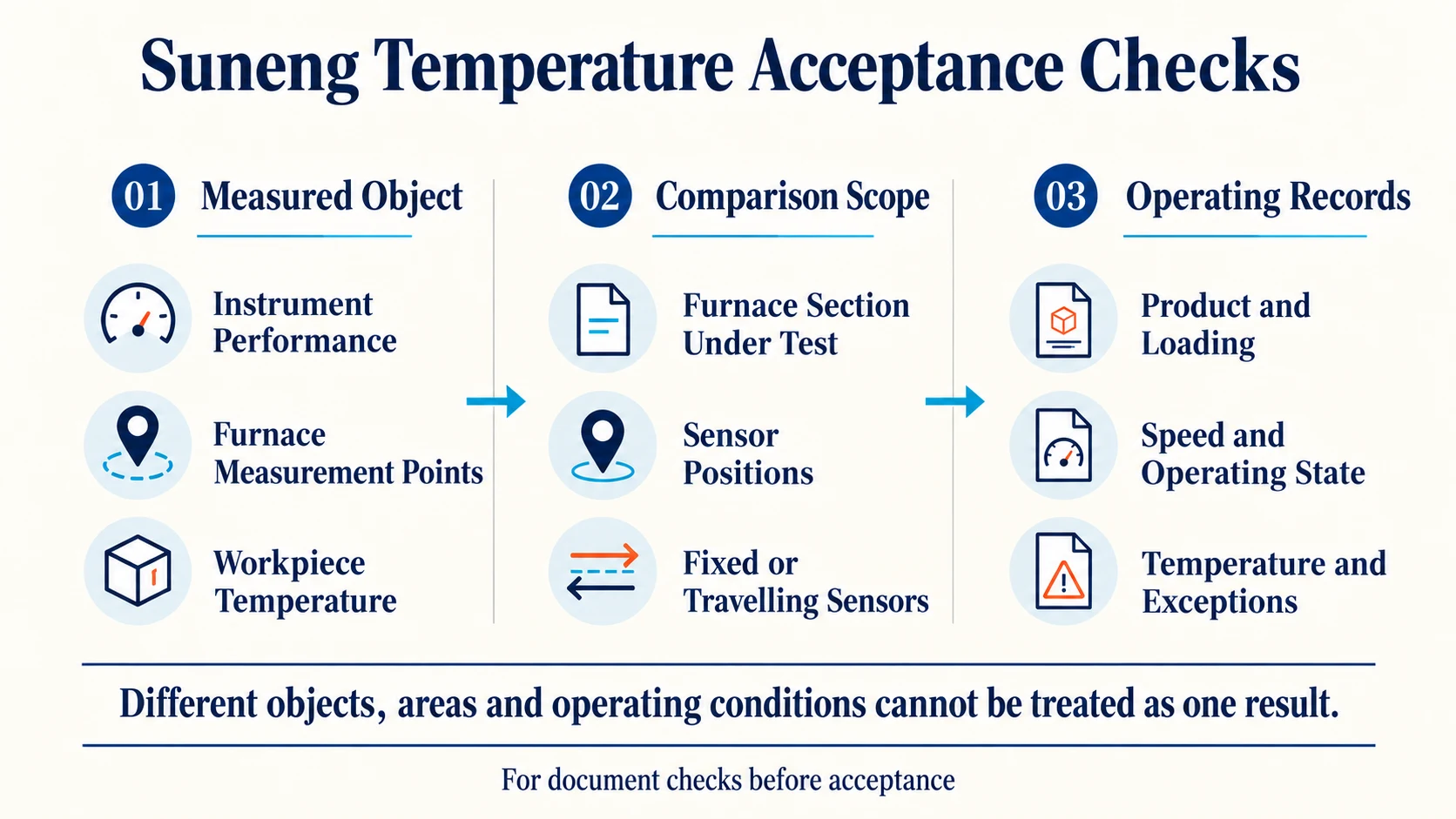
1. Identify what the data measures
Furnace temperatures, controller performance and actual workpiece temperature may appear together in proposals and acceptance documents. Label the measured object for each data set first.
Archived Suneng mesh-belt proposals separately list tempering-furnace uniformity and temperature-controller accuracy. Continuous-annealing proposals distinguish chamber measurement points from exit-strip measurement, and furnace-zone control fluctuation from strip-temperature fluctuation.
An instrument specification describes that instrument. A curve from one furnace point describes change over time at that location. Neither alone establishes temperature distribution throughout the agreed area.
Exit-strip measurement describes the strip at the measured location, not spatial uniformity throughout the furnace. Strip is metal moving continuously through the equipment in band form. For any curve, ask whether it records a furnace point, instrument display or workpiece. An undefined object leaves “pass” without a clear meaning.
2. Define which temperatures can be compared
A line has different operations; a continuous furnace may have preheating, heating and soaking zones. A soaking zone further brings the workpiece toward its required thermal condition. Different functions may use different setpoints.
Subtracting the minimum and maximum across unrelated process sections does not establish “complete-line uniformity”. Nor does an average of control points prove every position complies.
One archived Suneng mesh-belt tempering proposal limits uniformity to the same cross-section inside the chamber. Specify its orientation, width, height and location on the test drawing. This restriction cannot be expanded into a single inlet-to-outlet temperature-difference guarantee.
State whether sensors are fixed or travel with workpieces, and whether results cover a section, an agreed effective heating zone or the workpiece's temperature history through successive sections. The effective heating zone is the working region demonstrated by an agreed method to meet temperature requirements.
Fixed and travelling measurement duties must follow applicable documents and the test plan. A travelling device records its passage with the measured object; a complete time history does not automatically verify all spatial uniformity.
Suneng's sequence is to mark the tested furnace section on the flow diagram, define the comparison area on the sensor layout, then link every curve to a point or travel position. List untested areas explicitly.
3. Evaluate temperatures with operating records
Retain the product, loading, speed and equipment state corresponding to each curve. Archived continuous-annealing proposals define stable operation before performance evaluation and separately address stops, slow-down and time to restabilise. Mesh-belt controls provide zone temperatures, process time and historical queries.
The record used for acceptance must match its operating conditions. Product, loading or speed changes require explanation rather than carrying an earlier “pass” forward unchanged.
Keep complete stop, slow-down and manual-adjustment records. Apply pre-agreed rules to decide valid periods and supplementary tests. Do not retrospectively delete unfavourable data to improve a curve.
Temperature-acceptance checklist
| Provide | Suneng checks | Effect if missing |
|---|---|---|
| Agreement temperature requirements and process flow | Furnace/section and furnace versus workpiece measurement | Different objects may be mistaken for one promise. |
| Test-area/sensor drawings and channel descriptions | Cross-section/effective-zone limits; fixed/travelling sensor-to-curve relationship | Covered positions cannot be determined. |
| Raw curves with products, loading, speed and exceptions | Agreed operating conditions and abnormal-period treatment | Representativeness of the result remains unknown. |
Agree methods before testing
Determine allowed temperature differences, sensor count, calibration requirements, recording period and calculation method from applicable standards and project documents before the test. China's national standard on determining effective heating zones of heat-treatment furnaces is a reference to check. Applicability, edition and implementation require equipment/project confirmation.
This article supports pre-acceptance clarification for mesh-belt and continuous-strip annealing lines. It does not provide a universal acceptable temperature spread or a site sensor layout. For acceptance, match records to the actual equipment, measured area and valid operating conditions. Calculate results using the agreed method and compare each with its limit. A pass covers only the tested scope; deviations require disposition and retest. Missing or unmatched records require investigation, retrieval or an explicit undetermined conclusion, not an automatic “untested” or “passed” label. Passing temperature tests does not replace product-specification quality inspection.
Prepare for the first discussion
Provide the line type, page containing temperature requirements and an existing curve or sensor sketch. Suneng can identify objects, comparison boundaries and missing records before discussing the actual test. Public contact: +86-130-5298-6814.
Information basis
The method derives from archived Suneng mesh-belt and continuous-annealing documents, retaining distinctions between indicators, measurement scope and operating records. Related product/solution pages describe equipment scope. Consult the official Chinese national-standard public information for the standard name and edition.
Related Pages and Sources
- Contact the Suneng Engineering Team
- Roller-supported Mesh Belt Resistance Furnace Line
- Continuous Heat Treatment Line Planning
- Chinese National Standard Public Information