

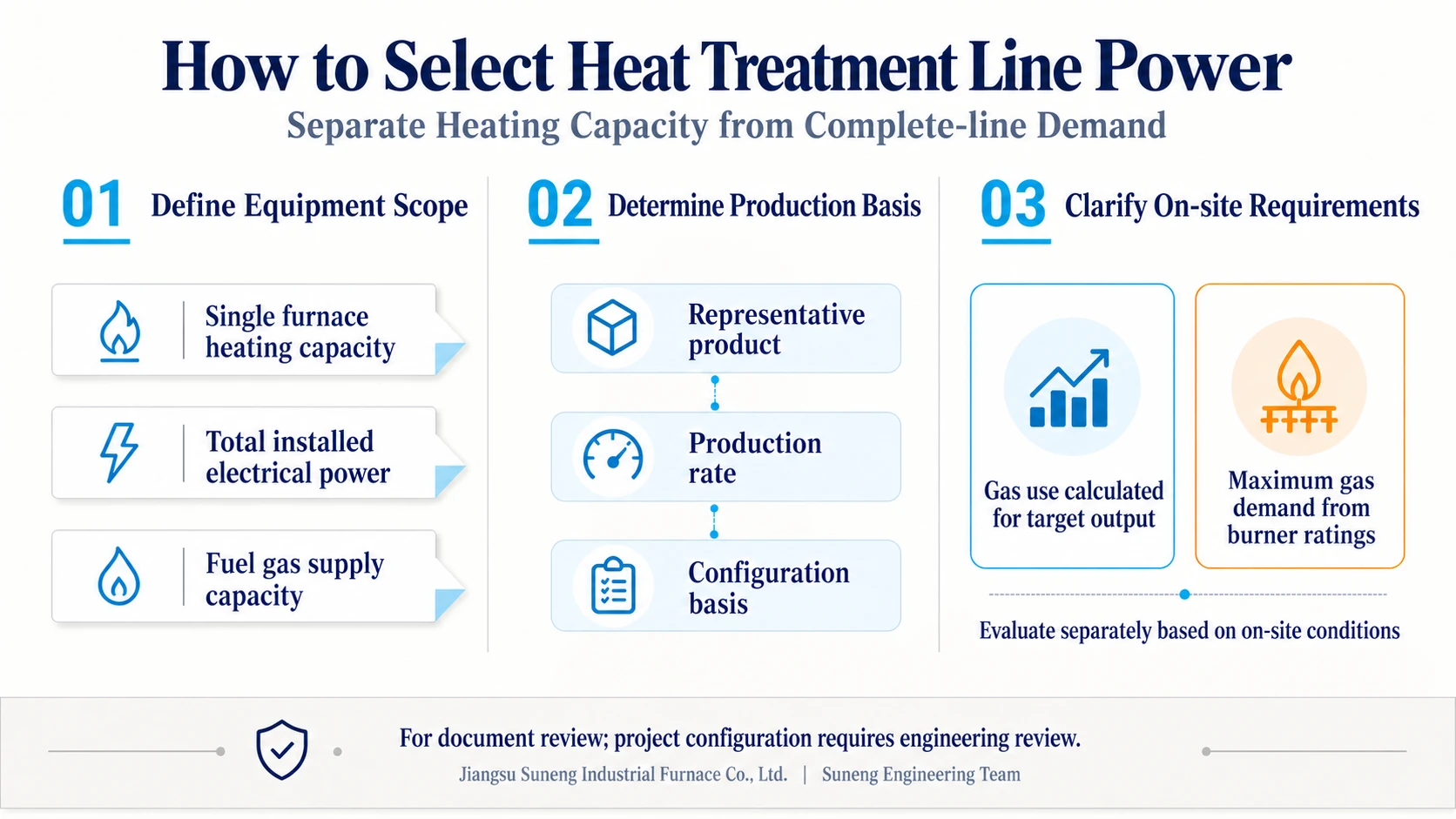
Select power by checking equipment scope, products and production speed, then site energy conditions. From continuous-annealing and mesh-belt line documents, Suneng derives three comparisons: equipment scope, production basis and site demand. For gas heating, distinguish consumption calculated for target output from maximum demand based on all burners. A burner supplies fuel for combustion heating.
Comparison 1: whose power is being quoted?
A proposal may state one furnace's heating power, total installed electrical power for the line and gas-fired heat-input capacity. Total installed electrical power sums rated electrical loads within a defined scope; it is not power continuously consumed during operation.
Archived Suneng mesh-belt documents list line power and individual-furnace heating power separately. Comparing a quenching furnace's heating power with another proposal's total line power cannot establish which configuration is better.
Gas heat input also differs from electrical demand: fans, conveying and controls may still require electricity. Identify included equipment and buyer-supplied auxiliaries before comparison. Every number needs an explicit equipment boundary.
Comparison 2: what production task must the power support?
Thermal load is the heating duty per unit time under specified production conditions. Establish product, process and speed before engineering calculations determine installed heating capacity.
Suneng continuous-annealing proposals relate representative product, speed, output, heat calculation and gas consumption. Mesh-belt documents tie output to shape, size, weight, loading and process. Power and capacity must therefore refer to the same production conditions.
Trace representative product → production speed → heat requirement → configuration basis. A representative product is a typical calculation workpiece; its result does not automatically cover every product. Cross-check heating time against the proposal's effective heating length and speed.
If a supplier gives only power and hourly output, request the corresponding product, loading and process assumptions. Even identical output figures can use different conditions. The result should be a configuration explanation traceable to inputs. Heat calculations, efficiency assumptions and allowances require project engineering review and cannot simply be copied from another line.
To form a configuration, calculate workpiece heat demand from product and throughput, then include applicable tooling heat, furnace storage, wall and exhaust losses. Distinguish net demand from source input. Check production, heat-up and low-load operation separately, including zone ratings, controllable range and justified allowances. Revise options that meet production demand but fail the agreed heat-up task or cannot regulate stably at low load. This is a purchasing review sequence, not a project calculation; use consistent energy boundaries without counting losses twice. See the U.S. Department of Energy process-heating sourcebook for general context.
Comparison 3: production consumption versus maximum site demand
An archived Suneng gas-fired continuous-annealing proposal lists both gas demand calculated for rated production and maximum demand based on all burner ratings. Here, rated production means the proposal's capacity for agreed products and operating conditions.
The first describes calculated use for specified production. The second describes maximum demand associated with the installed burners. The production figure alone does not establish adequate site gas capacity; maximum burner demand is not continuous actual consumption. Confirm supply requirements from operating modes and site conditions.
Electric lines also need matching equipment and power-supply scopes. Suneng mesh-belt documents separately assign factory-supply-to-cabinet and cabinet-to-equipment connections. After power checks, confirm termination points and connection responsibility so site provisions are not omitted.
Power-comparison checklist
| Provide | Suneng checks | Effect if missing |
|---|---|---|
| Power figures and corresponding equipment list | Separate furnace heating, line electricity and gas heat input; included auxiliaries | Proposal scope cannot be compared. |
| Representative parts, process and target output | Common product, loading and speed basis for power/output | Configuration may not match the production task. |
| Consumption explanations and known site electricity/gas conditions | Production-calculated use versus maximum demand; connection points and owners | Utility adequacy and missing provisions remain unknown. |
Scope and first discussion
This method supports pre-purchase document checks for continuous-annealing, mesh-belt and similar lines. It identifies mixed scopes, missing calculation inputs and site gaps. It does not replace project thermal calculations, electrical distribution or gas-system design, and gives no general consumption/output guarantee.
Provide representative parts/material, process and target output; attach power/utility pages from existing proposals. Suneng can identify equipment scope, calculation conditions and missing information before discussing configuration. Public contact: +86-130-5298-6814.
Information basis
The method derives from archived Suneng continuous-annealing and mesh-belt technical documents and retains purchasing-check relationships only. Related line and roller-supported mesh-belt product pages describe equipment scope. ISO's furnace energy-balance/efficiency information provides general methodological context, not a universal configuration value for an individual line.
Related Pages and Sources
- Contact the Suneng Engineering Team
- Continuous Heat Treatment Line Planning
- Roller-supported Mesh Belt Resistance Furnace Line
- ISO Standard Information