

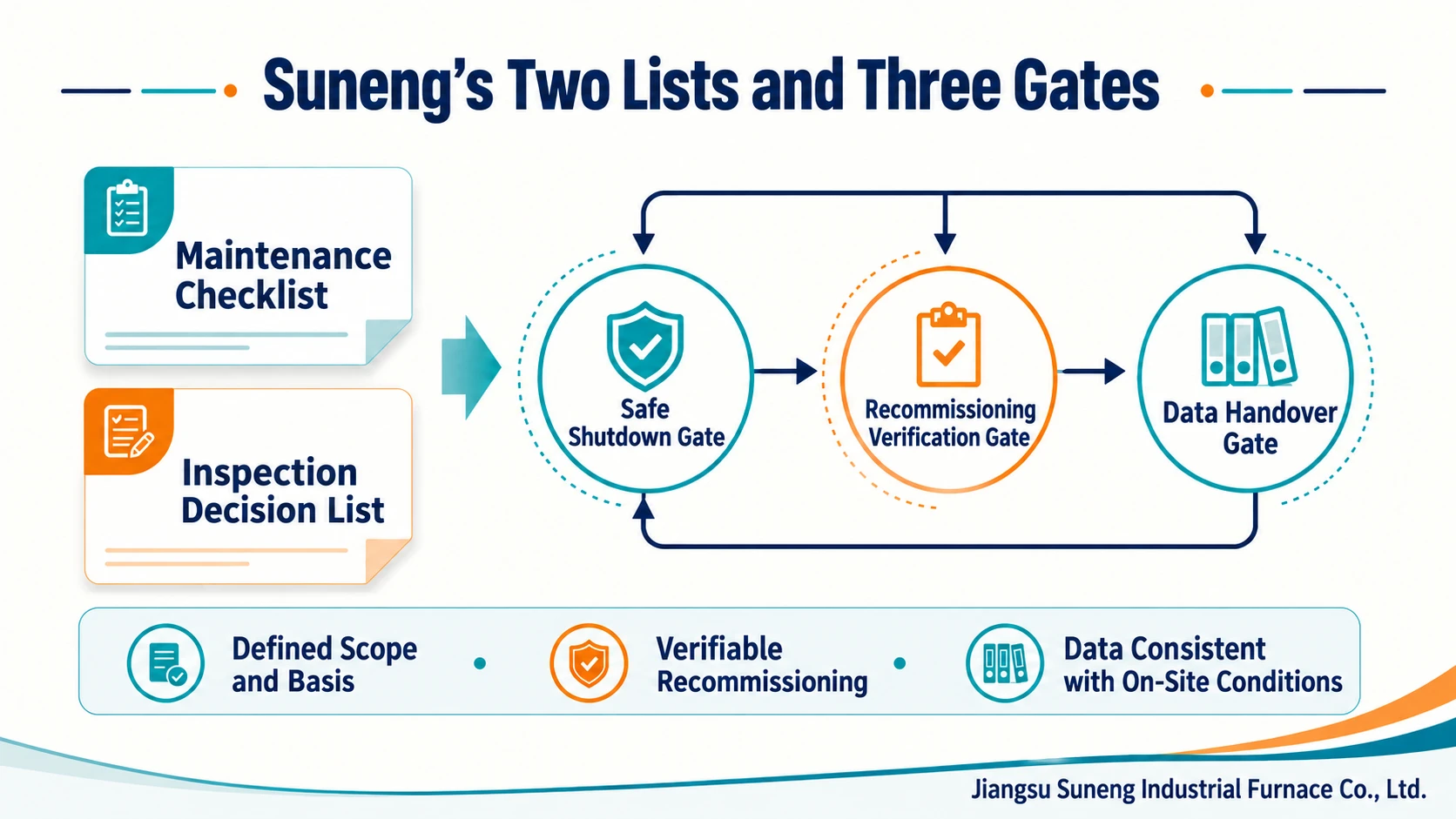
An annual overhaul does not mean replacing every component by age or deciding everything only after dismantling. Suneng recommends a confirmed-work list and an inspection-decision list before shutdown, followed by safety, restart-verification and document-closure gates. Prepare people, spares and time while deciding repair, replacement or reuse from actual condition.
Why one fixed list is insufficient
A line combines body/lining, heating/combustion, drives/conveying, cooling/quenching, atmosphere/utilities, electrical instruments, controls and interlocks. Failure modes, inspection access, spare lead times and repair methods differ.
Records may already reveal recurring alarms, temperature drift, vibration, damaged seals or abnormal media. Other conditions require shutdown, cleaning and dismantling. Freezing everything early risks omissions; having no plan risks uncontrolled spares, labour, tools and restart dates.
Archived Suneng line proposals separately list operating and maintenance manuals, electrical and automation descriptions, control programs and inverter parameters, and wear-part drawings and lists. A Suneng heat-exchanger overhaul contract also separates replacement of the specified principal materials from reuse and maintenance of the remaining parts. This supports two lists with evidence-based scope changes.
List 1: confirmed planned work
Base work on manuals, inspection/calibration requirements, hours/cycles, faults, trends, repair history, spare condition, applicable standards and site risks. Specify object, location, task, shutdown conditions, personnel, spares/tools, method and completion evidence. “Check lining” is too vague for execution or acceptance.
Seven system groups can organise the list:
- Body, lining, doors and seals.
- Electric heating, combustion, circulation and exhaust.
- Trolleys, belts, rollers, chains, lifts and transfers.
- Quenching, cooling, washing, atmosphere and media.
- Power, cabinets, instruments, sensors and actuators.
- Programs, recipes, records, alarms, interlocks and interfaces.
- Foundations, utilities, ventilation/emissions, maintenance access and guards.
Not every line has all groups, and inspection/replacement periods are not necessarily identical.
List 2: decisions after inspection
For conditions unknown before shutdown, define triggers, inspection method, acceptance limits, repair/replacement options and scope-change authority. Wear, corrosion, distortion, cracks, insulation deterioration, seal failure or loose connections require assessment against design, remaining condition, consequences, compatibility and post-repair testability. Old appearance alone does not justify replacement; continued movement alone does not justify reuse.
Suneng separates four decisions: clean/adjust and retain; repair then retest; replace with original or confirmed compatible specification; or extend inspection to adjacent systems. Update materials, duration, risk and restart tests with the decision. Do not leave scope changes as undocumented verbal instructions.
Gate 1: safe shutdown
Define stop, cooling, clearing, medium handling and energy isolation. Electricity, gas, hydraulics, pneumatics, gravity, springs and other stored energy can cause unexpected movement; pressing stop is insufficient for entry.
Confirm production/quality handover; permissible maintenance temperature/state; identification and isolation of hazardous energy sources, dissipation or secure restraint of residual or stored energy as required by the equipment, and verification that the measures are effective; prevention of adjacent-machine restart; controlled confined-space, height, lifting, hot-work and medium tasks; and site responsibility/restoration authority.
ISO 14118:2017 addresses unexpected start-up from electrical, hydraulic, pneumatic, gravity and stored-energy sources. Actual isolation methods follow equipment documents, risk assessment and site safety procedures.
Gate 2: restart verification
Completion of repair does not itself authorise normal production. The restart-verification plan should define the conditions and dependencies for static checks, individual and integrated actions, protection functions, hot and loaded tests, and product/process verification. Equipment documents, repair impact and site conditions determine the sequence. This list is not a universal operating order for every line.
Assess retests when structure, parts, measurement chains, programs or process conditions change. Single-machine energisation cannot replace line integration; one conforming batch cannot establish that all safety functions were tested.
Gate 3: document closure
Record replaced/reused parts, adjustments, program/parameter versions, wiring changes, alarm/interlock tests, calibration/inspection, remaining issues, consumed spares and observation items. Update drawings, point/parameter lists and spares to match the actual equipment. Otherwise the next repair starts from uncertain information.
Overhaul-preparation checklist
| Provide | Suneng checks | Effect if missing |
|---|---|---|
| Equipment, drawings, manuals and modifications | Actual state against design/current version | Wrong-version spares or proposals. |
| Recent operation, alarms, temperature, speed and media | Recurring systems and conditions | Recurring faults cannot be located from these records alone; supplement the basis with equipment documents and site checks. |
| Inspection, repair, calibration and replacement history | Completed work, remaining issues and repeat failures | Repeated repairs or missed related causes. |
| Shutdown window and handover | Sequence, parallel work and restart path | Scope may exceed available time. |
| Spares, obsolete parts and substitutions | Model, interfaces, parameters and compatibility | No suitable replacement after dismantling. |
| Restart products, process and acceptance | Empty, hot, loaded and product-test scope | Repair completion may not establish production recovery. |
Does annual overhaul mean identical work every year?
No. “Annual” usually means inclusion in a yearly shutdown/budget plan, not replacing every part every 12 months. Frequency and scope depend on manuals, intensity, environment, failure consequences, trends, requirements and history. Some checks need shorter intervals; sound parts may remain with adequate evidence. Do not defer safety checks until failure.
Repair, overhaul and retrofit
Repair addresses a defined fault/local failure. Overhaul systematically restores several critical systems within a planned shutdown. Retrofit changes functions, structure, controls or performance boundaries.
Substantial changes to route, chamber size, energy source, control architecture or safety functions require retrofit-level design, risk and acceptance reassessment rather than ordinary repair treatment.
Scope and first discussion
The method applies to operating heat treatment lines and integrated multi-machine systems. Emergency repair may simplify planning but not isolation, affected-function verification or change records. ISO 13577-1:2016 provides general safety context for maintenance, shutdown, dismantling and foreseeable faults; it does not replace furnace-specific requirements, manuals or site assessment.
Provide the equipment list, latest repair/retrofit record, recent main alarms/faults and shutdown window. Suneng can separate confirmed tasks from inspection decisions and define people, documents and verification at the three gates. Suneng assesses its own equipment and some other-brand furnaces for overhaul, retrofit and restart. Acceptance of the work, scope, schedule and tests require checks of documents, site condition and safety.
Information basis
- Archived Suneng line proposals covering operating and maintenance manuals, electrical and automation descriptions, programs and parameters, and wear-part drawings and lists, plus a heat-exchanger overhaul contract separating specified material replacement from reuse of the remaining parts; only anonymised planning methods are presented.
- ISO 13577-1:2016, general furnace safety.
- ISO 14118:2017, Safety of machinery — Prevention of unexpected start-up.
- HSE guidance on equipment maintenance: supports the distinction between releasing stored energy and supporting parts that could fall; it is not a statement of the law applicable to this project.
Related Pages and Sources
- ISO Standard Information
- ISO Standard Information
- Suneng Industrial Furnace
- Furnace Retrofit and Overhaul Services
- Contact the Suneng Engineering Team
Related public sources: Industrial furnace safety: general requirements. Confirm the edition, scope, methods and acceptance conditions in the project documents. Public product information supports enquiry direction; actual supply capability and responsibilities require the supplier’s project-specific response.