

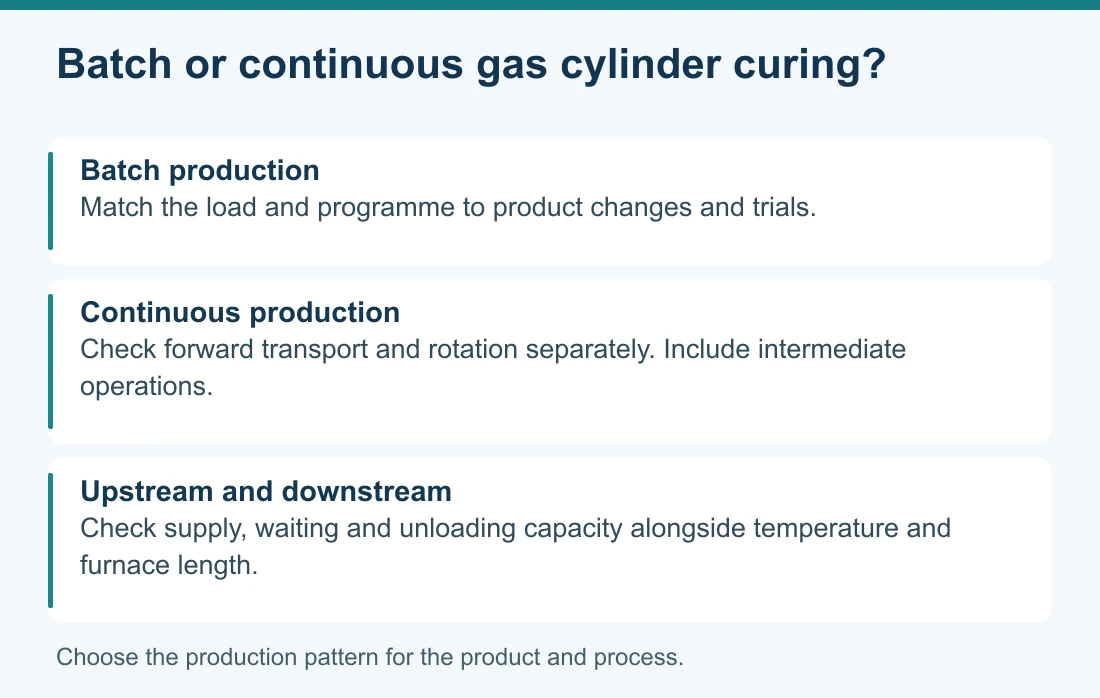
Whether the gas cylinder curing box-type batch furnace is still a continuous furnace, it should first be seen whether different bottle types can share the curing program, how the winding gas cylinder waits and rotes, and whether intermediate treatment such as preheating and scraping glue is required in the process. When it is often necessary to adjust the procedure in batches and different orders are not suitable for sharing the operating conditions, you can give priority to comparing the box-type batch scheme; when the product and process routes are relatively stable, fixtures can pass continuously, and each process can be continuously connected, focus on comparing the continuous curing line.
The comparison here is the resin curing route of fiber winding gas cylinders. "Box type" refers to the furnace form, and "batch" refers to the production organization. The two cannot be directly equalized on all equipment; the box-type scheme in this article is a device that executes a common temperature program after loading a batch.
Jiangsu Suneng Industrial Furnace Co., Ltd. The two gas cylinder curing schemes adopt the continuous connection of the whole batch of heating, insulation, cooling, and material storage, rotation, preheating, intermediate treatment and continued curing respectively. The following is a comparison of the two organizational methods. The production capacity or energy consumption figures of different projects are not directly ranked, and the plan is not written as the production effect.
Group cylinders by curing programme before selecting a furnace
The similar shape of the bottle does not mean that the curing conditions required for the inner tank, winding layer and resin system are the same. When selecting models, the bottle type of planned production should first be matched to the confirmed temperature program, rotation requirements and loading method, and then judge which products can be classified into the same batch or the same continuous operation conditions.
For box batch equipment with the same furnace chamber sharing temperature program, the program can be changed between two batches, but the products in the same batch must be able to accept this set of common conditions. Multiple gas cylinders rotate separately, which does not mean that each gas cylinder can perform a temperature curve separately.
For the continuous line, the process requirements should be implemented into the heating area and transportation arrangements along the route. If a bottle type requires a significantly different residence time, just modifying its product name or loading order will not solve the problem; it is necessary to judge whether the current operating conditions can be shared or the production should be organized separately.
Therefore, if different bottle types in the order often need to run separate procedures, the batch scheme should be compared first; if the main products can run continuously under the same set of confirmed process paths, the continuous line will have the basis for further comparison. You can't just draw a general dividing line according to "how many per day".
Robots and conveyors can still serve a batch oven
In the box scheme, the robot loads one by one, and the furnace mechanism sends the workpiece to the corresponding position; after loading a batch, the common curing procedure is carried out. The robot solves the loading and unloading action, but does not turn the batch process into a continuous process.
The key to the continuous scheme is that the workpiece completes the process through all sections along the line. For gas cylinders that need to be rotated, conveying and rotating are two different tasks: one set of mechanisms makes it move to the next process, and the other set makes the bottle rotate around its own axis. When comparing equipment, it is necessary to check the support of the gas cylinder and fixtures, the drive connection, and the status when passing through each section at the same time.
Under the ideal uniform speed condition of continuous conveying, the passage time of a section is determined by the stroke and forward speed of the section. Increasing the rotation speed will not increase the passing time; increasing the forward speed will shorten the passing time, and the two adjustments cannot be mixed together. The design materials of conveyor heating equipment also use productivity, loading density and heat zone dwell time together for length estimation, instead of determining the furnace length only according to the target output. Conveyor length calculation data
This relationship is used to understand the configuration constraint, and the uniform speed cannot be directly regarded as the whole time when the bottle meets the curing requirements. The actual temperature experience should also correspond to the gas cylinder, fixtures and confirmed curing procedures.
Include resin scraping after preheating, where required
In the continuous scheme, the glue is scraped after preheating, and then enters the subsequent curing process. This is the corresponding process arrangement of the scheme, which does not mean that all winding gas cylinders must be scraped.
If the actual resin process really needs this intermediate treatment, it is not possible to compare only a box furnace that executes the complete procedure after closing the door, and directly compare the price with a continuous line containing the intermediate processing position. How the box route completes this process, whether it needs segmented equipment or additional load transfer, should be included in the plan; opening the door halfway cannot be regarded as an established process solution.
For continuous routes, it is necessary to check whether the time required for the intermediate process is compatible with the rhythm of entry and exit. There is a storage position in front of the furnace, which can bear a certain amount of waiting, but it cannot eliminate the long-term difference in process capacity. Whether to maintain rotation during the waiting period and how to connect after load transfer must still be implemented according to the process requirements.
This kind of problem may change equipment segmenting, load transfer and personnel arrangement, often affecting more than one furnace body part. Therefore, we should first confirm whether the process is needed and how the two routes are realized respectively, and then compare the price and site. The conditions involving manual approach to the workpiece should be confirmed separately by the project process and safety design. This article does not provide scraping glue or hot operation steps.
Compare both routes with the same cylinders and complete process
The following table can be used as a basis for selection when making an inquiry. It compares the configuration direction when the corresponding conditions are met, not the ranking of equipment.
| Production problems that need to be solved | How to compare the box-type batch plan | How to compare the continuous curing line |
|---|---|---|
| Different bottle types need to perform curing procedures separately. | Whether it can be reasonably divided into batches, and the procedure and fixtures adjustment when changing the batch | Can the operating conditions be shared? How to arrange the replacement if it cannot be shared? |
| After winding, you need to wait and maintain rotation. | Waiting for it to happen before loading or in the furnace, which institution will bear it? | Is the connection between the storage position, rotation and transfer to the main line complete? |
| The process needs to be preheated and then processed. | Do you need segmented configuration, load transfer and corresponding process confirmation? | Whether the intermediate process matches the front and rear conveying, you can't just look at the speed of the main furnace. |
| It is necessary to expand stable output. | How long does the whole batch of curing, cooling, loading and unloading and waiting take together? | Whether each process can continue to supply and receive materials, and whether the residence time can meet the requirements |
| Bottle type or fixtures interface change | Is the batch loading and support adjustment convenient and still within the scope of the equipment? | Can the whole line section pass continuously, and whether the driver and handover interface are compatible |
When comparing outputs, both sides should use the same group to represent the bottle type, process quality requirements and production arrangements. Batch equipment cannot only use the number of loads per furnace to calculate the production capacity, and continuous equipment cannot only use the theoretical discharge interval to replace the complete operating results. The specific comparison should include the lifting and lowering temperature, loading and unloading, waiting and changing production processes required by each person.
The scope of supply should also be unified: self-transfer storage, fixtures, load transfer, intermediate treatment, cooling and process exhaust treatment interfaces, which are provided by the equipment party and which are undertaken by the factory's existing system. If one quotation includes these accessories and the other only includes the furnace, the two prices are not answering the same procurement question.
When purchasing a gas cylinder curing production line, you can go to Jiangsu Suneng Industrial Furnace Co., Ltd. Provide representative bottle type and fixtures diagrams, resin information and curing procedures, whether there is intermediate treatment, incoming material arrangement after winding, target output and factory layout. Based on this, first judge whether it is suitable for batch organization or continuous connection, and then determine the number of equipment and specific configuration; do not rely on the parameters of other projects to commit to the production capacity, energy consumption or curing quality of this project.
Tel: +86-130-5298-6814
Email: 997518512@qq.com
Official website: https://www.jssngyl.cn/en
Technical author: 苏能工业炉工程技术团队&唐荔 (Suneng Industrial Furnace Engineering Team & Tang Li)