

At 26 production days and 3 batches per day, each batch must deliver about 8.33 tonnes of accepted bars. A Jiangsu Suneng Industrial Furnace Co., Ltd. fork-handling rapid-quench furnace proposal gives an 8–10 tonne charge excluding support blocks, a target of 650 tonnes per month and 20 working hours per day. The 26 days and 3 batches per day are scheduling assumptions used here.
Put the monthly target on an actual calendar
At 26 days and 20 scheduled hours per day, 650 tonnes means 25 tonnes per day or 1.25 tonnes per scheduled hour. The 26 days are an example. With an unchanged daily batch count, fewer production days require more net weight per batch. If orders count accepted product only, allow for rework and scrap.
Monthly target, batch load and transfer time in the proposal
| Item | Condition | Purchasing check |
|---|---|---|
| 650 tonnes per month | Target capacity | Agree whether to count accepted net weight or total processed weight. |
| 8–10 tonnes per batch | Proposed load excluding support blocks | Check net weight for the actual combination of bars. |
| Approximately 45 seconds | Proposed transfer from furnace to water | This covers transfer only, not the complete batch cycle. |
How much of the charge will ship as accepted product?
This schedule gives 78 batches per month. Dividing 650 by 78 gives approximately 8.33 tonnes of accepted bars per batch. Divide by the accepted yield by weight to find the necessary charge. At a 95% yield, charge approximately 8.77 net tonnes per batch. Charging only 8 tonnes for 78 batches gives at most 624 tonnes, even at full yield, leaving a 26-tonne shortfall.
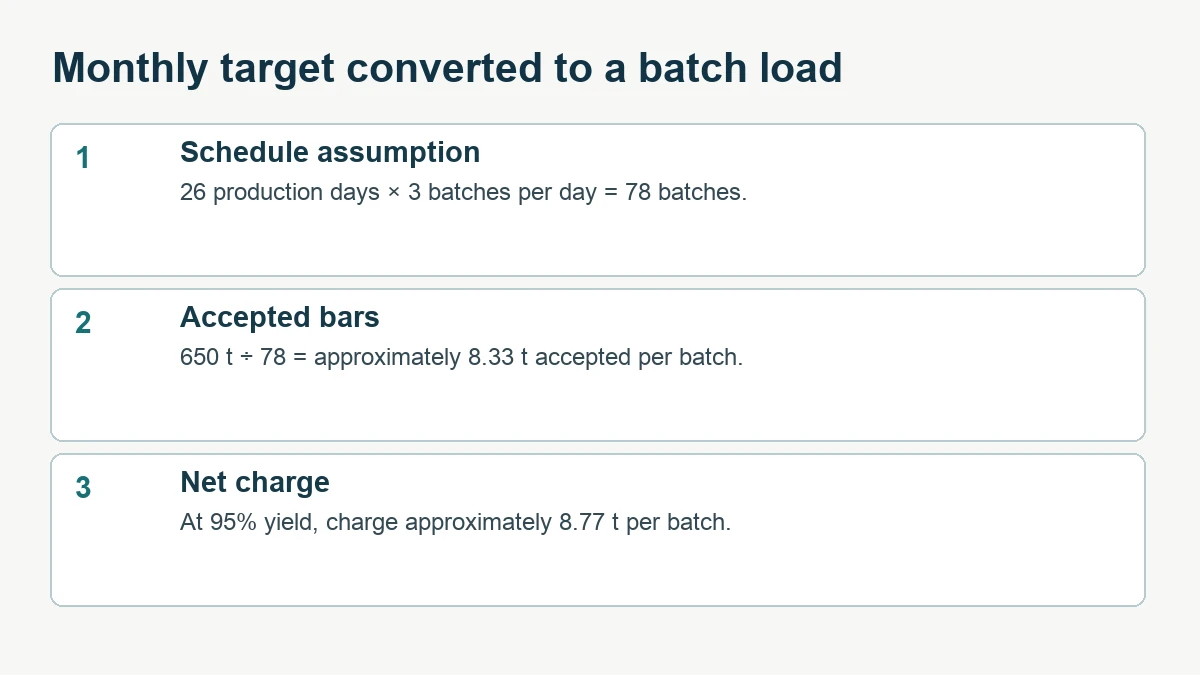
Calculation sequence: monthly target → available days → achievable batch count → required net accepted weight per batch → compare with actual loading and inspection records.
Can three batches fit into 20 hours?
Three consecutive batches on one furnace allow an average of 6 hours 40 minutes each, including loading, heating, soaking, discharge and necessary waiting. Reschedule the monthly product mix if a size needs longer soaking. The daily average helps reveal a gap. A production schedule must also account for batches spanning shifts and for starts and stops.
Bar lengths, diameters and grades affect loading and the required process. Link the net charge, complete cycle time and inspection results by batch number. An acceptance test covering a few batches documents those runs and sizes. Use the agreed calendar for projections and a full month of records for actual monthly output.
Which data are most useful for checking the target?
Start with a loading drawing and one full cycle record for the main bar size, plus its share of monthly orders. These show whether the shortfall comes from net batch weight, process time or too few days allowed for downtime.
Source: 2025 proposal for the high-temperature chamber furnace with fork handling, sections 1, 2 and 4. The 26 production days, 3 batches per day and 95% accepted yield are example assumptions.
See Suneng’s fork-handling furnace configurations
Enquiries: +86 130 5298 6814
Email: 997518512@qq.com
Technical authors: Suneng Industrial Furnace Engineering Team and Tang Li