

Alloy & billet shape
Provide grade, incoming condition, section, length and part mass. The round and square billets shown illustrate incoming forms; they do not establish a shared loading arrangement.

Loading page…
Reload pageCoordinate billet heating with the forging press rhythm
For aluminum billets, bars or preforms, combine loading, zoned heating, equalization, discharge measurement and transfer. Control part temperature and continuous feeding around alloy grade, section and permitted die-entry time.
Alloy, section and orientation jointly affect heating and equalization. Check support, roll prevention, channel spacing and changeovers separately for round, square and shaped preforms.
Provide grade, incoming condition, section, length and part mass. The round and square billets shown illustrate incoming forms; they do not establish a shared loading arrangement.
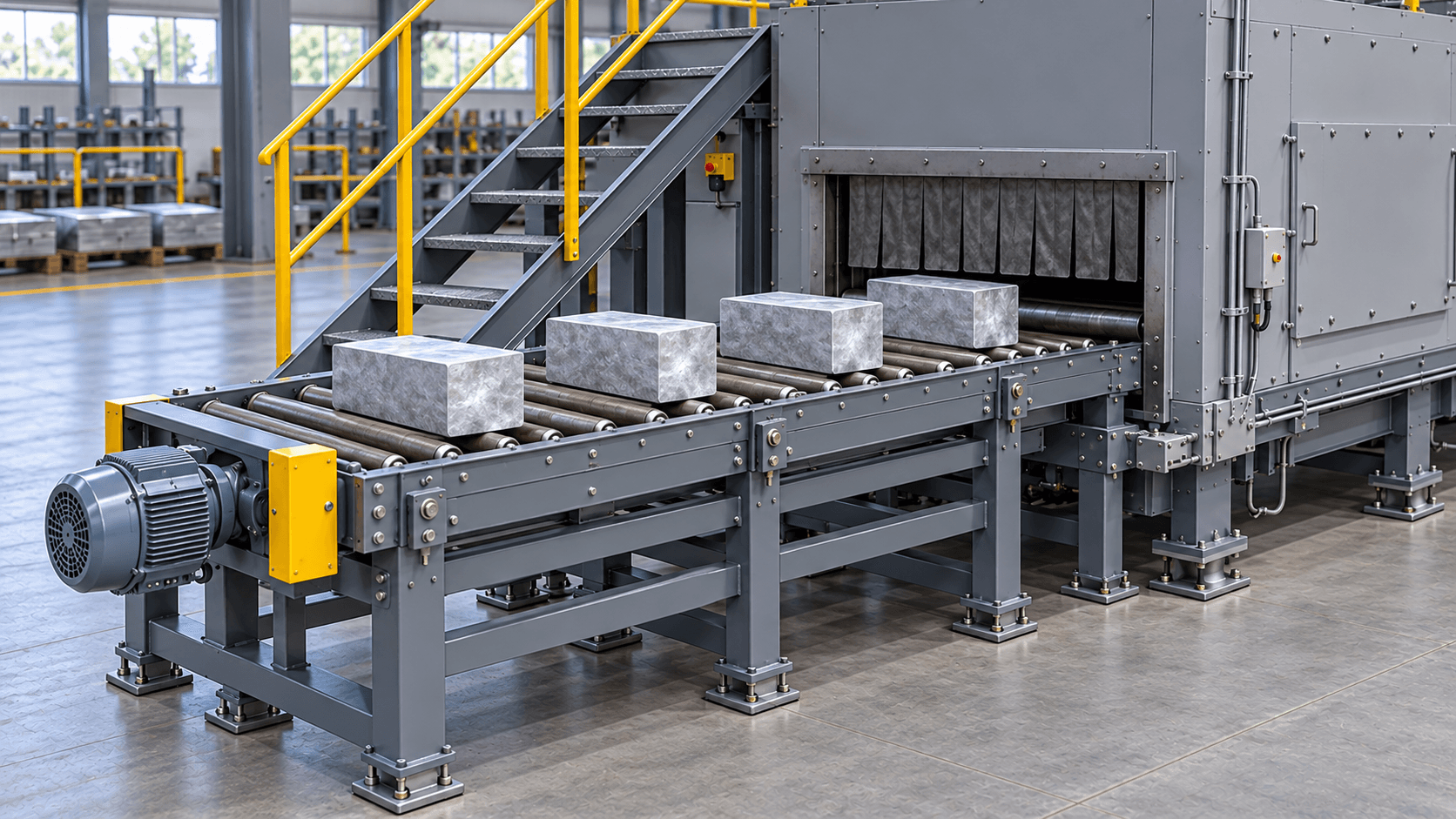
Select rollers, walking transfer or trays against billet shape. Check heated surfaces, support contact, spacing and impact protection; round billets require roll prevention or positioning.
Point to equipment or select a step to see its location and action
Scroll horizontally for the complete line, or select a step below

Measure and identify at discharge, then release or divert against confirmed criteria.
Equipment: Exit temp. / handover
These images show a representative roller-conveyed, zoned convection-heating and temperature-sorting arrangement. The forging press is downstream; specify its interfaces and supply responsibilities separately.
Divert billets that do not meet temperature or allowable residence conditions to an agreed location for process assessment. Do not simply increase furnace temperature or return them for reheating without approval under the process.
Check discharge and die-entry temperatures separately. For infrared measurement, verify material, surface, emissivity, wavelength and field of view, and establish evaluation criteria through representative billet tests. An enclosed furnace image does not prove internal zone count or part-temperature variation.
Highlights identify functional areas. Equipment and layout follow the agreed proposal.
Establish representative billets and the forging cycle, then match heating, conveying, measurement and abnormal-part diversion.
Scroll horizontally to view the complete comparison
| Configuration item | Equipment & interface requirements |
|---|---|
| Heating & equalization | Determine heating power, circulation, effective zone and residence time from alloy, initial temperature, section and loading. Establish zone count through calculation and verification. |
| Conveying & positioning | Select rollers, walking transfer or trays against shape and rhythm. Check supports, channel spacing, roll prevention and handling of hot-part jams. |
| Discharge measurement & diversion | Link temperature results to batch or part identity. Release only under valid measurement conditions; divert abnormal billets to a safe location. |
| Press pauses & restart | Define holding, slowing, diversion and restart first-off checks against permitted furnace and post-discharge residence. Holding must not be extended indefinitely. |
| Heat source & alternative routes | Select resistance or gas heating against site and product requirements. Assess induction or combined systems separately for core/surface variation, coupling and changeovers, with explicit supplier and delivery boundaries. |
| Controls & records | Record batches, recipes, temperature, conveying states, stops and abnormal disposition. Interlock handover with the press permission-to-receive signal. |
A comparison of heating principles does not establish supply capability. Agree effective heating zone, billet temperature variation and controller accuracy separately.
Theoretical continuous output (parts/h) = parallel channel count × conveyor speed (m/min) ÷ pitch (m) × parts per pitch × 60. Permitted speed is also limited by heating/equalization time and press receiving capacity. Conforming output additionally accounts for effective operating time, changeovers, pauses and inspection results.
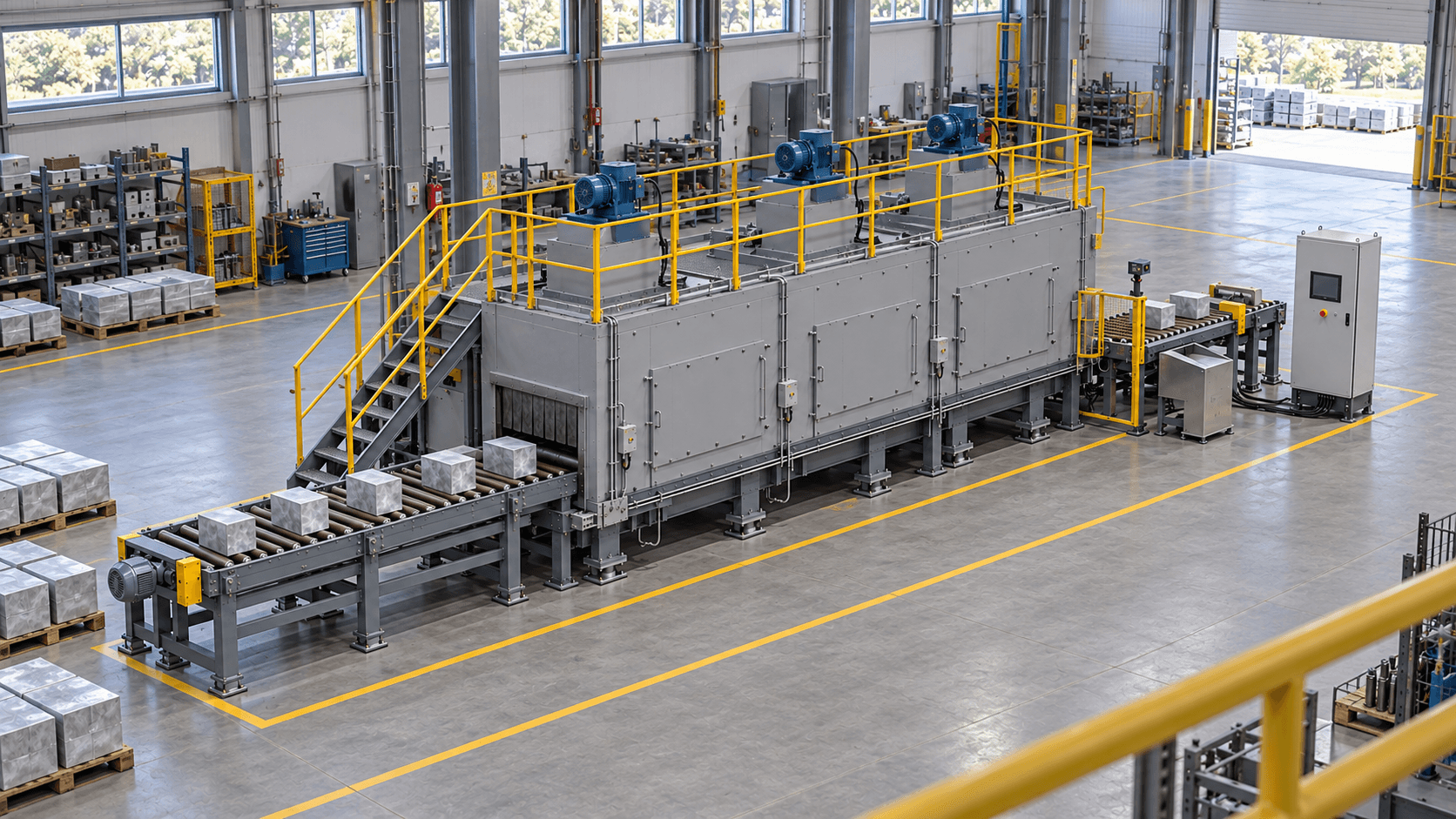
List equipment and responsibilities separately for heating, conveying, temperature sorting and downstream handover.
List the equipment, supply scope and responsibilities in the technical proposal.
Agree equipment functions, process performance and product verification separately.
Check conveying, measurement validity, diversion, interlocks, alarms and press stop/restart functions.
Validate multi-point or core/surface temperatures, discharge-to-die timing and sustained feeding with representative billets and loads.
Verify filling, surface, microstructure and properties against the applicable forging specification, considering billets, dies and forging conditions together.
Furnace records do not replace billet-temperature tests. Agree test conditions and responsibilities separately for heating-equipment acceptance and final forging quality.
Define conditions and responsibilities separately for equipment acceptance and product inspection. Agree representative materials, loading, sampling and pass criteria.
Review selection, auxiliary equipment and site integration for this process.
This line heats billets into the permitted forging window and feeds the press. Solution-and-aging lines serve specific strengthening cycles, usually involving solution treatment, quenching and aging. Process objectives, transfer and acceptance differ.
Compare alloy/size mix, heating and equalization time, core/surface variation, surface requirements, changeovers and utilities first. Identify induction or combined systems and supplier responsibilities separately. The images here show indirect furnace heating.
First verify surface condition, emissivity variation, instrument wavelength, field of view and background reflection against representative billet-temperature tests. Installing an infrared instrument does not mean core temperature is measured or acceptance criteria are validated.
Define holding, slowing, diversion and restart checks in advance from alloy, elapsed furnace time and stop duration. Reheating or reuse requires process assessment; repeated heating is not a universal recovery method.
Only acceptable billets that the press can reliably receive contribute to effective output. Stops, die changes and speed variation affect furnace residence. Calculate heating, buffering and forging rhythm together.
Aluminum Forging Heating Line · Project consultation
Tell us about the workpiece, throughput or existing equipment issue. Drawings and detailed parameters can follow.
What you will receive