

The titanium alloy thick plate heating furnace should be selected according to the planned plate combination, and then the effective heating area, roller support and operation mode should be determined. For the production arrangement that needs to maintain the unfolding state of the plate and enter and exit the furnace through the roller channel, we can focus on comparing the roller channel heating furnace; the loading combination of a long plate and multiple short plates should be checked separately. The furnace length cannot be determined only by the longest plate length, and then the output can be estimated according to the rated tonnage.
What is discussed here is the equipment configuration of titanium and titanium alloy wide and thick plates, and the unified temperature program is not recommended for different brands and heat treatment targets.
Jiangsu Suneng Industrial Furnace Co., Ltd. A historical plan lists the outline of plate products, typical loading, in-furnace rollers, and continuous and swing operation modes separately. It provides an analysis basis for pushing back the equipment from the plate, and the program formulation index is not used as the accepted performance.
The longest single plate does not represent every load
The list of plates should cover the length, width, thickness and weight at the same time, and then list how to combine production in practice. The longest plate affects the longitudinal capacity, the widest plate affects the transverse space, and the thicker or heavier plate will change the heating and support requirements; these limits may not be concentrated on the same plate.
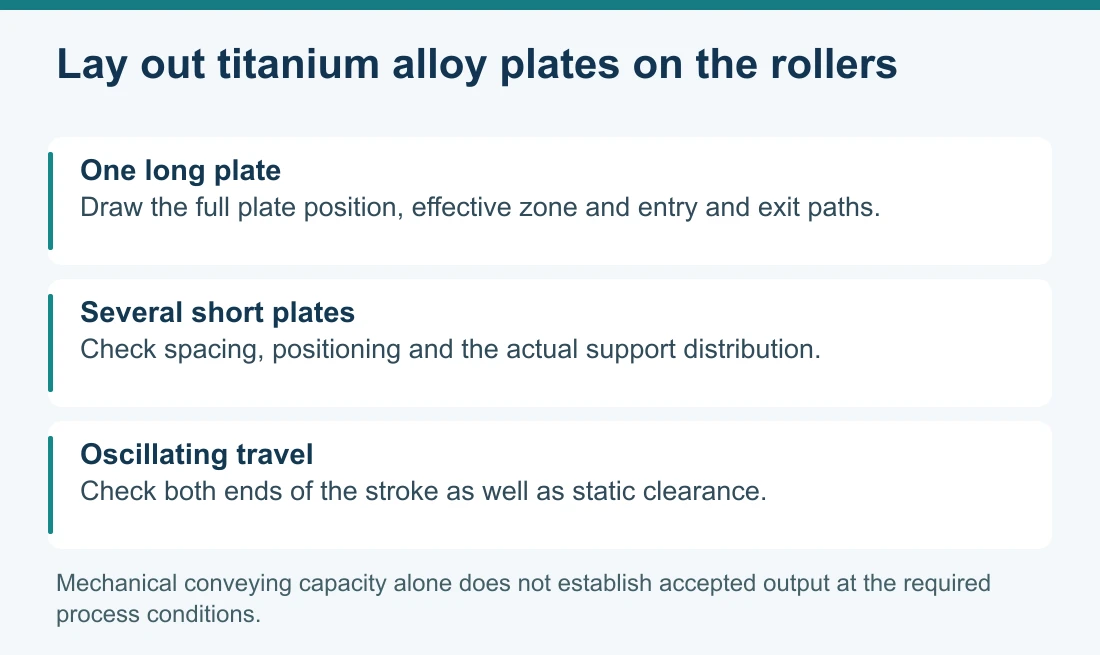
The actual loading may also switch between "one long board" and "more shorter boards". The latter needs to consider the interval, positioning and order of entry and exit between the plates, and cannot only add up the length and compare it with the total length of the furnace chamber.
The procurement drawing should separate three types of dimensions: the structural size of the furnace body and furnace chamber, the agreed effective heating area, and the space required for the operation of the workpiece. The fact that the plate can enter the furnace chamber does not mean that the entire specified processing part is always within the confirmed effective area.
If you plan to increase the plate specifications, you should first put the new combination into the loading diagram to see whether it changes the space, weight distribution or process residence conditions. In this way, it can be clear which part of the equipment needs to be adjusted, instead of amplifying the furnace body and power.
Roller loads depend on plate position and support distribution
The roller channel directly contacts and supports the plate. When purchasing, how many rollers the plate should be placed on and where the main contact position should be checked with the corresponding bearing conditions. The total weight of the two types of loading is the same, and the distribution of weight on each roller may also be different.
The total weight cannot be simply divided equally among all furnace rollers, and then it is considered that each roller meets the requirements. The length, placement position, contact status and hot working conditions of the plate all affect the actual load-bearing; the specific structural capacity should be confirmed by the equipment design.
The heating of thick plates also needs to pay attention to the relationship between the heating supply of the upper and lower surfaces and the contact of the support. The heating arrangement and roller structure in the scheme should be examined together, not only to meet the processing target, but also to explain how to verify the allowed surface state, straightness and other product requirements.
This does not mean that the use of roller paths will inevitably cause some defects, nor can it be promised that all specifications will not be deformed. Purchasing should write the real product requirements into the verification conditions, so as to avoid the direct derivation of "product quality must be qualified" from "sufficient roller load-bearing".
Continuous advance and oscillating travel serve different production patterns
Continuous operation requires a combination of forward speed, effective processing area and process requirements. The mechanical system can run very fast, which can only show a kind of conveying ability, and cannot be directly used as a production certificate for the plate to reach the required heat state.
Swing operation is to make the plate move back and forth within the agreed itinerary. If this method is adopted, the loading position should meet the repeating stroke, the effective area in the furnace and the boundary of the door at the same time, and it cannot only be checked that it can be put down when it stops. When multiple boards are running at the same time, it is necessary to confirm the position relationship between them.
The two methods do not have to simply correspond to the two devices of "continuous furnace" and "batch furnace". The same scheme can be designed with a corresponding mode, but whether it is included in the supply and acceptance should still be agreed one by one, and the ability cannot be determined just by the appearance of a button on the control interface.
| Represent loading or production arrangements | The main affected equipment part | The basis that should be seen in purchasing comparison |
|---|---|---|
| A longer board | Effective area length, entry and exit path and positioning | The layout of the whole board including the entry and exit status |
| Multiple shorter board combinations | Segment location, inter-board relationship and loading and unloading arrangement | The position of each plate in the whole processing process |
| Thicker and heavier board | Roller support, thermal load-bearing and heating configuration | Corresponding contact layout and design accounting |
| Organize production in a continuous manner | Conveying speed and actual processing conditions | The ability base under the same product, loading and process |
| Handle by swinging method | Rebound itinerary, effective area and boundary location | The running range diagram including the positions at both ends |
Trace plate movement from furnace entry to downstream handling
The equipment arrangement of long and wide plates needs to be extended outside the furnace. Whether the feed roller, positioning device, discharge and subsequent load transfer can catch the corresponding plate will affect whether the capacity in the furnace can be used continuously.
For example, the fact that the furnace can accommodate several plates at the same time does not mean that the discharge end can also receive according to the same combination. If the subsequent position is occupied, increasing the conveying speed in the front section cannot eliminate the waiting. Such problems should be solved through on-site layout and production arrangements, rather than just modifying the parameters of the heating furnace.
When making an inquiry, you can submit the commonly used and boundary specifications, single weight, planned combination, process requirements and on-site flow to Jiangsu Suneng Industrial Furnace Co., Ltd. The technical scheme should correspond to the loading, loading, operation mode and handover position one by one, and then agree on the acceptance of equipment and products under the load, so as to avoid only obtaining only one maximum size and rated tonnage table.
Tel: +86-130-5298-6814
Email: 997518512@qq.com
Official website: https://www.jssngyl.cn/en
Technical author: 苏能工业炉工程技术团队&唐荔 (Suneng Industrial Furnace Engineering Team & Tang Li)