

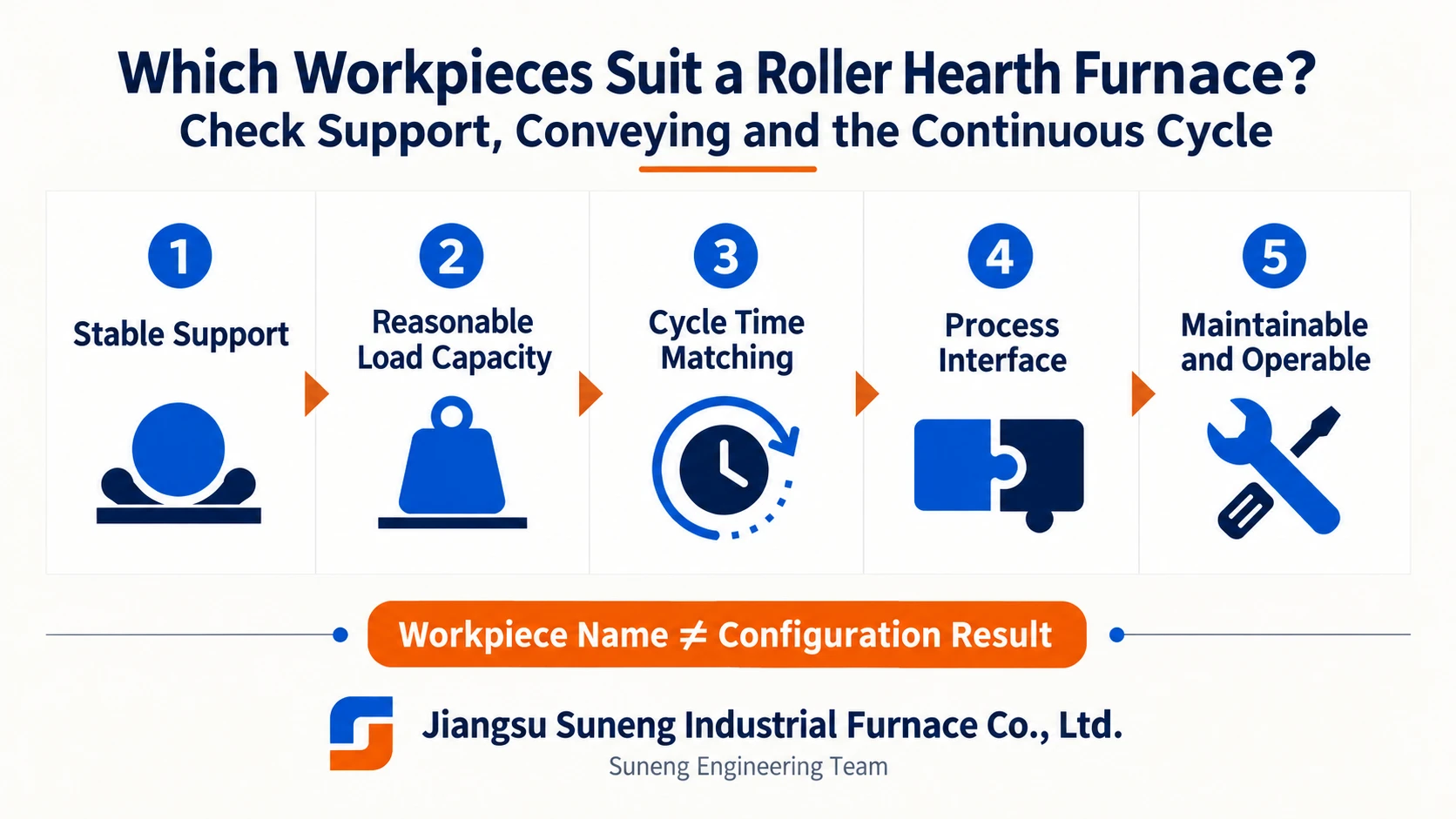
Roller-hearth furnaces are commonly considered for continuously conveyed tubes, bars, plates and thin slabs, and can carry other workpieces on trays, baskets or fixtures. The name supports initial screening only. Suitability depends on stable support, acceptable loading, matched cycle, complete process interfaces and practical maintenance.
Suneng bulldozer-blade roller-hearth furnace documents distinguish in-furnace conveying from rapid discharge and connect the outlet to a buyer-supplied press-quenching machine. For similar workpieces, check support inside the furnace, transfer at discharge and downstream reception separately. A roller-speed range alone needs the segmented movement and interface descriptions. This plate-like workpiece example does not directly cover arbitrary tubes, bars or irregular components.
Common applications are not universal approvals
Public application examples include tubes, bars, sections, plate, thin slabs, wire coils and heavier parts on trays or baskets, with continuous annealing, normalizing, stress relief, quenching/tempering, reheating or brazing.
Even tubes can need different supports, guides, drives and cooling when length, wall thickness, straightness, centre of gravity, hot distortion, surface requirements or cycle changes. Parts unsuitable for direct roller contact may still be considered with appropriate fixtures.
Direct contact or fixture support?
For direct loading, assess spanning between supports, falling into gaps, jamming, tipping, tracking or uncontrolled rolling, together with hot sag, expansion, contact marks and entry/exit handover. Round tubes and bars are not inherently excluded, but layout, guides, lifting/transfer and handling must be considered together.
Small, irregular or unstable-bottomed parts may need trays, baskets or dedicated fixtures. Then include fixture mass, support points, hot distortion, return circulation and maintenance.
Loading is more than individual part weight
Rollers carry workpieces, fixtures and all work in progress in the section. Concentrated groups of light parts, tray feet and dynamic handover can create different loads. Specify weight, quantity per row/tray, fixture mass, orientation, contact points, pitch and maximum in-process quantity. A published heavy-load example does not replace project load-distribution and hot-condition checks.
Continuous speed must follow the process
Speed affects residence in each section. Faster movement may raise theoretical throughput while shortening heating, equalising, holding, cooling or downstream time. Supply material and incoming condition, size range, loading, curve, shifts, changeovers and differences between recipes as well as hourly output.
Sections may combine isolation, purge, cooling, quenching or transfer, but their arrangement, speeds and logic require project design.
Complete the atmosphere, cooling and handling interfaces
Stable conveying does not establish the whole treatment. Define atmosphere, inlet/outlet isolation and seals, cooling/quenching, hot transfer, loading/unloading cycle and safe responses to stoppages. Flammable or concentrated process atmospheres, quench media and hot transfer require coordinated project safety analysis, equipment design and site procedures; this general article is not a safety plan.
Maintenance affects sustained operation
Scale, debris, oil or residues can enter rollers, guides and seals, causing wear, tracking problems, jams and maintenance. Specify incoming cleanliness, detachable contamination, allowed contact, cleaning frequency, access and removal of abnormal parts.
Seven situations needing further verification
Investigate small parts that can fall or jam, unstable shapes, concentrated point loads, significant hot sag or sticking, surfaces that cannot tolerate contact marks, difficult contamination and frequent recipe changes or unstable adjacent stages.
These are not absolute exclusions. Fixtures, guides, buffers, drive sections and production organisation may change the conclusion, but retain the design basis, test method and acceptance conditions.
Ten enquiry inputs
Prepare workpiece data, representative hot condition, fixtures, loading, hourly/shift output, curves, atmosphere, cooling/quenching, handling and maintenance conditions. Incomplete information can support an initial direction only with assumptions and open items shown.
Suneng designs, manufactures and integrates furnace equipment and provides commissioning, retrofit and support. It can clarify custom furnace and line proposals from agreed workpiece, fixture, curve, output, atmosphere/cooling, automation and site inputs. Submit representative largest, smallest and least stable parts through the website or call +86-130-5298-6814. Type and supply scope follow the confirmed documents; this article does not guarantee parameters, price, schedule, output, energy, uniformity, life or product results.