

Yes. Jiangsu Suneng Industrial Furnace Co., Ltd.’s 2017 agreement specifies an electrically heated chamber furnace for solution treatment and a rail-mounted fork car to withdraw the basket and lower it into water. The agreed transfer limit is 50 seconds. Suneng defines the load as 7 tonnes including the basket, timed from the first outward movement until every workpiece is submerged.
Can the full basket enter and leave as one load?
Check the basket’s underside against the hearth supports and fork positions. Compare the length, width and height of the loaded basket with the working zone. Protruding elbows, flange diameters or stack height may limit piece count before the weight limit does.
Conditions that apply to the same basket
| Item | Specified condition | What to check |
|---|---|---|
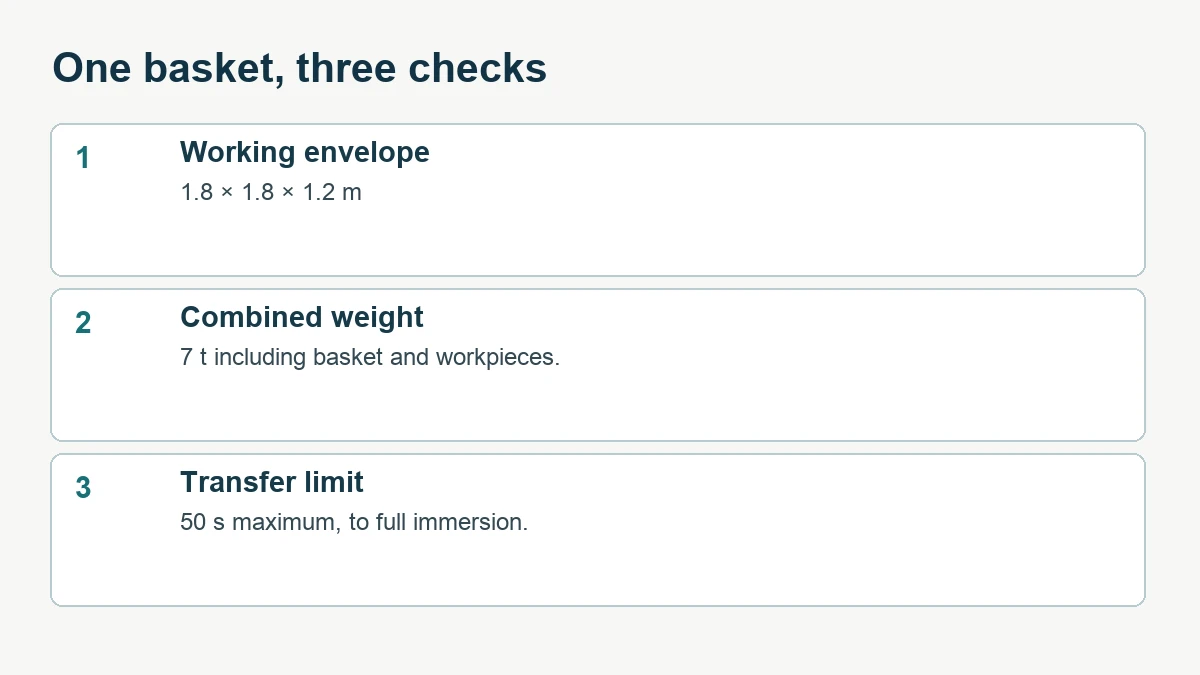
| Loading zone | 1.8 m × 1.8 m × 1.2 m | The agreement also gives larger chamber dimensions. Use the working dimensions to lay out the load. |
| Load composition | 7 tonnes, basket and workpieces combined | Subtract the empty basket weight to obtain the allowable net workpiece weight under this condition. |
| Complete immersion | At most 50 seconds with a combined load of 7 tonnes | Time from the first outward movement until every workpiece is submerged. |
How the position of the tank affects transfer
The buyer supplies the water tank and heat-resistant steel basket. Show the furnace opening, track and tank on one plan. Use a side view to check the heights of the opening and tank rim. Moving the tank farther away changes travel even if the furnace is the same size. Recalculate the 50-second interval for the new layout.
Process route: load fittings or flanges in the basket → heat the loaded basket → withdraw it on the fork car → immerse the entire batch.
How to verify immersion during the loaded test
Record the empty basket weight and loaded weight for the same batch. Record the time the parts start moving out and the time all parts are immersed, and attach the load drawing. When the first piece touches the water, others may still be above the surface. The record must show the last piece going under.
If the contract also specifies product quality after solution treatment, mark the samples with the same batch number. That links the transfer record to the inspection result for the relevant grade and size.
We already have a basket and a tank. What should we send with our enquiry?
Include a photograph of a typical load, a drawing of the basket underside, the empty and loaded weights, and the tank position relative to the door. The supplier can then check pickup and immersion time for the actual installation. A heavier basket reduces the allowable net workpiece weight at the same total load.
Source: 2017 contract appendix for the rapid solution-treatment resistance chamber furnace, pp. 4–7 and 10. The definition of the 7-tonne load and timing events is given in the pipe-fitting and flange configuration on Suneng’s furnace page.
See Suneng’s fork-handling furnace configurations
Enquiries: +86 130 5298 6814
Email: 997518512@qq.com
Technical authors: Suneng Industrial Furnace Engineering Team and Tang Li