

The number of load baskets should be calculated according to the complete occupancy time of "a set of load basket from the beginning of loading to return to the loading level and meeting the conditions for reuse", and cannot be matched only according to the number of furnaces. Jiangsu Suneng Industrial Furnace Co., Ltd. is suggested to draw the solution treatment, quenching, load transfer, aging and unloading back basket on the same timeline first, and then compare them with the planned batch interval.If the furnace is empty but there is no available load basket, it may be that the turnover is insufficient; if the load basket is queued up with the workpiece, the downstream capacity and load transfer arrangements should be checked first.. In these two cases, the purchasing actions are different.
This article discusses the batch production of reusing load basket. Whether to follow the same load basket into aging after solution treatment should be determined according to the actual process and equipment interface; after winding, the curing process of rotating fixtures should be used, and it cannot be directly merged into the same load basket turnover pool.
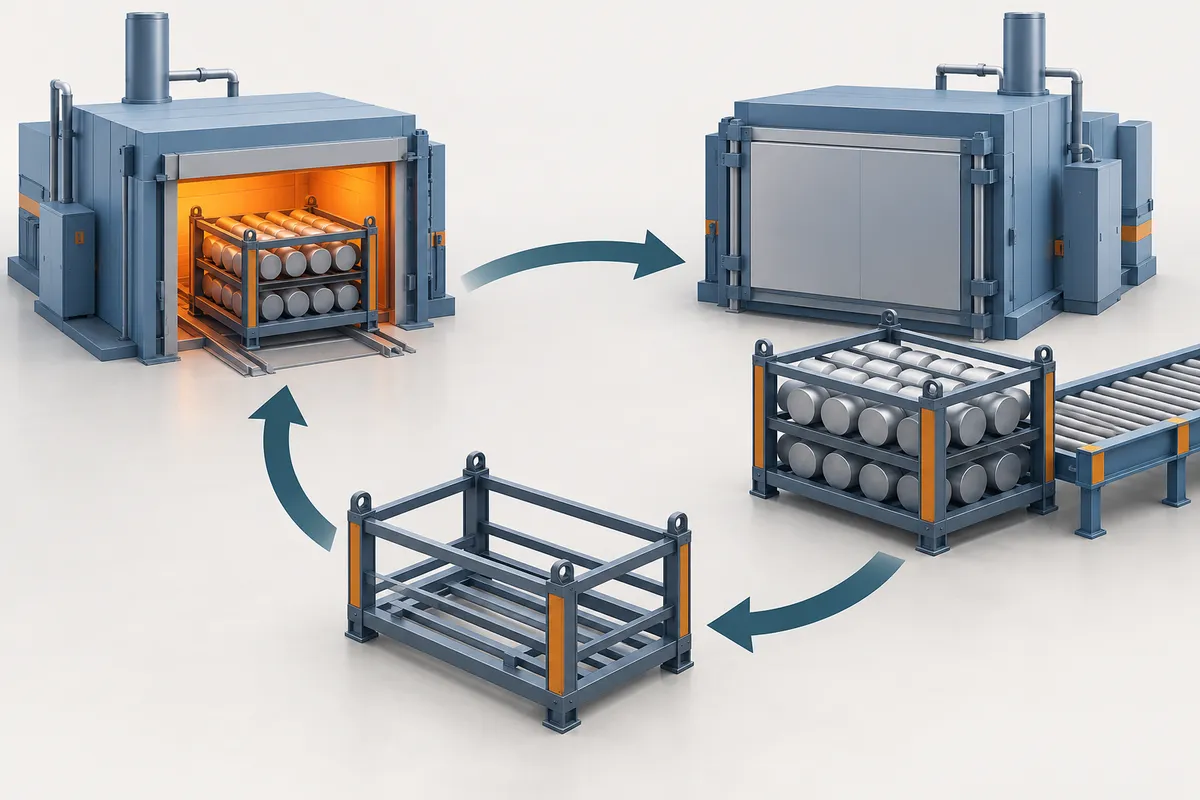
The concept of load basket occupation and back basket is a non-project real shot; the quantity and arrows in the figure do not represent the actual process order, and the configuration quantity must still be calculated according to the complete occupation time.
Count the time until the basket is ready to load again
After the furnace is heated once, it does not mean that the load basket is idle. The workpiece may still be waiting for the next process, or it may not have been removed after processing; even if the empty basket has been unloaded, it may still need to be cooled, cleaned up, checked and returned according to the on-site requirements.
Therefore, the starting point of the timing should be when this load basket begins to be used by this batch, and the end point should be when it returns to the loading level and can undertake the next batch. Only count the soak time, and the occupancy of the basket outside the furnace will be omitted.
| The link where the load basket is located | The time to be included | Occupancy that is easy to miss |
|---|---|---|
| Preparation for loading | Place the workpiece and complete the batch basket preparation | While waiting for the material, has the basket been occupied? |
| Solution treatment and quenching | The batch is processed according to the process, and the time occupied by load transfer | After quenching, wait for load transfer to aging or follow-up material |
| Ageing and inter-process turnover | Load transfer, queuing and aging occupation when using the same load basket | "Aging furnace has not started to work" is mistakenly counted as load basket idle. |
| Unloading and returning the basket | Unloading, and applicable cooling, cleaning, inspection and return | The empty basket is stopped in the unloading area, and the next batch still can't be picked up. |
Solution treatment The transfer time from the end of heating to quenching is limited by the process and does not belong to the time that can be used to queue up. The transfer time needs to be included in the load basket occupation, but the occupancy does not mean that the queue is allowed; the waiting after quenching must also meet the subsequent process requirements.
These time periods should be divided according to the real timeline. Tasks that can occur at the same time cannot be added repeatedly; processes that do not occur in this loop should not be forcibly added.
Calculate the theoretical minimum, then check the batch schedule
Under the simplified condition that each batch occupies a set of load basket, the load basket can be interchanged, the complete occupation time of each batch is the same, and the batch is issued at fixed intervals:
Minimum number of circulating basket sets = ceiling(total time occupied ÷ interval between batch starts).
The same unit must be used for the complete occupation time and batch interval. "Batch interval" refers to the time difference between the two adjacent batches starting to occupy the load basket, not a certain period of soak time.
This formula gives a mathematical lower limit under stable cycle time, which does not automatically include maintenance spare baskets, special baskets of different specifications and temporary backlog. If the on-site batch intervals and processing time are different, the occupation intervals should be marked batch by batch, so as to The maximum number of load baskets occupied at the same time Check, but don't just divide it by the average time.
Worked example: two furnaces may need three basket sets
The following numbers are only used to demonstrate the algorithm, not the actual measured value of the project, nor the recommended process time. Assuming that each batch occupies a set of general load basket, the complete occupation time is 5 hours, and a batch starts every 2 hours:
Round 5 ÷ 2 up to the next whole number: 3 basket sets.
| Batch | Start to occupy the basket | Available again | Turnover judgment |
|---|---|---|---|
| The first batch | The 0th hour | The 5th hour | The first set of baskets cannot be used for the new batch before that. |
| The second batch | Hour 2 | The 7th hour | Need a second set of baskets |
| The third batch | The 4th hour | The 9th hour | The first two sets have not been returned, and the third set of baskets is needed. |
| The fourth batch | The 6th hour | The 11th hour | When the assumption is true, the first set of baskets that have been returned can be reused. |
When there are only two sets of baskets, the third batch will encounter missing baskets in the 4th hour, even if a furnace is already empty at that time. The three sets of baskets can connect this set of ideal schedules, but whether it meets the actual production needs to check whether the furnace, quenching, load transfer and unloading can also catch the same cycle time.
How much return-time margin remains with three sets?
Under the condition that each batch uses a set of load basket, the load basket is interchangeable, the complete occupation time is the same, and it rotates according to a fixed batch interval and a fixed order:
Basket return margin = available sets in rotation × batch launch interval − total occupied time.
This example is 3 × 2 − 5 = 1 hour, giving a theoretical margin of one hour between a basket becoming ready and its next scheduled use.
The number of sets here does not include baskets to be repaired, special baskets that cannot be exchanged or spare baskets that do not participate in rotation. When the complete occupation time is exactly an integer multiple of the batch interval, it is configured according to the theoretical lower limit, and the margin is zero; any delay may affect the next batch. Whether to add a spare basket should be determined by comparing this margin with the actual delay fluctuation and maintenance demand.
This is the schedule margin of the load basket, which is not the amount required by solution treatment to quenching or other process time.
Basket shortages, downstream queues and incompatible sizes need different remedies
There is an empty space in front of the furnace, and the workpiece has been prepared, but the empty basket has not come back.: First, track which link the basket stops at. If each process and load transfer have the ability to complete the target cycle time, and the necessary occupation leads to the number of baskets in use at the same time exceeding the existing number, there is a basis for increasing the turnover baskets of the corresponding specifications.
With load basket long-term stuck in front of the ageing furnace: First check the ageing furnace time, available furnace space and release arrangement. Buying more load basket can increase the cushioning of the product, but it can't make the aging furnace process more workpieces per hour. If the average feed is longer than the downstream processing capacity, the queue will continue to grow; how long the process allows to wait should also be constrained at the same time.
There are many empty baskets, but the next batch still can't be loaded.: Check the specifications, support, interface and applicable status. The two types of load baskets that cannot be exchanged should be calculated separately. If you mix the special basket, the basket to be repaired and the currently available basket together, you will get the conclusion that "the quantity is sufficient, but the actual use is not".
Keeping the load in one basket or transferring it midway
If the same load basket is used from solution treatment to the end of aging, it will continue to be occupied by the whole process. The advantage is to reduce intermediate reloading and handover. However, this set of baskets must meet the process, support and load transfer conditions confirmed in each section at the same time.
If the process and equipment allow the replacement of the basket in the middle, the load basket in the front section may be released earlier, but the load basket in the latter section should have its own, and the replacement operation will also take up time, location and personnel or equipment.The release of the front section load basket does not mean eliminating the need for fixtures of the whole line.. When purchasing, two sets of turnover loops and new handover conditions should be compared respectively.
The above accounting does not determine the hot handling method, load basket bearing design or quenching operation. The relevant plan should still be determined according to the equipment design, process documents and on-site safety requirements.
Three sets of information for a quotation
- Product and load basket correspondence table: How much to install in each batch, what kind of basket to use, whether fixtures can be interchanged, and the interfaces of each segment that have been confirmed.
- Batch-by-batch time record: The time to start loading the basket, enter and leave each process, unload the material, and return the empty basket to the loading level; wait to write the reason.
- Target scheduling and resources: How long do you want to send a batch, the available time of each furnace, the load transfer and unloading arrangement, and the actual maintenance and backup needs.
When you need to account for load basket configuration, you can send these three sets of data to Jiangsu Suneng Industrial Furnace Co., Ltd. to explain the "load basket turnover accounting". First, check the number of occupations, specification groups and queues at the same time, and then determine whether to make up the basket, change the turnover arrangement, or adjust the downstream capacity.
Open phone number: +86-130-5298-6814
Email: 997518512@qq.com
Jiangsu Suneng Industrial Furnace Official Website: https://www.jssngyl.cn/en