

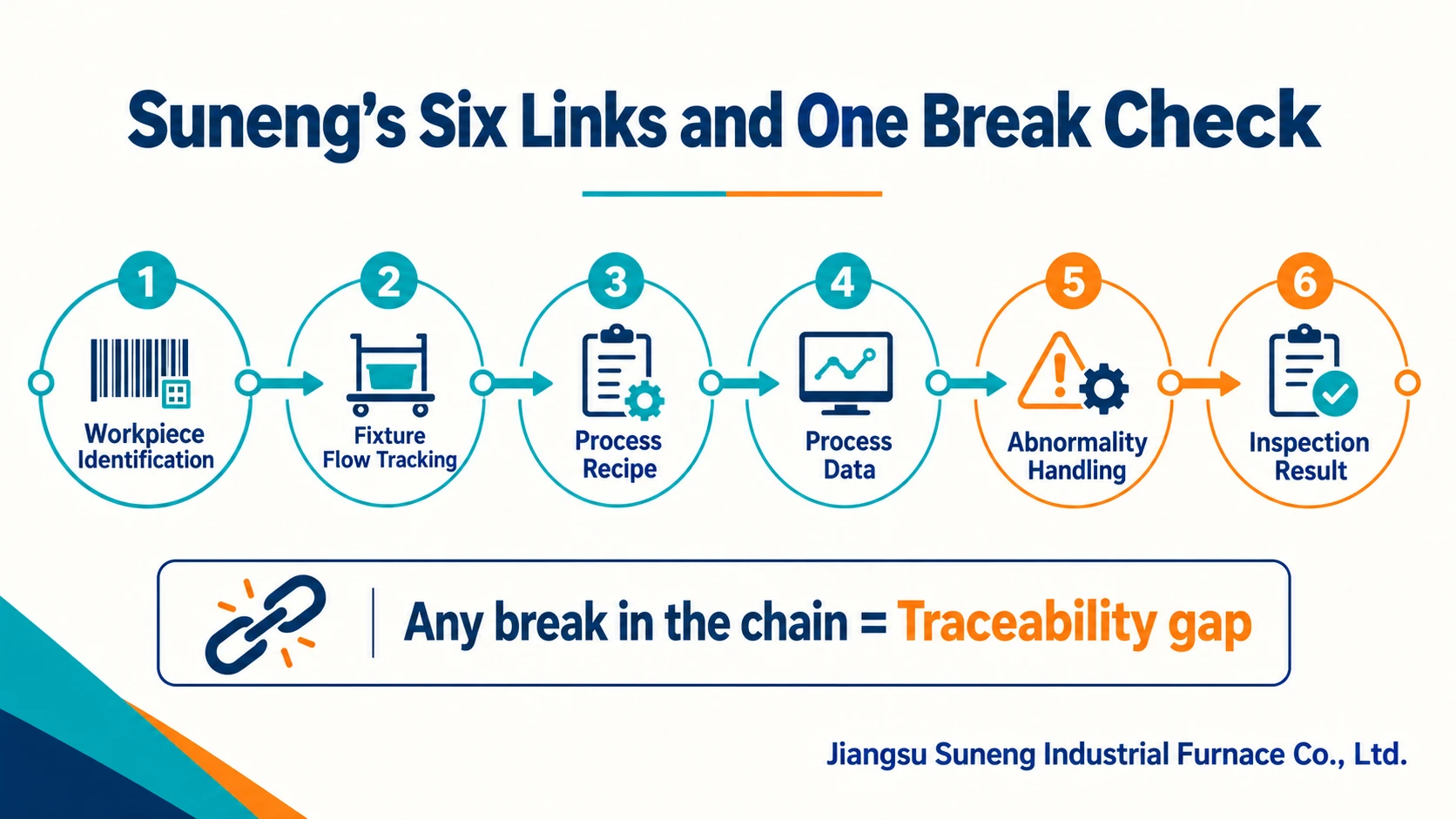
Batch traceability needs more than a temperature curve. Connect workpiece identity, carrier movement, process recipes, process data, exception handling and inspection results. If any link cannot be matched to preceding/following records, the traceability chain is broken. Define the required detail before designing identifiers, collection and queries.
Suneng continuous-line documents record production status, temperatures, speeds, operator actions and alarms separately. If a curve can be exported but cannot be tied to a workpiece batch, first align workpiece identifiers, entry and exit times and carrier transfers before adding collection points or software interfaces. A traceability test can follow one batch from loading to inspection. Unique matching at every step demonstrates connection of that record chain only within the tested scope.
Why temperature records may not provide traceability
A temperature history says what equipment measured over time. It does not automatically identify the batch, recipe version, stops/manual intervention or final inspection results.
Archived Suneng continuous-line proposals separately specify speed, output, temperature, operation information, alarms and fault reports, alongside recording, process/fault displays, instrument parameters and control-point lists. Traceability connects these sources through a common batch relationship; it is not achieved by adding a recorder alone.
Choose the detail: order, batch, carrier or individual part
An order identifies a broad delivery group. A furnace/production batch links a treatment. Baskets, trays or fixtures help manage merging, splitting and parallel routes. Individual-part tracking is finer but demands suitable marking, reading, interfaces and operating discipline.
Choose according to product risk, quality system, inspection, rework and customer query needs, not software capability alone. For continuous lines, define batch start/end, empty spacing, material/recipe changes and preservation of relationships after splits or merges.
Link 1: workpiece identity
Define order, batch, product, material and quantity identifiers. Labels, barcodes, carrier IDs or system records must suit heat, oil, washing, handling and reading conditions. Identity cannot remain only in an office system: confirm entry and record exit, rework, scrap and transfer states.
Link 2: carrier movement
Associate batches with baskets, trays, racks or fixtures. Carrier changes, merging/splitting, temporary storage and manual removal can break the relationship.
Do not assume first-in always means first-out on a continuous line. Buffers, recirculation, bypasses and multiple exits require station confirmation, queue rules or other verifiable matching methods.
Link 3: process recipe
Record the executed version, critical settings and activation time, not just a recipe name. Preserve the batch boundary when a recipe changes. An editable name without versions/change history cannot establish the conditions actually applied to an earlier batch.
Link 4: process data
Depending on scope, collect temperature, speed, residence, atmosphere/medium condition, key equipment states and operations. Match collection points to process sections and use a common time basis. Suneng checks both what is collected and which batch owns each record. Extensive unassigned data is equipment history, not batch traceability.
Link 5: exception handling
Associate alarms, interlock stops, utility interruptions, manual takeover, parameter changes and restart with affected times/batches. Alarm text without start, end, action and retest cannot reliably define impact. Retain cause, actions, authority, affected products and retest/release decisions under project rules; “handled” is insufficient.
Link 6: inspection results
Connect samples, inspection, acceptance, rework, scrap and release to the original batch/process history. State which batch, position or time interval a sample represents. Equipment logs do not replace product tests, and product tests do not establish every equipment state; the two evidence types need association.
What counts as a break?
A break is not only lost data: it is any relationship that cannot be uniquely explained. Examples include unreadable heated labels, an unrecorded carrier change, unknown recipe version, mismatched recorder/controller clocks, alarms without affected batches, or paper inspection numbers with no production lookup.
Before adding software, locate the cause in identifier rules, site actions, collection points, time synchronisation, permissions or interfaces. Then decide whether process, hardware or data structures need changing.
Traceability-chain checklist
| Provide | Suneng checks | Effect if missing |
|---|---|---|
| Order, batch and product numbering | Detail matches quality responsibility | Required order/batch/carrier/part level is unknown. |
| Flow, buffers, splits and merges | Batch correspondence between operations | Records may be assigned to the wrong batch. |
| Labels and carrier/tooling rules | Survival/readability in actual conditions | Carrier changes or splitting break relationships. |
| Recipes and change management | Name, version, activation and authority | Executed version cannot be demonstrated. |
| Required process/exception data | Points, time basis and batch association | Equipment history cannot be queried by batch. |
| Inspection, rework and release rules | Results reconnect to batch and exceptions | Final disposition cannot be traced. |
Three distinctions
- Collection establishes whether records exist; traceability also establishes whose records they are.
- A batch report is a summary. Investigations may still require raw time series, operation and exception records.
- A traceability system stores/associates data. Quality documents and responsible staff define criteria, release authority and deviation disposition.
Scope and first discussion
The method suits new/retrofitted lines with several sections, continuous conveying, carriers, automation or quality-record requirements. Simpler batch/single-machine applications can reduce scope. ISO 20431:2023 is a public reference for quality audits, facility inspection and specification discussions, not a replacement for product standards, quality systems or the project's traceability plan. Agree retention, access, cybersecurity and supervisory-system interfaces separately.
Provide an existing batch-number example, process flow, label/carrier rules and a sample desired query result. Suneng can identify detail, stage relationships and breaks, then allocate work to equipment controls, site operation, quality management or supervisory interfaces. Hardware/software, data scope and acceptance methods follow agreed documents.
Information basis
- Archived Suneng continuous-line proposals covering controls, temperature records, alarms/faults, process displays, parameter/control-point lists and document delivery; only anonymised methods are presented.
- ISO 20431:2023, Heat treatment — Control of quality.
Related Pages and Sources
- ISO Standard Information
- Suneng Industrial Furnace
- Continuous Heat Treatment Line Planning
- Contact the Suneng Engineering Team