

Let's look at the timing basis stipulated by the process first. If the workpiece is required to keep warm within the specified temperature range, the calculation cannot be started just because the furnace temperature display reaches the set value; it should be confirmed that the agreed representative material temperature measurement point meets the conditions. If the current process adopts the furnace temperature procedure that has been verified with material, it should be checked whether the loading of this batch is still within the scope of verification. It is not allowed to add another period of material temperature to wait, and it should not be terminated in advance at will.
For coil annealing in pit furnace, Jiangsu Suneng Industrial Furnace Co., Ltd. is recommended to record "when the furnace temperature arrives", "when the material temperature meets the conditions" and "when does the heat preservation start timing" separately. Only by reading these three times clearly can we judge whether the soaking is sufficient, instead of just looking at the countdown on the screen.
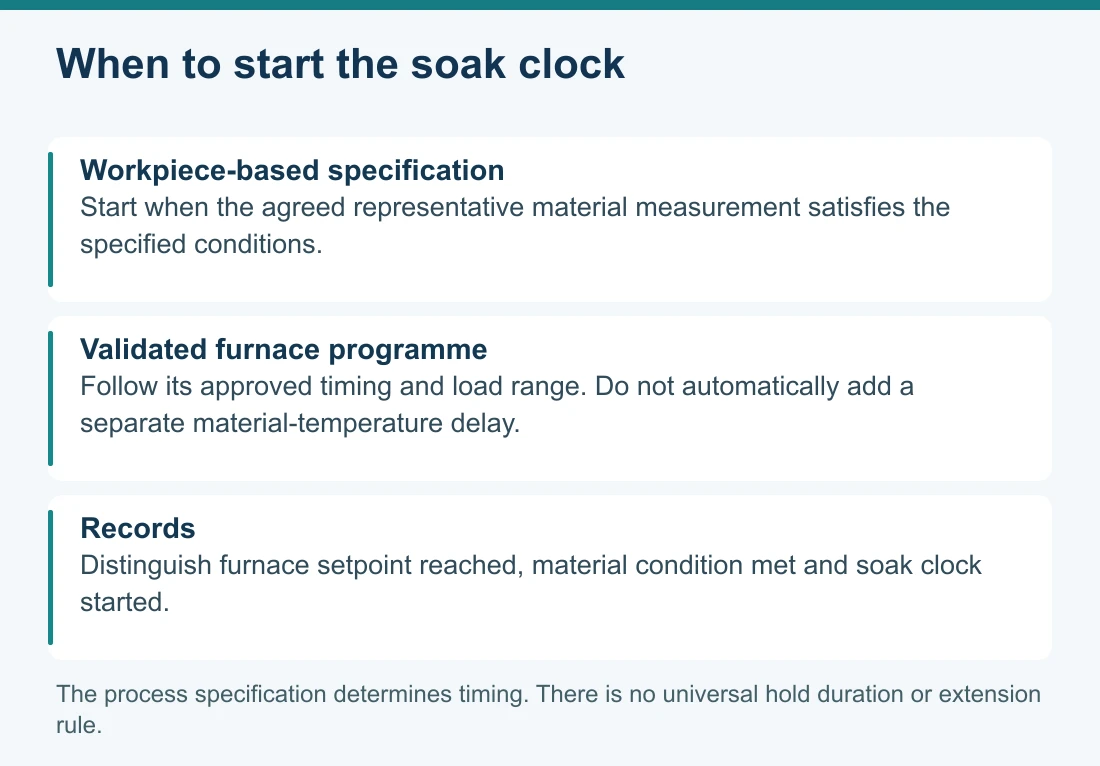
Distinguish furnace temperature, material temperature and the soak clock
The furnace temperature thermocouple mainly reflects the temperature of its installation location and is used to control the heating in the furnace. The material temperature thermocouple reflects the temperature of the corresponding position of the workpiece according to the measurement scheme. The accurate display of the sensor does not mean that it measures the temperature inside all coils.
The external coil receives heat first, and the internal heating is also affected by the coil shape, stacking, gap, contact state and heat transfer path. Therefore, it is not contradictory that the furnace temperature has stabilized and the material temperature is still rising. Forced circulation can improve the heat exchange between the gas and the workpiece, but it cannot be determined that the inside of the coil has been synchronized with the furnace temperature.
| Record or function | What can you answer? | You can't launch anything directly. |
|---|---|---|
| Furnace temperature curve | Does the temperature control point follow the setting procedure? | All workpieces have reached the same temperature inside. |
| Material temperature curve | What kind of temperature process has the corresponding measurement point gone through? | The measured point represents the slowest heating position of the whole batch without verification. |
| Heat preservation timing | When are the conditions of the design met and how long does it last? | As long as the countdown is over, the performance of the whole batch will be qualified. |
The large number of test points does not mean that the representativeness has been established. The position of the coil center, close to the bottom of the furnace or away from the main air flow can be a candidate for point verification; which part is the slowest should be determined by the temperature measurement results under the representative loading, and it cannot be pre-determined that "the positive center must be the coldest".
After changing the roll diameter, single roll weight, furnace loading position or stacking method, whether the original measuring point and timing conditions are still applicable should also be checked together. Only increasing the total soak time may not explain or eliminate the differences between different positions.
Trace one batch on a single timeline
The following is a pure teaching hypothesis, which is used to illustrate the timing caliber, not the actual annealing system. Assume a confirmed process requirement: after the two verified and representative material temperature measurement points enter the specified temperature range, keep warm for 90 minutes continuously; after the two measuring points enter, they remain within the range, the measurement is valid, and other process conditions continue to be met.
| Incident | Assuming the time of occurrence |
|---|---|
| The furnace temperature reaches the set value. | 09:00 |
| Material temperature measurement point A enters the specified range | 09:25 |
| Material temperature measurement point B enters the specified range | 09:50 |
| The two material temperature measurement points meet the timing conditions of this case at the same time. | 09:50 |
| The 90-minute soaking specified in this case is completed. | 11:20 |
If the timing starts from 09:00 by mistake, the countdown will end at 10:30. However, the test point B was only experienced within the specified range from 09:50 to 10:30. 40 minutes, did not meet the 90 minutes required in this case.
Under the premise that all agreed test points continue to meet the conditions and there is no measurement failure or process interruption after entering the range, this example can be written as:
Soak start = the time at which the last agreed measurement point enters the specified temperature range.
Soak completion time = soak start + the hold duration specified in the process.
These two relationships are only applicable to the above conditions. We can't just take the moment when each measuring point reaches the temperature for the first time, and ignore whether the test point that reaches the temperature first has left the range later; nor can a number of sporadic temperature-reach time be added together as a continuous soaking completion.
If the process adopts a verified furnace temperature program, it may already include the time required for the workpiece to follow the temperature. At this time, it should be implemented according to the original program and its loading scope, and the waiting time of this case can no longer be mechanically superimposed. The timing and product disposal after temperature deviation, power failure or measurement failure shall be determined according to the specific process documents. There is no unified make-up rule in this article.
Which measurements can be recorded, and which can start the timer?
The material temperature thermocouple and temperature recorder are written in the procurement configuration, which can only indicate that there are corresponding measurement and recording functions, and cannot automatically prove that the material temperature will participate in the program timing.
The supplier needs to explain: which route or which channel temperature is triggered by the timing, whether it is manual confirmation or program judgment; after starting the timing, it only alarms when the temperature deviates, or will the timing be changed; whether these events can be found in the same batch record.
The functional definitions of different controllers are not the same. For example, Nabertherm's controller instructions describe different logics such as entering heat preservation after temperature, multiple selected temperature areas entering heat preservation after temperature, and suspending timing when deviating from the temperature range. It only says that the actual configuration must be checked when purchasing, and the function of a certain controller cannot be regarded as the default capability of all annealing furnaces. Original factory instructions
The acceptance record should be able to correspond to the batch, furnace loading diagram, measurement point position, furnace temperature and material temperature curve, timing start and stop and abnormal events. In this way, we can answer "why does this furnace start timing from this moment", instead of leaving only a seemingly stable temperature curve after the fact.
If there is a difference in the softness and hardness of the same furnace coil at the site, the temperature record can help check the heating process, but the reason cannot be determined by a curve alone. The condition of the material and the front channel, the cooling process and the product inspection may also affect the result; the correct soaking timing does not mean that the whole annealing process or product performance is automatically qualified.
During the consultation, you can provide the material brand, wire specifications, coil inner and outer diameter and weight, furnace loading photos, current process sheet, and the same batch of furnace temperature and material temperature records. Jiangsu Suneng Industrial Furnace Co., Ltd. can assist in sorting out whether the temperature measurement position, timing conditions and equipment configuration correspond. The specific temperature system and product judgment are determined by the process requirements.
Jiangsu Suneng Industrial Furnace Engineering Technology Team
Inquiry: +86-130-5298-6814|997518512@qq.com
Official website:https://www.jssngyl.cn/en