

Bolts and nuts can be included in the product range of the same heat treatment line, provided that the processes required by each are within the equipment capacity, and the loading, support and full line handover can be adapted separately. Shared equipment does not mean that two workpieces can be mixed at will, nor does it mean that the same output can be obtained using the same loading method.
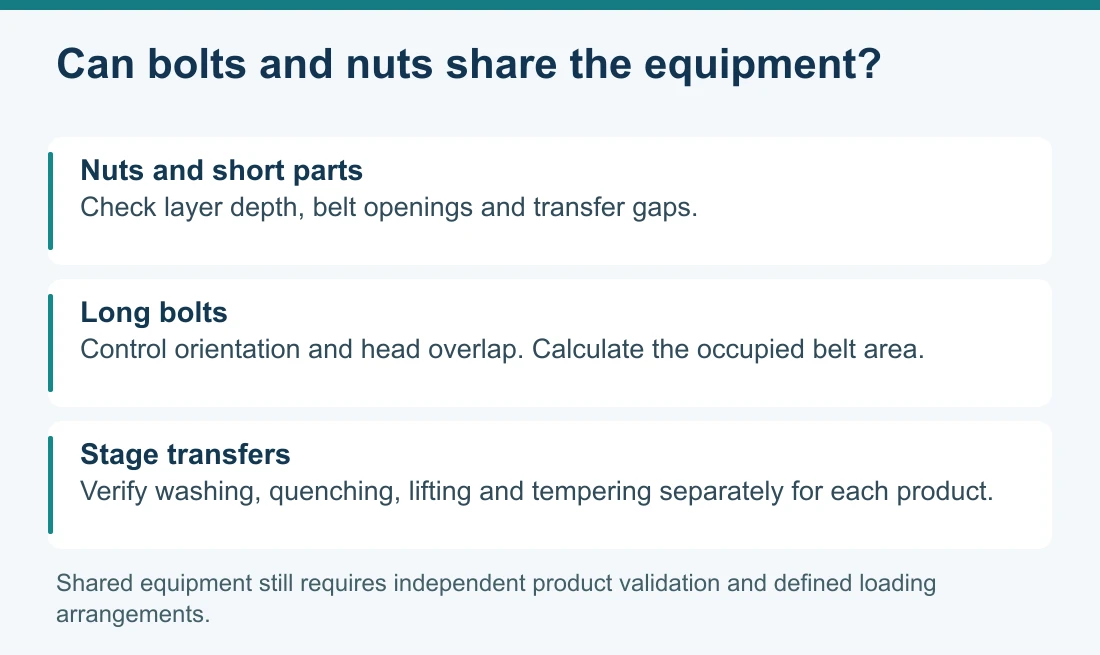
For long bolts and nuts sharing mesh belt quenching and tempering lines, the first thing that needs to be separated is often the fabric method. Nuts and short parts can be controlled and uniform fabrics, while long bolts need to pay more attention to the placement direction, head staggering and load transfer drop.
The feasible common line scheme is usually to configure the nut fabric and the controlled arrangement of the long bolt respectively, and then connect the cleaning, heating, quenching, tempering and other processes. Let's discuss how to judge this kind of common line scheme; the specific configuration still needs to be verified according to the actual bolt and nut specifications.
Different belt loading requirements for bolts and nuts
The number of nuts is large and the single piece is short. When fabricing, it is necessary to control the thickness and distribution of the layer to avoid excessive accumulation of parts. For long bolts, there is a difference in the shape of the rod and the head. After stacking, there may be head hanging, crossing and direction out of control. It is necessary to design the direction of the material together with the guide structure.
This is also why it is not enough to provide thread specifications. The actual contact between the mesh belt and the channel is the shape of the workpiece. The total length of the bolt, the size of the head and the weight of the single piece may affect the adaptation; the nominal specification cannot replace the complete drawing.
If the long parts are arranged in a certain direction, the procurement comparison should calculate the occupied area according to this arrangement method, and the loading amount should not be used when the nut bulk material is used. A mesh belt that can withstand the same weight may not be able to install two types of workpieces of the same weight on the same length of the belt.
The loading configuration can share some equipment or set it separately. Whether a special material mechanism is required, it should be based on the stability of the product, the burden of manual ingredients and the actual delivery test. There is no need to force all front-end equipment to be exactly the same for the "common line".
Follow each product through every transfer
Check that it can't be stopped at the entrance of the heating furnace. The workpiece also needs to be cleaned, baked, quenched, lifted, tempered and discharged. The long bolt works normally on the straight belt surface, and the posture may change between the belt and the belt, the steering point or the lifting junction.
Therefore, the conveying confirmation should cover both ends at the same time: whether the smaller nut will enter the unsuitable gap, and whether the longer or heavier bolts will cross, touch the channel or lose the original direction when crossing. The longest part, the largest head part and the heaviest part may not be the same product and should be covered separately.
If you are going to use pallets, load baskets or special supports, you should check along the whole line, instead of adding fixtures only in the heating section. They will go through the follow-up process with the workpiece, which may change the conditions of cleaning, quenching contact and load transfer, and also need to be arranged for recycling and re-loading.
This kind of confirmation is suitable for forming a loading and handover indication in the equipment design stage, and it is verified by representing the workpiece test. The article does not provide the operation method of modifying the mesh belt, removing the guide or adjusting the quenching device on the spot.
Define separately testable capabilities
The supplier said that "bolts and nuts can be made", and should continue to ask which products are suitable, how to load and under what conditions for acceptance. The following table can be used as a basis for comparing common line schemes.
| Comparison link | Focus on nuts and short parts | Focus on long bolts | The results to be given by the common line scheme |
|---|---|---|---|
| Top up | Whether the distribution and layer thickness can be controlled | Whether the placement direction and head staggering can be controlled | The respective loading methods of the two types of products |
| Support and channel | Adaptation of small parts and meshes and gaps | Occupation after full length, head and posture changes | Represents the adaptation range of workpiece and fixtures |
| Process handover | Is there any accumulated material, omission or mixed batch? | Is there any crossing, inter-hanging and steering obstruction? | Transmission confirmation record covering the whole line |
| Special fixtures | Whether to change the original fabric and processing conditions | Can it be stable and complete the turnover? | Fixtures weight, position and applicable process |
| Product switching | Materials, grades and batch numbers can be traced back | Materials, grades and batch numbers can be traced back | Process and acceptance conditions of sub-products |
The table emphasizes the itemized confirmation of equipment capabilities, and does not require each product to be equipped with a completely independent production line. The part that can be reliably shared can be retained, and the links with real differences can be adapted.
Keep product-specific evidence for output and quality
Both types of workpiece can pass, and their hourly qualified output is the same. The surface area occupied by the controlled placement, the accompanying weight of fixtures, the actual heating requirements and the processing capacity of the front and rear sections may make different products use different production arrangements.
The common line planning should establish a product portfolio according to the materials, specifications and performance requirements of regular production, rather than just listing a "maximum processing capacity". Different specifications under the same material name should also check the acceptance conditions; products of different materials or grades cannot automatically share a process curve because the equipment is the same.
If the production arrangement requires continuous batch change, the batch boundary and traceability method should be clarified in advance to avoid only recording the operation curve of the whole line, but not being able to correspond to specific products. How to switch should be implemented in the confirmed process documents, and the general operation steps should not be given by the equipment leaflet.
Before purchasing, you can provide the bolt and nut drawings, main product proportions, existing loading methods and inspection requirements to Jiangsu Suneng Industrial Furnace Co., Ltd. The common line scheme should answer "how to go for each type of workpiece" and "under what conditions each type of product is a qualified output" at the same time, so as to judge which adaptations need to be added and which equipment can be shared directly.
Tel: +86-130-5298-6814
Email: 997518512@qq.com
Official website: https://www.jssngyl.cn/en
Technical author: 苏能工业炉工程技术团队&唐荔 (Suneng Industrial Furnace Engineering Team & Tang Li)