

When the bearing wire is loaded with coil furnace, the fixed pit furnace and the movable bell furnace can be used as the comparative direction of spheroidizing annealing equipment. The starting point of the selection is how the coil is installed, how it is heated and cooled, and how long the heating equipment is occupied in a cycle. Loading and unloading and whole batch processing are organized around the fixed furnace position, and the fixed well structure can be focused on comparing. If you want to remove the heating cover at the stage allowed by the process and let another furnace base continue processing, you can compare the combination of removable cover and multiple furnace base.
This choice should not be decided only by "how many tons per furnace". With the same weight coil, the inner and outer diameter, stacking layers, support and circulation channels are different, and the required space and processing arrangements in the furnace will also be different.
Jiangsu Suneng Industrial Furnace Co., Ltd. The two bearing wire spheroidizing annealing schemes list the fixed pit furnace body and the composition of the heating cover, furnace base, furnace tank and cooling cover respectively. This article compares according to the actual structure, and does not regard the program formulation cycle as the verified production capacity.
The coil load determines more than furnace diameter
First of all, the inner diameter, outer diameter, height and weight of the coil should be given, and then the batch should be single-layer or multi-layered, and what kind of bearing structure should be used. The empty furnace can accommodate several round outlines, and only a part of the geometric check has been completed.
The space between the middle, outer and upper and lower bearings of the coil is also related to the passage of circulating gas. The above scheme is equipped with a wind guide structure, a circulation fan and a bearing base respectively, indicating that the loading and the airflow organization need to be considered together. The coil should not be filled first, and then the remaining gaps should be treated as air ducts.
If the roll diameter, the number of stacking layers or the loading rack is changed, the original loading conditions will also change. Whether the new combination can meet the requirements of the temperature process needs to be confirmed under the corresponding load, and the result of another placement method cannot be directly followed.
When purchasing, the equipment should be asked to give the relative arrangement of coil, bearing structure, furnace tank and circulation channel. In this way, we can distinguish whether there is insufficient space in the furnace or the existing layout needs to be adjusted, instead of increasing the furnace body as soon as loading difficulties are encountered.
Which components stay in place in each design?
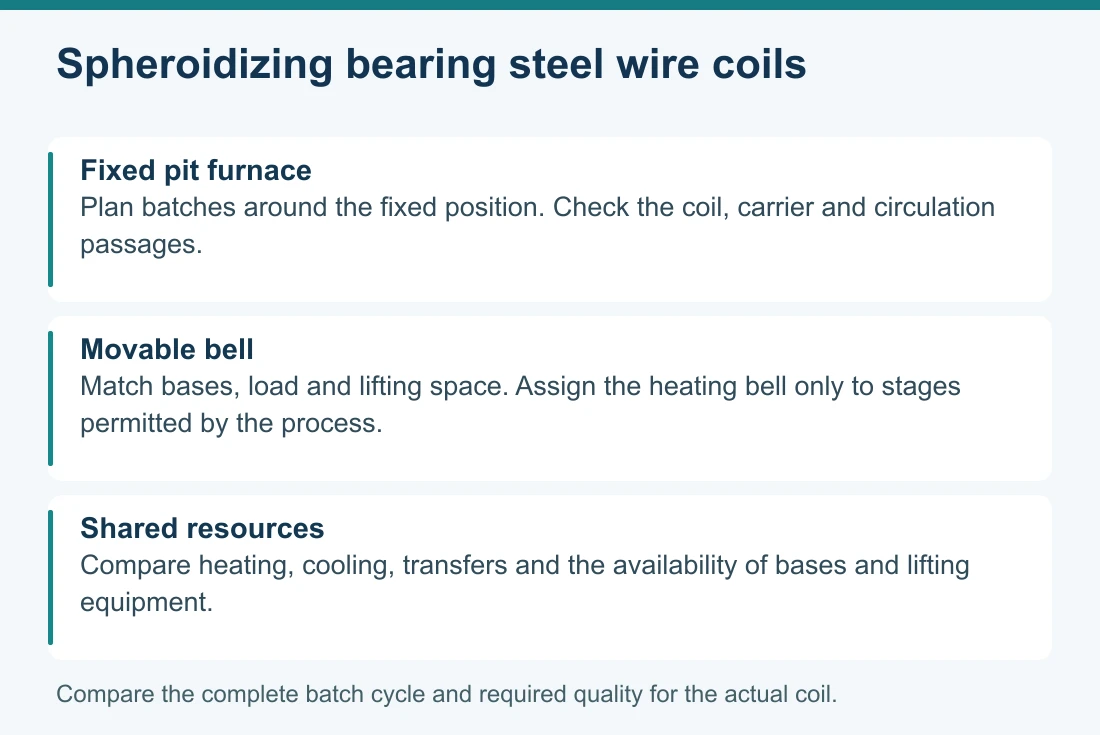
The fixed well scheme arranges the heating furnace body in the fixed furnace position, and completes loading and unloading and heat treatment around the furnace position. It can be used as a route for batch-by-batch production, but it is necessary to confirm the entry method of coil and fixtures, the hoist cover and the space above the furnace mouth.
The bell-type scheme can be moved to separate the heating hood, the load-bearing furnace base and the furnace tank. After meeting the process conversion conditions, the heating cover can be transferred, and the original batch of workpiece is still undertaken by the corresponding furnace base and furnace tank, and then the cooling is arranged according to the plan. This gives the heating equipment a chance to separate the whole stage occupation process from the workpiece.
Whether this opportunity is worth adopting depends on the actual production arrangement. If a batch still needs to be continuously heated according to the process during cooling, the heating cover cannot be removed in advance just to catch up with the next batch; if the hifting equipment and moving path are occupied by other operations for a long time, it cannot be produced only according to the theoretical action of the equipment.
Therefore, the transferable hood increases the resource combination method, and at the same time increases the cover parking, transfer, furnace base interface and scheduling needs. Whether these conditions can be implemented on site will affect the selection as well as the rated power of the furnace.
Compare the two arrangements using the same coil batch
The two types of equipment should be compared with the same representative materials, coil combinations and product acceptance requirements. Otherwise, the combination of light load and easy handling is used on one side, and dense heavy load is used on the other side, and the resulting cycle is not comparable.
| Production conditions | Key points of fixed well scheme | Key points of the movable bell-type scheme |
|---|---|---|
| Changes in coil specifications and stacking methods | Can the fixed furnace be compatible with fixtures and circulation channels? | Whether the furnace base, the furnace tank and the heating cover are suitable together |
| It is necessary to organize loading and unloading around fixed workstations. | Check the loading and unloading space and adjacent logistics | Check whether the cover transfer brings additional occupation |
| The cooling phase takes up a long time. | Clarify which equipment will be occupied during this period | Confirm which stages are allowed to transfer the heating cover |
| It is proposed to configure multiple furnace bases | Arrange production according to the actual independent heating unit | The number of furnace base is accounted for together with the capacity of heating hood and cooling hood. |
| Requires stable access to spheroidizing annealing products | Acceptance according to materials, loading and complete process | Acceptance under the same conditions cannot be directly guaranteed by the bell-type structure. |
One more furnace base does not mean one more set of simultaneous heating capacity. When a heating hood is equipped with two furnace bases, only the heating hood still undertakes its corresponding heating task. What stage the other furnace base can undertake should be jointly determined by the process, equipment configuration and scheduling, and the output cannot be directly doubled.
Accept the product against its spheroidizing requirements and choose equipment for the production pattern
The product requirements of spheroidizing annealing should be determined by the steel type, the state of the front road and the subsequent processing needs, and then form the executable process and inspection conditions. The choice of furnace type solves how to carry and organize this process. The well-type or bell-type name alone cannot promise the organization, hardness or processing effect.
Equipment comparison should at least correspond to the loading diagram, temperature process record, actual time occupied by each component, and product inspection results to the same batch of representative coils. Only when these evidences are complete can we compare the time and resources consumed by a batch of qualified products.
Jiangsu Suneng Industrial Furnace Co., Ltd. According to the size, fixtures, processing requirements and workshop load layout, the selection and analysis of fixed well type and movable bell-type combinations can be carried out. The protective atmosphere and cooling conditions need to be confirmed according to the specific process. This article does not provide gas switching, temperature setting or hot lifting operation.
Tel: +86-130-5298-6814
Email: 997518512@qq.com
Official website: https://www.jssngyl.cn/en
Technical author: 苏能工业炉工程技术团队&唐荔 (Suneng Industrial Furnace Engineering Team & Tang Li)