

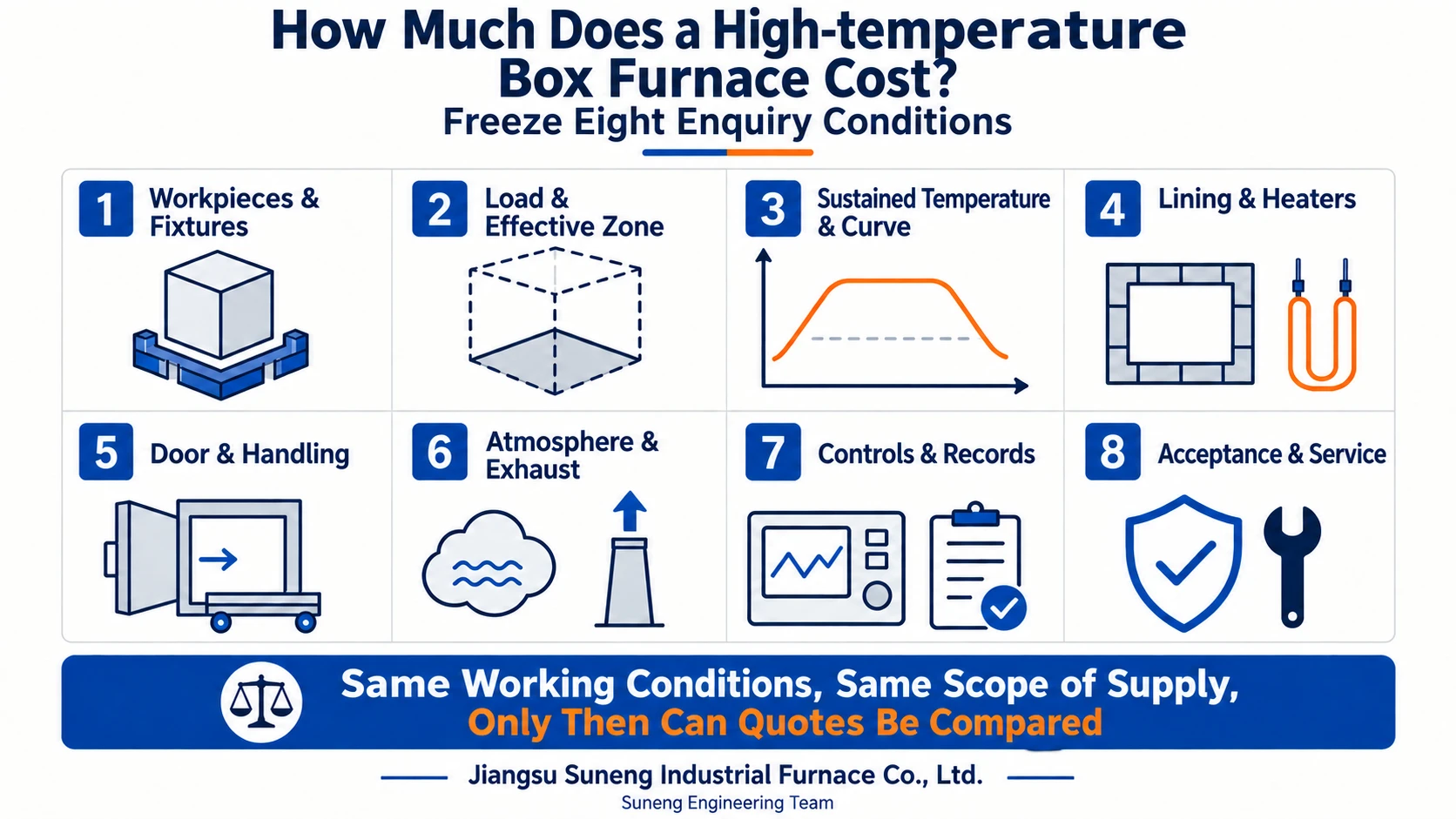
Freeze eight inputs before comparing quotations: workpieces/fixtures, batch load/effective zone, sustained temperature/curve, lining/heaters, door/handling, atmosphere/emissions, controls/records and acceptance/service. Without alignment, identically named equipment may have different configurations and responsibilities.
A Suneng box-furnace document places heating elements on several chamber surfaces but groups their control into front and rear zones. List element positions, control groups and associated measurement points separately. More heated surfaces do not mean more independent control zones. Match loading positions to control requirements before checking electrical circuits and recording provision.
Why there is no universal price
Weight, usable zone, sustained temperature, holding duration, frequent thermal cycles, atmosphere, records, zones and acceptance scope change structure, materials, controls and delivery. Historical transactions, online prices and another project's budget describe their own conditions, not the current offer. Ask every supplier the same questions first.
Sustained duty matters as well as the maximum
Specify the usual range, permitted maximum process temperature, complete curve, use frequency, prolonged holding, door openings and whether duty is continuously high. These affect lining, element selection/layout, controls, maintenance and hot structure. Keep rated/maximum temperature in the technical files, but do not use that label alone to select or price equipment.
Workpieces, fixtures and effective zone belong together
Provide maximum/usual dimensions, individual weight, batch quantity and orientation, plus trays, baskets, blocks, lifting devices and fixtures. The combined envelope determines passage through the opening, stable positioning, support and heat transfer. Define the effective loading zone with the heater layout, measurement locations, door effects and acceptance method; it is not automatically the full chamber.
Lining and elements require a duty-based explanation
Temperature, curve, loading and frequency determine material systems, layers and heater material, arrangement and loading. Ask why the selection suits the duty, where wear and maintenance occur, how elements are inspected/replaced and what happens after an abnormality. The supplier should design and freeze the actual choice in the project documents.
Door, seals and handling affect the structure
Define the opening and movement, compression/seals, loading depth, fixture support, fork or mechanical interfaces and hot-operation clearance. Specify interlocks with heating, alarms and other mechanisms. Explain passage, positioning, removal and abnormal stop/reset rather than only “door included.” Actual operation follows the project procedures and manual.
Atmosphere, control and records
Air or protective atmosphere, oxidation limits, process media, emissions and ventilation affect seals, utilities, controls, safety and auxiliaries. Discuss zones, programmed heating/holding, sensors, records, alarms, interlocks and data delivery. Batch traceability needs content, storage, time reference, export and responsibility.
Instrument/control accuracy, effective-zone uniformity, actual workpiece temperature and product quality are different evidence layers.
Eight-input checklist
| Input | Supply | Supplier response needed |
|---|---|---|
| Workpiece/fixture | Grade, dimensions, weight, orientation and tooling. | Entry, support, positioning and removal. |
| Load/zone | Quantity, usual/maximum load and batches. | Usable-zone, chamber and door boundaries. |
| Sustained temperature/curve | Usual/maximum process temperature, curve and frequency. | Basis for lining, heaters and hot structure. |
| Lining/heaters | Duty, maintenance access and life concerns. | Materials, layout, inspection and replacement. |
| Door/handling | Method, fixtures and site space. | Opening, movement, seals, interlocks and operation. |
| Atmosphere/emissions | Medium, oxidation and ventilation. | Interfaces, seals, auxiliaries and safety. |
| Controls/records | Zones, curves, records, alarms and data needs. | Logic, points, records and delivery. |
| Acceptance/service | Tests, documents, installation, training and maintenance roles. | Exclusions, methods and support scope. |
Adapt these groups to the project; they are not a fixed contract directory.
Align delivery and maintenance boundaries
Compare design/manufacture, packaging/transport, commissioning, training, foundations/utilities, factory checks, load conditions, site tests, documents, spares, warranty start and post-warranty service. Equipment-only and fully supported prices are not directly comparable. Prepare a scope-deviation table first.
Common questions
Are maximum temperature and chamber size enough for an accurate price?
They may support an estimate, but load, sustained duty, curve, atmosphere, handling, controls, acceptance and supply must be frozen for a comparable formal quotation.
Are higher-grade materials always better?
No. Match materials to duty, thermal cycling, loading, structure and maintenance. A higher grade alone does not prove performance.
Does high control accuracy prove uniformity?
No. Instruments, furnace distribution, workpiece temperature and product inspection must be separately defined and verified.
Suneng's scope
Suneng designs, manufactures and integrates furnace equipment and provides commissioning, retrofit and support. It can clarify custom box-furnace proposals and quotations from agreed workpiece, material, load, sustained duty, atmosphere, interfaces and acceptance.
This guidance does not guarantee type, materials, parameters, price, schedule, consumption, uniformity, capacity, life or product quality. The confirmed technical, acceptance and commercial documents govern the final proposal.