

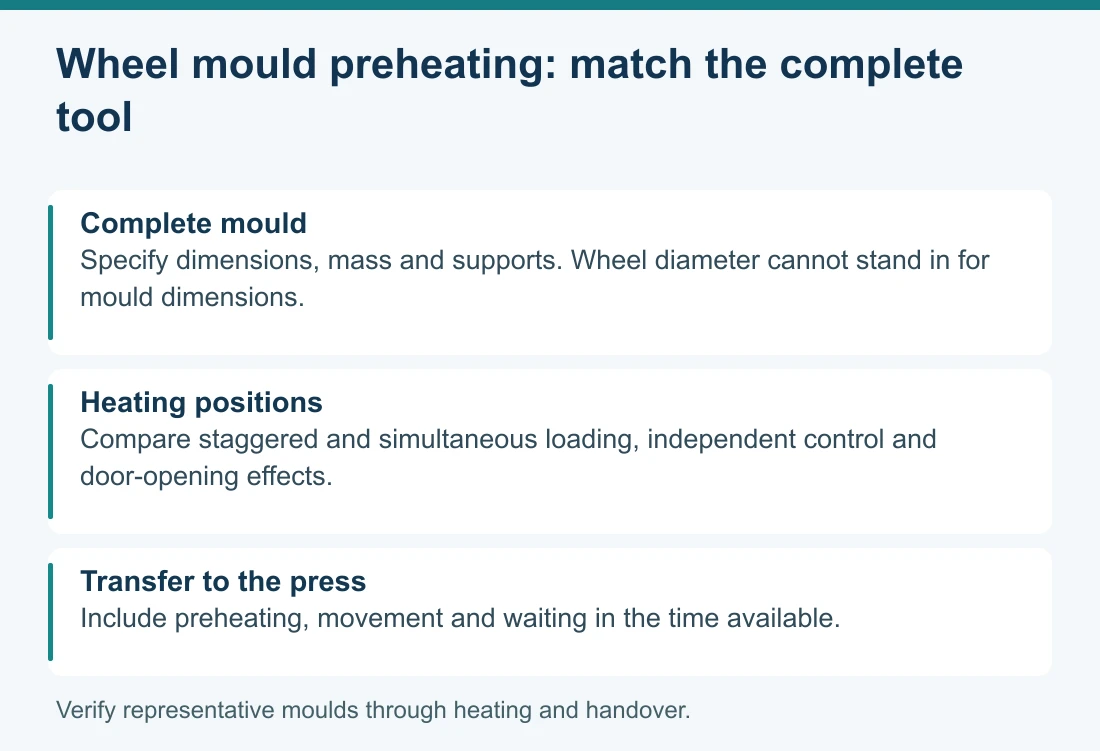
The hub mold preheating furnace should be selected according to the shape, weight, coating status and machine arrangement of the whole set of casting molds. When multiple sets of molds need to be ready at different times, you can focus on comparing the configuration of independent heating chambers and their respective loading, unloading and control; if the molds can be put in and out in batches, the organization mode of heating in the same batch can be compared. The choice depends on the mold turnover, and the number of furnaces should not be directly determined according to the annual output of the hub.
The heating here is the casting mold of the aluminum alloy hub, not the solution treatment and aging of the hub products. The product size can indicate which wheel models are served, but it cannot replace the shape and weight of the mold assembly.
Size for the complete mould rather than the nominal wheel diameter
The nominal size of the hub is different from the space occupied by the whole set of molds. The procurement should provide the length, width, height, weight and actual heating status of the mold, and then determine the loading platform, furnace mouth and effective heating area.
If the upper and lower molds, side molds or related components enter the equipment as a whole set, the drawings should be provided according to this real combination; if the process requires splitting and heating separately, the splitting status should also be clearly explained. You can't calculate the size of a single mold at the time of inquiry, and put the whole set in when it comes to production.
At the same time, check the support position and handling interface of the mold. The heating room can accommodate the whole set of molds, which does not mean that the furnace mouth, the material table and the on-site handling equipment can be completed. The material table and the furnace door mechanism need to be included in the design separately, because the capacity and loading and unloading need to be adapted together.
Match the heating chambers to the machine schedule
First, list the common mold change and preparation arrangements in production: which molds enter preheating at the same time, which need to be staggered out of the furnace, and whether there are often temporary mold replacement tasks. Then use these needs to judge whether the furnace room needs to be independent.
If different molds are often installed at different times, the independent heating chamber can provide conditions for arranging procedures and loading and unloading separately. However, "multiple positions" is not equal to "multiple independent heating chambers". It is necessary to check whether the insulation separation, temperature control and furnace doors are configured for this purpose, and how to confirm the impact of opening one room on other rooms.
If several sets of molds can adopt the same program, enter the same batch and be used at a similar time, sharing a batch of heating space is also worth comparing. At this time, it is still necessary to confirm the loading position and temperature performance of each mold, and the temperature cannot be fully synchronized by default because it enters the furnace at the same time.
Independent configuration also has corresponding land area and equipment input. It is not the more rooms the better. Each heating position should correspond to the real mold preparation task to avoid increasing long-term idle workstations in order to pursue the number of configurations.
Check coating condition, heating method and mould temperature together
The preheating conditions of the mold after spraying should be determined by the coating and casting process requirements. The state before entering the furnace, how it is allowed to be heated, and what are the requirements on the surface of the cavity all affect the comparison of the heating method.
If the project needs to avoid burning flue gas directly into the workpiece space, indirect combustion heating can be used as a comparative direction; however, the name of the heating method alone cannot be used to promise that the coating, surface or casting results are qualified, and it should also be verified in combination with the actual mold and process.
The highest temperature of the equipment and the working state to be reached by the mold should also be recorded separately. The procurement goal is to prepare the mold for the machine according to the process requirements, and the air in the furnace reaches a certain set value, which is only a part of the process information.
| Procurement issues | Input to be provided | Corresponding equipment and acceptance priorities |
|---|---|---|
| Can the furnace be installed? | The shape, weight and support position of the whole set of molds | Joint adaptation of the furnace mouth, material table and effective area |
| Several independent heating positions are required. | The frequency of mold change and the time required for the mold to be ready | Each room controls, opens doors and influences each other |
| What kind of heating method should be used? | Coating status, environment and surface requirements | Heat source form and actual mold verification |
| When will it be ready to be completed? | Mold process requirements and temperature evaluation methods | Represents mold measurement and temperature conditions |
| Can the production be connected after it comes out of the oven? | Handling route, waiting and on-board arrangement | Complete connection from preheating to use |
Verify preheating, transfer and arrival at the machine
The equipment can complete the heating of a furnace according to the agreed conditions, but if the mold waits for a long time after being baked, the state before the machine cannot be directly replaced by the record of the oven. Therefore, the handling route and waiting arrangement should be included in the joint confirmation of the equipment and the production organization.
This does not require the unilateral responsibility of turning all the casting results into the heating furnace. A more reasonable practice is: the equipment party confirms the heating and control ability under the agreed loading, the user confirms the mold process and on-machine organization, and the two parties clarify how to judge the status when handing over.
The representative mold should cover the commonly used combination and the actual boundary combination, instead of using only a set of smaller molds to prove all adaptation. It should also check the performance of independent door opening, off-peak preparation or heating in the same batch according to the planned usage method, so that the acceptance corresponds to the actual production.
Jiangsu Suneng Industrial Furnace Co., Ltd. The preheating equipment configuration can be compared according to the mold assembly drawing, coating process, mold change arrangement and on-site logistics. After clarifying these conditions, determine the heating chamber, heat source and loading and unloading interface, which is closer to a procurable plan than asking "how many degrees the hub mold furnace is and how many sets can be placed" separately.
Tel: +86-130-5298-6814
Email: 997518512@qq.com
Official website: https://www.jssngyl.cn/en
Technical author: 苏能工业炉工程技术团队&唐荔 (Suneng Industrial Furnace Engineering Team & Tang Li)