

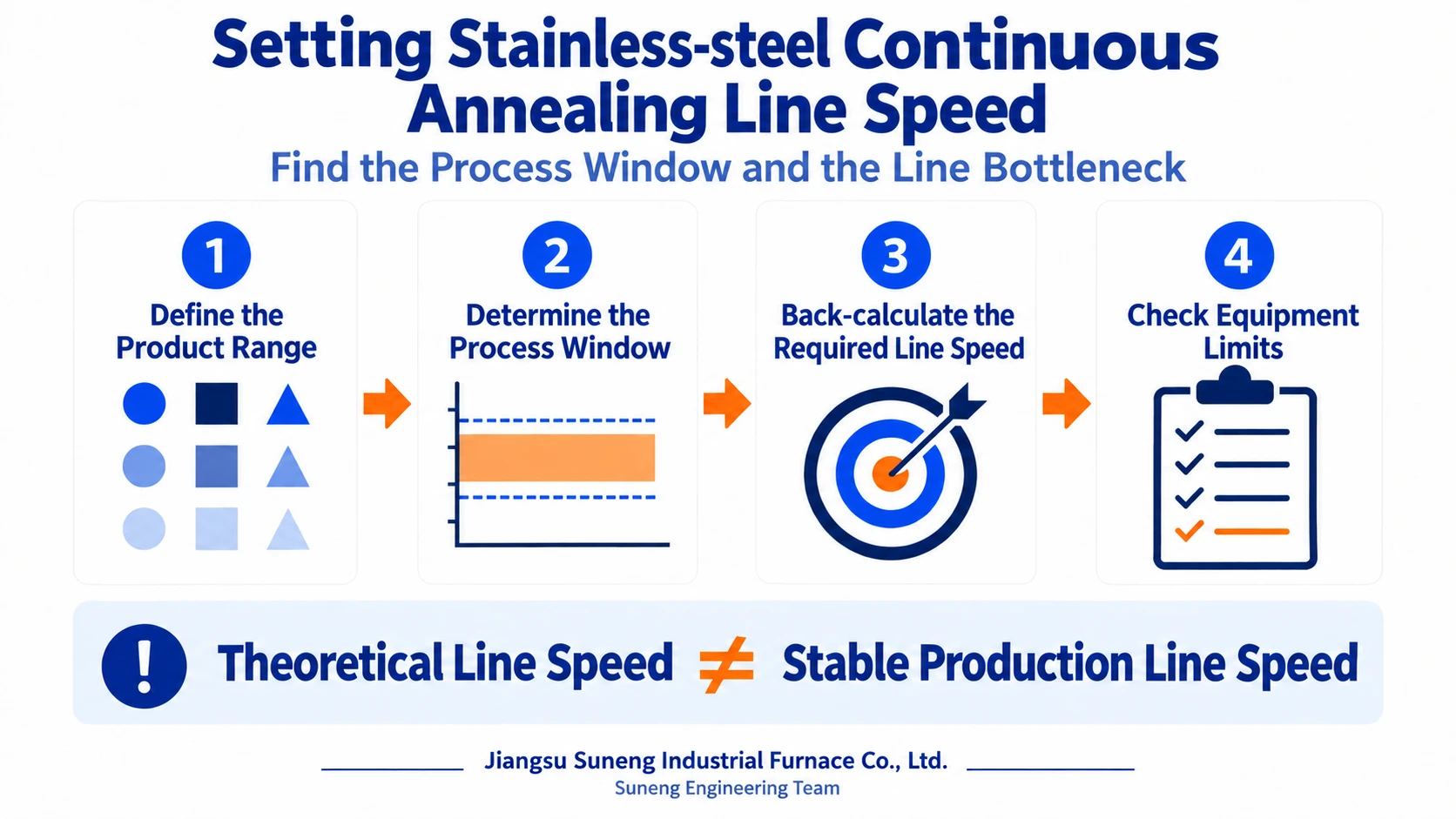
Set stainless-steel continuous annealing speed from the process residence window and the tightest complete-line constraint. Start with the product matrix, calculate heating, soaking and cooling time requirements, then check furnace load, tension/tracking, entry/exit and downstream capacity.
Suneng dual-strip stainless-steel annealing furnace documents use different material specifications and speed combinations for design calculations and acceptance trials. For a new production task, state the material, width and thickness, strip count, process and product criteria before matching heating and cooling conditions. If the supplier gives only maximum conveying speed, request the corresponding process and acceptance conditions. A drive-speed limit is not the production speed for every specification.
Start with a product matrix
Grade, thickness, width, incoming condition and target quality change mass per unit length, heating, allowable thermal history, tension and cooling. Group products by material/standard, dimensions, coil weight, target strip temperature, equalising/cooling requirements, surface limits, output definition and adjacent-process interfaces.
Build a speed window from residence time
An initial calculation can use the effective strip path in a section divided by the required residence time. Effective path means the distance the strip actually travels in that section; time comes from the confirmed material process and thermal calculations.
Calculate heating, equalising and cooling separately. The lowest of the maximum speeds allowed by the critical sections limits that product family. JFE Steel's public discussion of general continuous annealing is not a stainless-steel line specification, but its logic linking target strip temperature, residence, furnace load and heating time illustrates the calculation order. Formal design still needs strip properties, heat transfer, zones, atmosphere and equipment response.
Calculate the speed demanded by output
Theoretical continuous-strip mass flow can be estimated from strip width × thickness × material density × line speed, using consistent units. An annual-output calculation also needs working days, shifts, coil changes, transition material, maintenance, faults and conforming-output definitions.
This determines the speed the output target would require. It cannot justify shortening the material's necessary residence time.
The tightest line constraint sets the final speed
Entry coil change and joining, accumulator recovery, furnace tension, tracking, heating, cooling, pickling, washing and recoiling can each limit the line. Distinguish mechanical maximum speed, product-family process range, stable production speed, transition speeds and abnormal slow-down/stop conditions in the technical agreement.
Refine theoretical speed with measurements
A speed change immediately changes residence, while the furnace, heating and cooling systems respond over time. Synchronise strip temperature, tension, tracking, surface and property records with the speed curve.
Only after continuous operation under defined conditions meets process and product criteria should a theoretical speed enter a stable production recipe. Briefly reaching a speed does not establish sustained output, quality, energy performance or availability.
Suneng's scope and enquiry inputs
Suneng designs, manufactures and integrates furnace equipment and provides commissioning, retrofit and support. For stainless-steel annealing or an existing-line retrofit, it can clarify furnace capability, speed windows, coordinated controls and supply after the product matrix, thermal history, output basis and interfaces are defined.
Prepare grade/standard, thickness/width, coil weight, target thermal history, output basis, internal strip path, atmosphere, cooling, adjacent processes and trial/acceptance requirements. Use the website or call +86-130-5298-6814. Final parameters and delivery follow the agreed documents.
This general selection method does not provide a universal speed, temperature, residence, output, consumption, price or quality guarantee.