

Six workstions are not equal to six sets of production units that can not affect each other.. Jiangsu Suneng Industrial Furnace Co., Ltd. is suggested to compare the process required by the product first, and then check the temperature program, thermal space, circulation and exhaust, loading and unloading actions and shared resources of each workstation. Only when these conditions support the product portfolio in the plan can we further recognize "can put six batches" as "can make different products in parallel".
This article discusses the multi-workstation combination and batch-by-batch curing equipment. The "workstation" here is the loading or processing position, which does not automatically represent the independent furnace chamber or the independent temperature area, nor the six processes passed in succession on a continuous line.
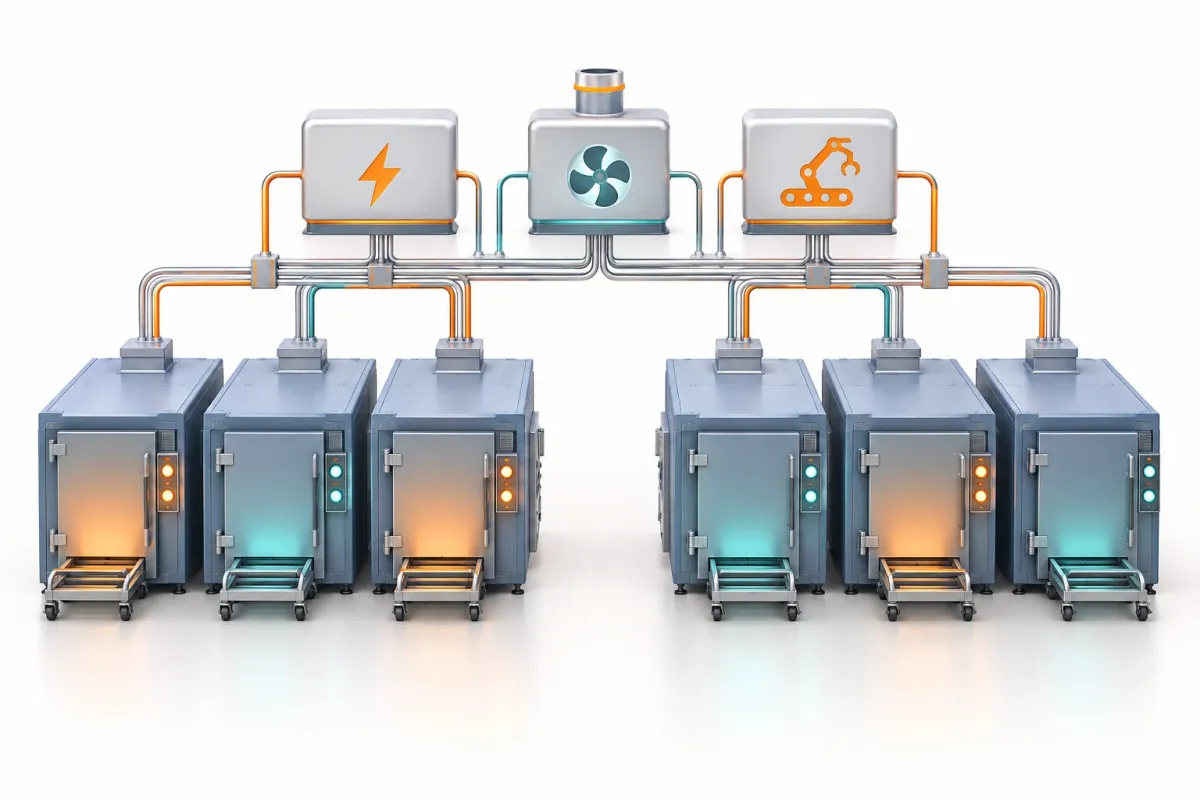
The concept of multi-station and public supporting relationship, non-project real shooting; the number of works and independent panels do not prove that different processes can be run at the same time.
Do the products require different processes?
If the material system, temperature and insulation requirements of several products can use the same set of verified processes, the key is to check whether different fixtures and loading are still within the allowable range, and whether the records can be traced separately.
If a batch needs to be heated, the other batch has entered heat preservation or cooling. Even if the final set temperature is similar, it belongs to a different time process. At this time, it relies more on the thermal separation, independent control and off-peak loading and unloading ability between the workstation.
Therefore, "support multiple formulas" can only indicate that there may be multiple sets of parameters in the program. It can't answer separately whether these formulas can be in different positions.Execute at the same time It cannot prove that the process of other workstations will not be affected when a certain workstation opens the door and changes the batch.
What can each station control independently?
| Check the level | Questions to ask the supplier | What will it affect if it is not clear? |
|---|---|---|
| Temperature program and execution | Can each workstation set, execute and record curves separately? Which workstation corresponds to the measuring and heating actuators? | Multiple displays may still control the same thermal process. |
| The furnace room is separated from the thermal industry. | Do the worksties share the hot space, send back the wind or open the mouth? How is the temperature change of the adjacent worksty transmitted? | Different processes may interfere with each other, and independent settings are not equal to independent temperature performance. |
| Circulation and exhaust | Which windways are independent and which are connected to the public system? How to allocate the capacity when different combinations run at the same time? | The normal operation of a single work stable does not prove that the simultaneous operation of multiple works still meets the requirements. |
| Loading and unloading and fixtures | Can the furnace door, furnace trolley, support and load transfer paths be used separately as planned? Will there be a queue for shared loading and unloading equipment? | It can be processed in parallel in the furnace, but the batch change may wait for each other. |
| Public energy supply and protection scope | According to what concurrent working conditions are gas supply, power supply and public facilities configured? What protection will affect multiple workstions? | If the number of units is sufficient, the public capacity or the scope of joint deactivation may still limit the schedule. |
| Data and batch | Can the workstation, product, fixtures, formula version and curve correspond? | Multiple curves have been saved, but it is impossible to prove which set of processes a certain batch has gone through. |
This is a procurement checklist, which is not a recognition of the independent operation ability of a device, nor does it stipulate the security interlock operation.
Identify the control boundaries and physical separation
Multiple independent temperature processes can be managed by the same main control system, as long as the measurement, execution, program and recording are correctly assigned to the corresponding objects. Conversely, even if each workstation has an independent operating panel, if they share hot spaces or wind channels that cannot meet different requirements, they cannot promise to run different processes at the same time.
A work station may also contain multiple temperature control zones; multiple work stations may also be affected by the same temperature zone. Therefore, when comparing quotations, the supplier should be asked to draw the corresponding relationship of "workstation-temperature zone-heating-wind channel-control". It is easy to overestimate the independence of the thermostat, burner or fan, and may also misunderstand the shared control as inparallel.
Can shared systems handle simultaneous demand?
Public gas supply, power supply, exhaust main pipe or load transfer equipment does not naturally exclude multi-station production. However, the selection should be based on the simultaneous operation combination allowed by the plan, not the demand of a single workstation.
For example, verifying that only one workstation is heated and the rest is idle cannot prove that multiple workstations can also reach the target curve. If the design adopts off-peak start to control the peak demand, the off-peak conditions should be constrained by scheduling, and cannot be started and calculated at any time according to all work positions in the capacity commitment.
The same goes for shared loading and unloading resources. When multiple workstations are completed at the same time, whether the workpiece is allowed to wait, whether the loading and unloading equipment can be picked up in time, and when the next batch can enter may affect the actual batch completion.
The parallel ability that can really be used for scheduling is the ability that can be achieved under the constraints of confirmed product portfolios and public resources, not a simple addition of the number of workstations.
Test the intended product combination
The supply and demand sides should choose a representative combination consistent with the planned production according to the approved verification plan, and evaluate the process records of each workstation separately:
- Same process, simultaneous operation: Look at the performance of public energy supply and supporting systems under the demand at the same time.
- Different processes, simultaneous operation: Within the scope allowed by the design, see whether each workstation meets its own curve and loading requirements respectively.
- Change the batch at the wrong peak: Under the normal operating conditions allowed by the equipment, check whether the curves and records of the remaining operating positions are still in accordance with the agreement when changing the batch of a workstation.
The comparison must bind the product, material system, fixtures, loading, program version and work position. The original verification was to run synchronously with the same formula, but later it was changed to different formulas to run at different peaks. The original conclusion may not cover the new combination.
The operation, scope of protection and abnormal disposal of the equipment in the specific verification shall be carried out in accordance with the project documents; public protection or artificially creating dangerous working conditions shall not be lifted on its own in order to prove "independence".
Define the simultaneous duties before requesting a quote
It is recommended to prepare a product portfolio table first: which workstation corresponds to each product, what process is used, when the plan starts and ends, and what public resources are occupied by the replacement batch. Then ask the supplier to answer item by item which combinations can run at the same time, which must be staggered, and the impact of these restrictions on the pace of output and delivery.
If the requirement is only parallel to multiple batches of the process, there is no need to require all systems to be completely separated for the sake of the word "independent"; if it is really necessary to change batches with different curves or off-peaks, the corresponding control, thermal separation, public capacity and verification conditions should be written into the technical agreement.
The product portfolio, curing curve, workstation loading and on-site public supporting information can be sent to Jiangsu Suneng Industrial Furnace Co., Ltd. to explain "multi-station independent operation verification". Confirm the parallel scenario in the plan first, and then compare the equipment configuration and procurement scope.
Open phone number: +86-130-5298-6814
Email: 997518512@qq.com
Jiangsu Suneng Industrial Furnace Official Website: https://www.jssngyl.cn/en